
Target audience: European outdoor vending machine integrators and OEMs
Purpose: Practical technical guide to selecting, integrating, testing, and supporting sunlight-readable, industrial high brightness LCD displays — with concrete design guidance, standards to watch, field best practices, case examples and an ROI/TCO lens to help you specify RisingStar displays with confidence.
Executive summary (TL;DR)
Outdoor vending machines operate in harsh, variable environments: rain, salt spray in coastal areas, winter freezing, summer heat, intermittent sunlight and vandalism risk. Choosing the right display is mission-critical: it drives usability, sales conversion, UX, and service costs.
Key takeaways:
For window-facing or direct sunlight installations you should plan for displays in the ~2,000–5,000 nits range (exact value depends on orientation, size and ambient lux).
Build to at least IP65 (dust-tight + water jets); consider IP67/IP68 or greater sealing for machines exposed to heavy rain, hoses, or coastal immersion risk. IEC 60529 defines IP ratings.
Ensure CE/EMC compliance (EN 55032 / EN 55035 and EU EMC Directive), RoHS and the appropriate product safety standards for your jurisdiction.
Specify rugged thermal design and test to environmental procedures (e.g., MIL-STD-810 methodology) for temperature, humidity, solar load and shock where uptime matters.
Plan lifecycle, maintenance and TCO: high brightness industrial LCD modules with LED backlights commonly cite ~30,000–50,000 hours to half-brightness depending on drive current and operating temperature; plan content schedules, dimming and power management to extend life.
This guide expands each area with actionable engineering specs, procurement checklists, testing protocols, integration tips, UX/content considerations, and commercial guidance for working with RisingStar as your display partner.
1. Why the display matters for outdoor vending machines
A vending machine is an interactive retail touchpoint. The display is the machine’s storefront:
It controls user flow (product selection, payment, upsell).
It presents promotions that increase basket size.
It is the human-machine interface for assistance and maintenance.
A poorly chosen display reduces usability (illegible menus in sunlight), shortens uptime (overheating or water ingress), and increases warranty/service calls. Investing in a properly specified high-brightness, ruggedized display increases transaction success rate, reduces field visits, and improves brand perception.
Quantitative impacts integrators report from digital vending screens include measurable increases in impulse purchases and average transaction value when content is legible and dynamic (see kiosk industry case studies for outdoor kiosks & vending).
2. Brightness & sunlight readability — how many nits do you actually need?
Practical rule of thumb
Brightness (measured in nits = cd/m²) should be selected based on installation exposure:
Shaded or semi-outdoor: 500–1,500 nits.
Window-facing / bright indirect sun: 1,500–3,000 nits.
Direct, full-sun facing: 3,500–5,000+ nits — some applications require 5,000 nits or more for crisp readability and vibrant color.
Why brightness alone isn’t the whole story
Contrast ratio and anti-reflective surface treatment matter. A 3,000-nit display with high surface reflection can still be unreadable; low reflection coatings and matte glass/haze control are vital.
Optical bonding (reducing air gap between LCD and cover glass) dramatically improves contrast by eliminating internal reflections, especially in bright light.
Adaptive brightness sensors and content-aware contrast can keep perceived readability high while saving power and extending lifetime.
Viewing distance and text size: for vending UI where users are <1 m away, screen resolution and pixel density are important; choose resolution to match UI font sizes and expected distances.
Content & contrast guidance
Use high-contrast UI (dark text on light backgrounds or vice versa depending on scene) and large tappable targets.
Avoid low-contrast overlays (translucent gradients) for core information.
For daylight, prefer solid colors and bold typography; minimize fine detail.
(References above for recommended nit ranges and practical advice.)
3. Mechanical, ingress and vandal resistance (IP, IK and enclosure design)
IP rating considerations
IP65: dust tight + protection from water jets — suitable for most outdoor vending machines that are mounted under some shelter or exposed to rain.
IP66/IP67: better liquid resistance (stronger jets / temporary immersion) for machines exposed to pressure washing or coastal splash.
IP68: continuous immersion rated — generally unnecessary for typical vending but required for submerged installations. Refer to IEC 60529 for definitions.
Impact resistance (IK rating)
For coin-and-card acceptors and screens accessible to the public, specify IK10 or equivalent impact resistance for enclosures and protective glass to deter vandalism.
Thermal expansion and sealing
Use materials with matched thermal expansion coefficients (aluminum housing, silicone gasketing rated for wide temp ranges) to maintain seals across −20°C to +60°C operational windows.
Maintenance access and serviceability
Design the enclosure with front-serviceable modules: quick-release bezels, gasketed connectors, replaceable display modules and a modular replacement plan for field swaps (e.g., hot-swap front module with power off or guided replacement).
4. Thermal management and power architecture
Why thermal matters
Display brightness is proportional to power. Running high brightness (2,000–5,000 nits) increases heat generation; heat accelerates backlight aging and reduces lifetime. You need effective thermal design to maintain image quality and reliability.
Engineering recommendations
Passive cooling where possible: thermally conductive aluminum chassis, internal heat spreaders and external fins. Minimizes moving parts (fans) which are maintenance points.
Active cooling: where ambient temps exceed 45°C or the installation is fully sun-exposed, integrate thermostatic fans with dust filters or heat pipes. Ensure fans are accessible and replaceable.
Thermal testing: run a thermal soak test at highest brightness for prolonged time in the operating temp range to validate equilibrium temperatures. Use thermocouples at critical points (LCD panel, driver board, power supply).
Power supply headroom: ensure 20–30% margin over measured peak draw (brightness + touch + computing + peripherals). Use high-efficiency switching supplies with wide input range (100–240VAC or DC options for kiosks).
Dimming & ambient sensing: integrate ambient light sensor and intelligent dimming to throttle brightness during evenings to extend lifetime and reduce power draw.
Power budget example (typical)
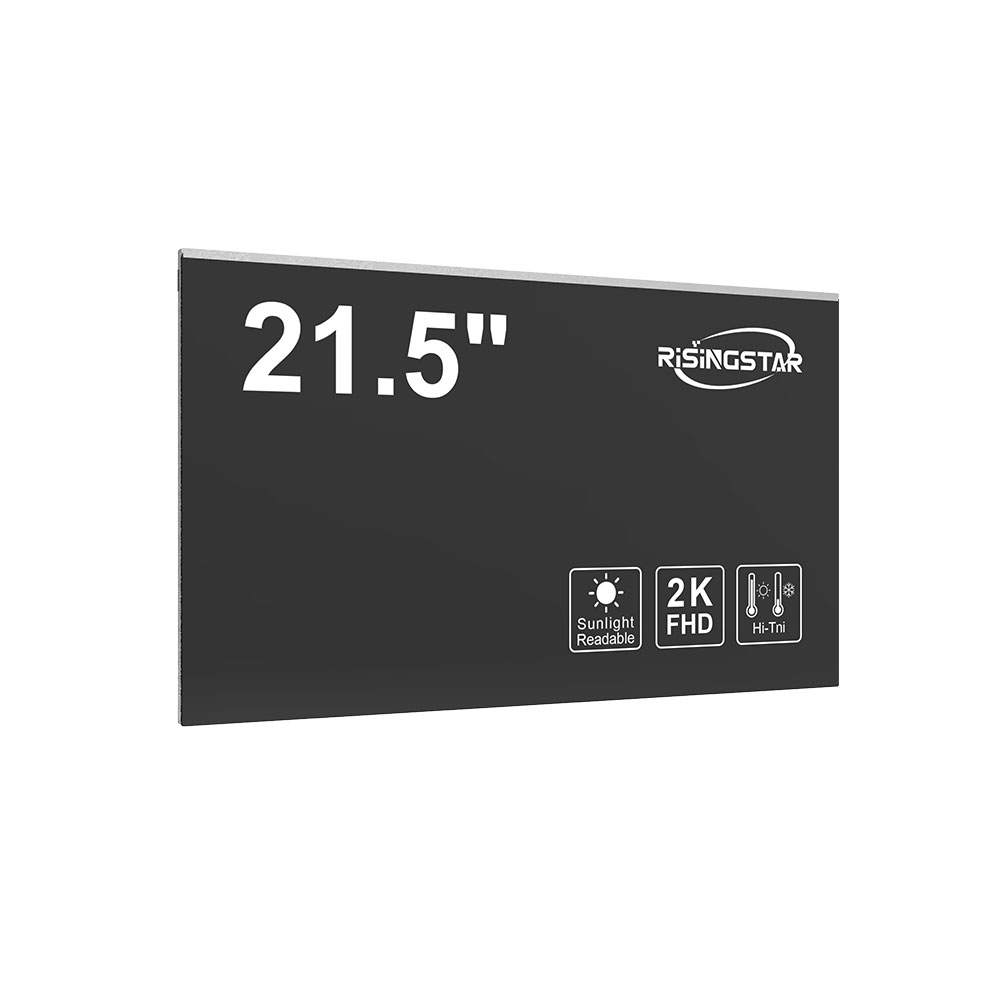
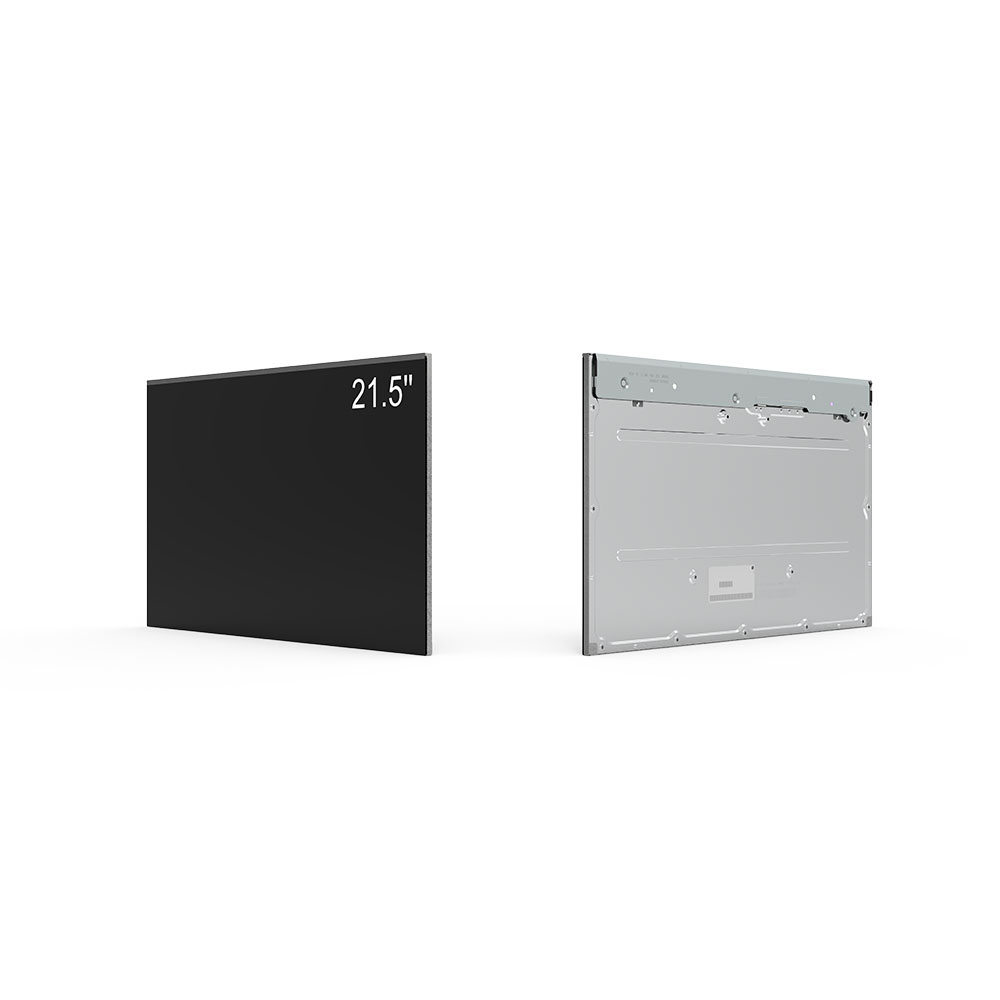
21.5" industrial high brightness LCD at 2,500 nits (with LED direct backlight): ~35–60 W depending on panel efficiency and drive current. Add CPU/kiosk controller: ~10–25 W. Provision for peak inrush currents for PSU sizing.
5. Optical engineering: glass, coatings, and touch options
Cover glass and coatings
Optical bonding (LCD to cover glass) improves contrast, reduces condensation/MDI failures and increases mechanical robustness. Specify optically clear adhesive (OCA) bonding.
Anti-reflective (AR) coatings lower surface reflection and improve perceived contrast. Haze levels of cover glass should be matched to the application — very aggressive haze reduces sharpness for video; a mid-level haze (20–30%) often balances glare reduction and image clarity.
Hard coating (2H–7H) protects against scratches; for vending glass, aim for ≥3H.
Touch technologies
Projected capacitive (PCAP) touch is the default for modern vending UX: multi-touch, good durability, works with gloved fingers depending on controller.
Resistive is less common now due to lower optical clarity and wear.
If you need operation in wet conditions, select touch controllers with water rejection algorithms or specify physical protective bezels to avoid touch false-triggering.
6. Environmental & regulatory compliance (EMC, CE, RoHS and more)
CE marking & EMC
Multimedia displays sold in the EU must comply with EMC requirements. EN 55032 (CISPR 32) for emissions and EN 55035 (CISPR 35) for immunity are the harmonized standards to reference for multimedia equipment. Maintain test records and an EU DoC.
Also consult the EU Single Market guidance on harmonized standards under Directive 2014/30/EU for up-to-date harmonized references.
Other regulatory items
RoHS (Restriction of Hazardous Substances), REACH where applicable, and product safety standards (such as low-voltage directives) must be part of procurement QA.
For EMI/EMC, plan layout and shielding early: filter input supplies, design grounding, and avoid long unshielded cable runs close to RF sources in the machine.
7. Reliability: lifetime expectations, burn-in and failure modes
Backlight lifetime
Modern LED backlit industrial LCDs frequently cite ~30,000–50,000 hours to half brightness depending on operating temperature and drive current. Lifetime shortens non-linearly with higher ambient temperature and higher brightness drive. Plan brightness profiles and duty cycles accordingly.
Common failure modes and mitigations
Backlight degradation: mitigate via dimming schedules and ambient sensing.
Thermal overstress: design passive or active cooling and validate with thermal cycling tests (operating and storage extremes). Consider MIL-STD-810 environmental tests for validation methodology.
Ingress & corrosion: specify appropriate IP rating and use corrosion-resistant fasteners/coatings for coastal deployments.
Connector and cable wear: choose sealed connectors and strain relief; avoid routing through hinge points.
Burn-in and acceptance testing
Factory burn-in: run units at full brightness for 72 hours (or longer depending on batch) to catch early failures.
Acceptance checklist: dead pixels, color uniformity, audible anomalies (coil whine), thermal stability at high brightness, touch responsiveness, ingress test bench (spray test), and EMC pre-test.
8. Integration checklist for vending machine OEMs
Use this as your procurement and integration checklist when specifying displays:
Mechanical and optical
Display model, visible area, OD dimensions, mounting hole pattern.
Cover glass type, AR coating, hardness (H rating) and optical bond spec.
IK impact rating target.
Environmental & electrical
Required IP rating (IP65 / IP66 / IP67) — specify gasket & connector sealing strategy.
Operating temperature range (e.g., −20°C to +60°C) and storage temperature range.
Thermal dissipation plan and PSU sizing.
Power input (100–240VAC or DC options), standby power, wakeup time and surge tolerance.
Optical & UX
Target brightness (nits) for installation exposure.
Touch type (PCAP), glove/wet operation and controller part number.
Resolution and pixel density for UI design (FHD, 4K as needed).
Anti-glare / haze spec and optical bonding.
Regulatory & testing
EMC: EN 55032/EN 55035 test reports or plan.
IP test reports (IEC 60529) and ingress test levels.
Environmental test plan: thermal cycling, humidity, salt fog if coastal, vibration, shock, and optionally MIL-STD-810 tailored methods.
Lifecycle & obsolescence
Backlight lifetime (MTTF) and expected half-brightness hours.
Repair strategy: field-replaceable module or depot repair; spare parts lead times.
9. UX & content strategies for outdoor vending
Core UX principles
Large, legible text: minimum 18–24 pt for core menu items depending on viewing distance.
Minimal interaction depth: keep core purchase flow to <3 screens.
High contrast calls to action: bright buttons with clear affordance.
Fast boot and graceful failure: display a minimal offline experience if network/controller fails (e.g., “Insert card or use app”).
Content for daylight
Use static or lightly animated content for primary flows (animations can wash out in sunlight and increase CPU/GPU load).
Schedule night mode: reduce brightness, change color palette for lower ambient light to reduce glare and energy use.
Implement ambient-aware content that shifts contrast and UI based on sensor readings.
Accessibility & multilingual support
Multi-language support for EU markets; use language auto-detect by location and allow a persistent language selector.
Accessibility for visually impaired users: high contrast modes, voice prompts or audio-assisted UX where appropriate (consider GDPR/privacy for audio).
10. Field operations, maintenance and remote monitoring
Remote telemetry
Collect and monitor: ambient temp, display temperature, power consumption, uptime, brightness sensor readings, and error codes. Remote telemetry reduces truck rolls.
Predictive maintenance signals
Monitor backlight drive current and panel temperature trends to predict failing backlights or thermal excursion events before they become critical.
Service kit and spares
Keep a small spare stock of front-service display modules and common mechanical gaskets per 50 installed units in a region to minimize downtime. Ensure spare part SKUs have long availability or lifecycle commitments from your supplier.
11. Testing protocols (what to run before field deployment)
Functional smoke test (power on/off, touch, video, audio) — 15–30 mins per unit.
72-hour burn-in at typical and high brightness to catch infant mortality.
Thermal soak: run at maximum brightness in thermal chamber at +45°C for 8–24 hours, log surface temps.
Ingress / IP test: spray test per IEC 60529 for claimed IP level.
EMC pre-compliance: emissions pre-scan to reduce risk of failing final EMC lab tests.
Vibration & shock: as applicable for transit and in-field shock profiles (tailor to MIL-STD-810 methods for real-world simulation).
Document test results and include them in the supplier quality file.
12. Procurement language: sample RFP clause
Display module — functional & compliance requirements
Brightness: minimum 2,500 nits (operational) for window-facing units; alternative SKU options at 3,500–5,000 nits for direct sun facing. Supplier will provide measured luminance curves vs. drive current and ambient temperature.
IP Rating: minimum IP65; state IP66/IP67 test reports where required. Provide IEC 60529 test report.
Optical: Optical bonding to cover glass; AR coating; Haze ≤ 30%; Hard coating ≥ 3H.
Touch: Projected capacitive (PCAP), multi-touch, glove & wet operation documented.
Compliance: Provide CE Declaration of Conformity and EMC test reports to EN 55032/EN 55035.
Reliability: LED backlight rated ≥ 30,000 hours to 50% luminance; provide accelerated life test data and thermal derating curves.
13. Case studies & real-world lessons
Outdoor kiosk / vending case patterns
Sheltered vs fully exposed: sheltered installations converged on 2,000–2,500 nits; fully exposed direct sun used 4,000–5,000 nits with aggressive AR coatings and optical bonding for legibility. (Multiple industry vendor guidelines and case evidence).
Thermal throttling: machines without thermal headroom experience display dimming or shutdown on hottest days — provide thermal headroom and active cooling in spec.
Remote telemetry reduces faults: integrators who instrumented temperature, PSU status, and backlight current reported 20–40% fewer on-site maintenance visits in first 18 months.
(For kiosk and outdoor vending reference examples see outdoor kiosk and vending product pages and industry writeups.)
14. ROI, pricing & TCO considerations for integrators
Where the money goes
Upfront capex: high brightness, rugged displays cost more than consumer panels (premium for optical bonding, AR, sealed connectors).
Opex savings: fewer returns, less field service, better conversion rates and higher average purchases due to dynamic promotions.
Rough TCO model (example)
Premium for industrial/high brightness vs consumer panel: +30–150% depending on nits and IP/IK levels.
Reduced field maintenance: estimate 1–3 fewer truck rolls / 100 machines / year for properly spec’d displays. Monetize by hours saved × technician rate.
Commercial levers
Negotiate volume pricing and spare-part SLAs with display suppliers.
Request lifecycle availability (part continuity commitments) and extended warranty options for mission-critical deployments.
15. Why choose RisingStar (practical pitch for integrators)
RisingStar industrial high-brightness LCDs are purpose-built for outdoor retail kiosks and vending use:
High brightness options up to 5,000 nits (direct sunlight readable SKUs) with direct LED backlight for stable performance. (RisingStar product family includes E and D backlight designations and brightness tiers).
Industrial reliability: low power, low heat designs and aluminum housings for better thermal behavior.
Optical choices: optical bonding, AR coatings and a variety of cover glass hardness and haze options to match your UX needs.
Wide size range & modular SKUs enabling you to match screen size to vending footprint (10.1" to 55" and beyond in product family outlines).
Serviceability & supply chain: regional support, spare modules, and long lifecycle commitments to make large rollouts manageable.
(Technical specs and product lines are tailored for vending, EV kiosks, gas pump displays, and outdoor retail signage. For specific model specs and datasheets, RisingStar’s product literature contains detailed brightness, power curves, mechanical drawings and test reports.)
16. Practical integration example — a 21.5" direct sun vending build
Scenario: Street-facing vending machine in central European plaza, direct sun exposure between 10:00–16:00 in summer.
Display choice: 21.5" RisingStar RS21ENT-GD25 (example SKU family: direct backlight D, 2,500 nits class). For full sun choose RS21ENT-GD35/40 depending on orientation and expected ambient lux.
Key integration steps
Mechanical: front-service module with sealed NEMA gasket; IK10 glass.
Thermal: aluminum backplate with heat spreader; thermostatic fan with filter triggered above 45°C.
Electrical: 300 W PSU with 30% headroom; inrush limiter.
Software: ambient light responsive brightness curve; nighttime dim to 30–50 nits.
Testing: 72-hour burn in + 8 hour 45°C thermal soak at full brightness; IP65 spray test per IEC 60529; EMC pre-scan.
Outcome & metrics to track
Transaction success rate in peak sun (goal: maintain ≥98% completion).
Average brightness vs. ambient lux mapping and power consumption.
Time between on-site maintenance events.
17. Procurement & QA best practices when buying displays
Ask for measured luminance curves (nits vs. drive current and ambient temp) — not just a single “5000 nits” number.
Request environmental and IP test reports from accredited labs (IEC 60529 for ingress; MIL-STD test reports for tailored environmental exposure if claimed).
Demand EMC test reports (EN 55032 / EN 55035) for the final assembled display and for the integrated machine if possible.
Negotiate spare part lead times and an extended warranty (on backlight and panel).
Field pilot: deploy a small fleet in representative microclimates (coastal, urban canyon, plaza) for 3–6 months before full roll-out.
18. Common mistakes & how to avoid them
Specifying consumer panels — underpowered for sunlight and fail quickly outdoors.
Underengineering thermal design — leads to early dimming/TTL issues.
Ignoring IP ingress in spec — water damage is one of the most common field failures.
Not planning for remote telemetry — reactive field maintenance is costly.
Overlooking optical bonding/AR treatments — major UX impact in sunlight.
19. Appendix A — Helpful standards & reading
IEC 60529 — IP ingress protection rating definitions (Ingress protection (IP) ratings).
EN 55032 / EN 55035 — EMC standards for multimedia equipment (emissions and immunity).
MIL-STD-810 — environmental test methodology often used for ruggedized equipment (use as methodology, not a one-size certification).
Industry guides on display brightness & outdoor signage — Signagelive, Unit-LED and similar practical guides on nit selection and content best practice.
Panel lifetime & backlight guides — manufacturer insights on expected LED backlight lifetimes and derating.
20. Appendix B — Quick prototyping checklist
Select 2 display SKUs (one for shaded, one for direct sun).
Assemble 2 machines each in three microclimates (urban, sheltered subway entrance, open plaza).
Instrument each machine (temp, ambient lux, PSU current, backlight current, uptime).
Run 3 month field pilot, collect logs weekly, conduct one maintenance review mid-pilot.
21. Final notes — partnering with RisingStar
If you’re specifying displays for a 50–10,000 unit rollout across Europe, RisingStar can help with:
SKU matching (brightness, size, touch, optical options).
Regional logistics & spare pools.
Joint pilot programs and thermal/EMC test data exchange.
A recommended first step: identify three representative installs (coastal, urban, sheltered) and ask RisingStar for measured luminance vs temp curves, IP and EMC test reports for the chosen SKUs, and a proposal for front-service swap modules and spare parts pricing. (If you’d like, I can draft the email/RFP language to send to RisingStar with the procurement checklist embedded.)