
💡 **Quick Answers
Ingress vs. Thermal Balance: Fully enclosed IP66 waterproof monitor displays must rely on passive metallic conduction and internal airflow circulation rather than external vents to prevent water and particulate ingress.
Preventing LCD Failure: To prevent Temperature-Induced Nematic-Isotropic (TNI) blackening under unshaded solar loads, displays must incorporate liquid crystals with a high clearing point (Hi-Tni ≥110°C).
Salt & Acid Protection: Demanding industrial wash-downs and marine environments require high-grade 304 or 316 stainless steel enclosures paired with conformal-coated PCBs to eliminate the risk of internal moisture condensation.
- Standing near the edge of a windswept train station platform, this passenger information display is now entering its third year of continuous operation.
According to the original maintenance schedule, the housing should have been opened and cleared of internal dust buildup at least four times by now. It hasn't been touched. Every single day, it has been blasted by wind-driven grit, metallic brake dust from incoming trains, and wind-whipped rain driving sideways under the platform canopy. Worse yet, during late-night station wash-downs, it routinely takes direct hits from high-pressure water hoses.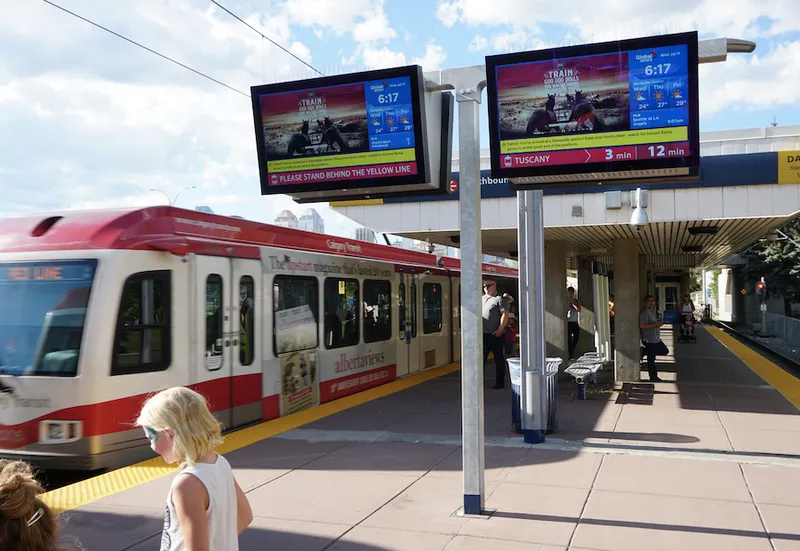
Yet, the schedule remains perfectly legible, and the screen hasn't missed a beat—because someone, somewhere in the procurement chain, refused to settle for a standard "weather-resistant" monitor and instead specified a fully sealed IP65/IP66 industrial enclosure.
That is the definitive line between a true outdoor waterproof LCD display and a commercial monitor with a few added gaskets. One is an engineered survival mechanism; the other is built to a budget. In high-traffic transit hubs where water intrusion or fine conductive dust means dead electronics, a cheap price point gets incredibly expensive, very fast.
This guide breaks down the critical engineering decisions behind deploying a sealed outdoor display. It explores how to build a system that doesn't just survive heavy downpours, but actively withstands high-pressure wash-downs, airborne particulate ingress, and intense thermal cycling—all while keeping its internal electronics bone-dry and preventing the LCD panel from blackening under direct sunlight.
For engineers and system designers specifying hardware for these demanding conditions, integrating reliable outdoor displays requires careful evaluation of thermal boundaries, housing materials, and cable connector seals early in the design cycle.
1. The IP66 Dilemma: How Do You Cool a Box You Can't Vent?
Here's the fundamental tension of outdoor waterproof display engineering: IP66 protection means zero ventilation holes, zero air filters, zero external airflow. But the backlights that make the screen readable under direct sunlight — 1,000 to 2,500+ nits — generate serious heat. Trap that heat inside a sealed box, and two things happen.
First, the internal air temperature climbs. When the LCD panel surface exceeds its thermodynamic clearing point — typically 65°C to 70°C for standard panels — the liquid crystals lose their aligned nematic phase and transition into an isotropic liquid. The screen develops TNI blackening: expanding dark regions that don't recover. Second, the trapped heat accelerates LED backlight degradation and stresses driver board components, shortening the display's operational life.
The solution isn't "add a fan" — an intake fan breaks the IP66 seal. The solution is to stop thinking of the enclosure as a box that needs venting and start treating it as a heat sink with a screen in it.
[Sealed IP66 Enclosure] → [Internal Recirculation Loop] → [Metal Chassis as Heat Sink] → [Natural Convection to Ambient Air]
High-heat components are coupled directly to the inner chassis wall via thermal interface materials. Internal recirculation fans — sealed entirely inside the chassis, moving only internal air — sweep hot air from the LCD backlight cavity toward the cooler metal walls. The metal chassis, typically aluminum (k ≈ 205 W/m·K) or 304/316 stainless steel, conducts the heat to its outer surface, where natural convection and radiation shed it to ambient air. The chassis stays sealed, and the heat still gets out.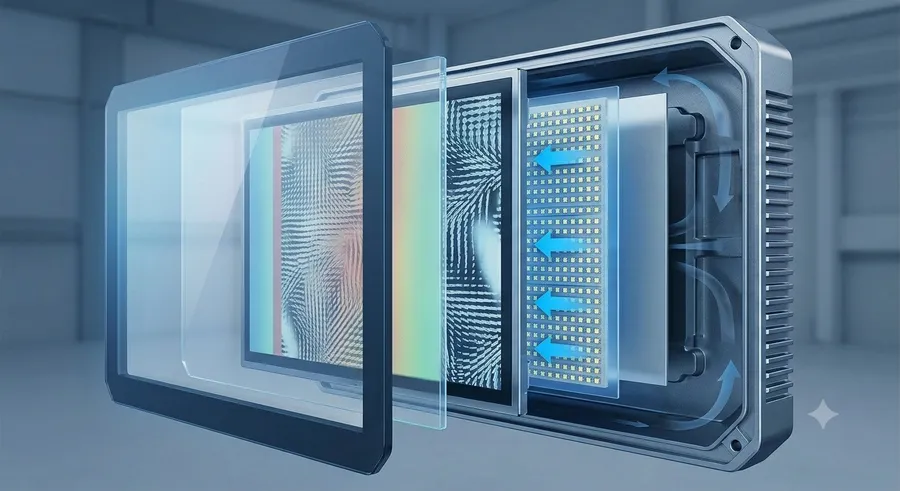
This is not a theoretical approach. It's the standard thermal architecture for every IP66-rated outdoor display that achieves a 50,000-hour backlight lifespan without a single external vent.
2. Selecting Your Configuration: Size, Enclosure, and Environment
Selecting the correct form factor and scale is critical to balancing optical performance with thermal headroom. The table below matches display configurations to environmental threats across the most common B2B deployment scenarios:
| Deployment Environment | Primary Threat | Enclosure Grade | Target Luminance | Recommended Cooling Mode |
|---|---|---|---|---|
| EV Charging Stations | Direct sun, rain, vandalism | IP56 Aluminum / Glass | 1,500–2,000 nits | Forced internal loop, Auto-dimming |
| Marine Deck Navigation | Corrosive salt-spray, vibration | IP66 Fully Sealed Stainless | 1,000–1,500 nits | Solid metal conduction, Conformal PCBs |
| Food Processing Cleanroom | Acid/alkali pressure wash-downs | NEMA 4X / IP66 Stainless | 500–1,000 nits | Fanless passive cooling, Flush mount |
| Unshaded DOOH Billboard | Scorching heat, extreme sun | IP65 Double-Skin Casing | 2,500–5,000 nits | Active heat exchanger, Hi-Tni panel |
The scale of the installation directly impacts the thermal strategy. For close-range, single-user interactive terminals — outdoor ticketing kiosks, payment terminals, EV charger screens — a compact 21.5-inch display generates manageable heat loads that a well-designed metal chassis can dissipate through conduction alone.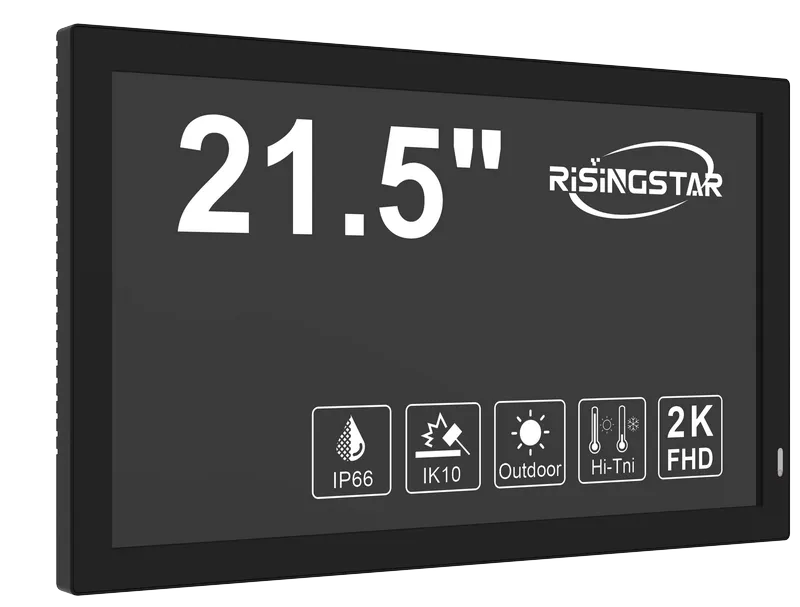
The RS215HNX02D01-BK is a representative configuration at this scale. This 21.5-inch maintenance-free display uses a highly conductive rear chassis to dump heat passively, maintaining 500 to 2,500 nits without requiring air filters — or filter maintenance.
Move up to mid-size installations — interactive directories, transit platform displays, outdoor wayfinding kiosks at 32 inches — and the thermal equation changes. A larger panel means a larger backlight array, which means more heat. At this scale, internal recirculation becomes essential. The RS320DPY-GD30 uses a modular air-cooled internal loop to balance up to 5,000 nits of luminance with IP56 ingress defense.
At the large-format end — highway billboards, building-mounted DOOH displays, stadium screens pushing 65 inches and beyond — thermal loads cross into a different order of magnitude. A 65-inch panel at 2,500–5,000 nits can dissipate over 400W. Passive conduction alone isn't enough; an active internal heat-exchange cycle is mandatory. The RS650HNX01-A01-BK is engineered for this class of deployment — 24/7 direct-sunlight operation with a sealed internal heat-exchange system that prevents both solar-induced yellowing and TNI blackening across its full 65-inch surface.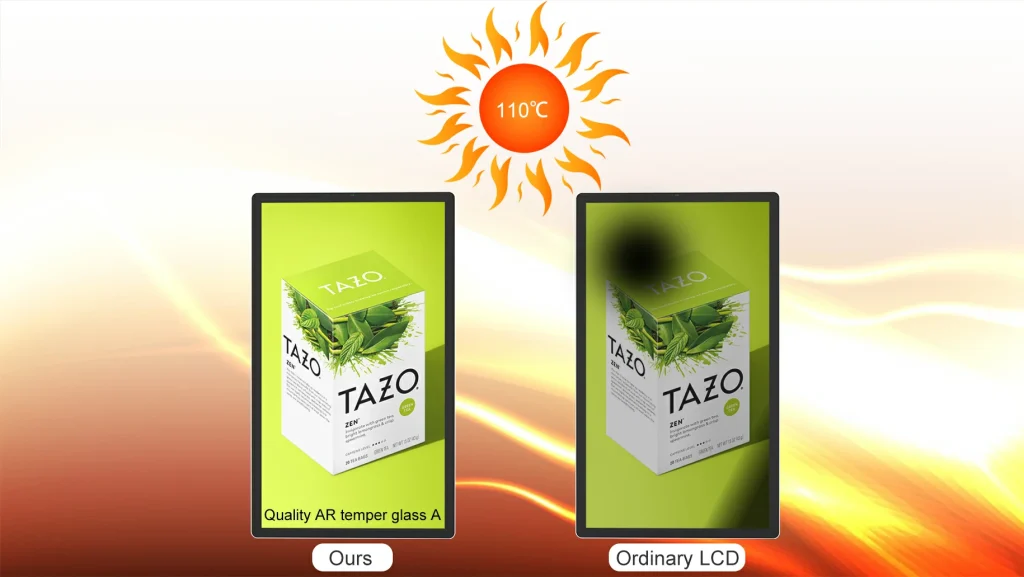
The takeaway: size the thermal solution to the panel size. A 21.5-inch kiosk screen and a 65-inch billboard may both need to be "waterproof," but the engineering required to keep them waterproof and cool are fundamentally different.
3. Behind the Glass: Advanced Ingress Defense & Condensation Control
A professional outdoor waterproof LCD display relies on three layers of engineering defense that separate it from consumer-grade hardware:
3.1 Optical Bonding vs. Air Gaps
A traditional air-bonded screen leaves a 0.5–1.0 mm air gap between the LCD panel and the front protective glass. Under daylight, sunlight hits the cover glass and the LCD surface, creating a high reflection rate that washes out the image — roughly 8% total reflection across two air-glass interfaces.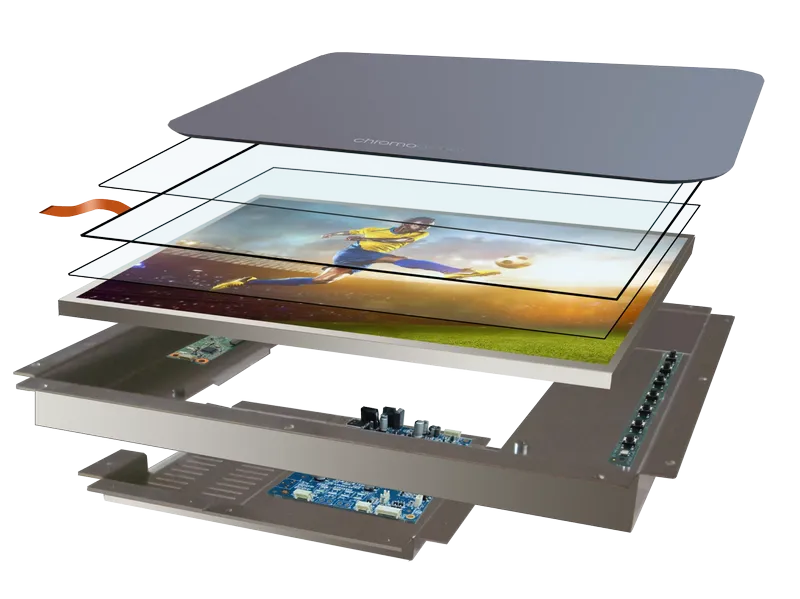
Temperature drops at night cause moisture trapped in this air gap to condense into water droplets, fogging the screen from the inside. Optical bonding replaces this air gap with a UV-cured resin matched to the refractive index of glass (~1.5). This eliminates internal reflections, improves thermal conduction from the panel to the front glass by up to 20%, and permanently prevents internal moisture fogging — because there is no air cavity for moisture to condense in.
3.2 The Condensation Cycle and Conformal Coating
When a sealed IP66 waterproof monitor undergoes severe day-to-night temperature changes, the air inside contracts, creating a pressure vacuum that slowly pulls in micro-humidity through gaskets — a process called gland breathing. Over weeks and months, this accumulated moisture condenses on internal surfaces.
To prevent this moisture from short-circuiting the electronics, professional displays incorporate Conformal Coating — a micro-thin polymer layer (acrylic, silicone, or polyurethane) applied to all driver boards, power supplies, and PCBs. The coating shields copper traces and solder joints from liquid water, salt-spray, and conductive industrial dust, effectively making the electronics immune to the condensation that inevitably occurs inside any sealed enclosure over its operational life.
3.3 Pressure Equalization Membranes
Rather than allowing the casing to "breathe" moist air through structural seams, industrial enclosures integrate hydrophobic, oleophobic PTFE breathing membranes (e.g., Gore vents). These membranes feature microscopic pores large enough to let air molecules pass through to equalize internal pressure — preventing the pressure differential that drives gland breathing — but small enough to block liquid water molecules and microscopic dust completely. The membrane is typically installed at the lowest point of the enclosure to avoid water pooling around it.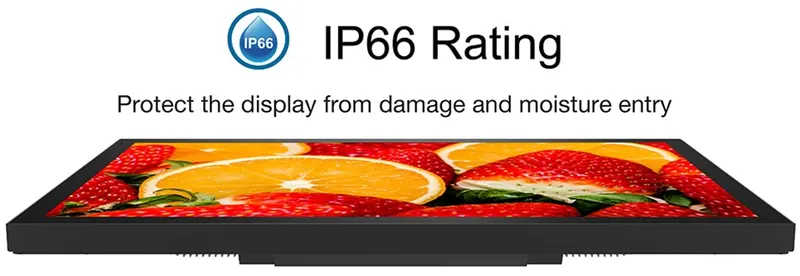
4. Sourcing Peace of Mind: RisingStar's OEM/ODM Advantages
B2B project lifecycles demand strict supply continuity. A consumer display model may go end-of-life (EOL) in 12 months, forcing system integrators to redesign their custom metal kiosks at a high cost.
Shenzhen RisingStar Outdoor High-Brightness LCD Co., Ltd., operating from a 4,000㎡ ISO 9001-certified facility, addresses these B2B pain points directly:
Long-Term Availability: We guarantee model and mechanical design availability for 3 to 5 years, protecting your engineering investments.
Strategic Tier-1 Partnerships: We source Grade-A industrial panels from LG Display, AUO, BOE, and Innolux to ensure zero-defect delivery.
Turnkey Customization (OEM/ODM): From custom 316 stainless steel housings for maritime deployments to zone-addressable local dimming modifications, our engineers tailor displays to match your exact thermal, electrical, and mechanical requirements.
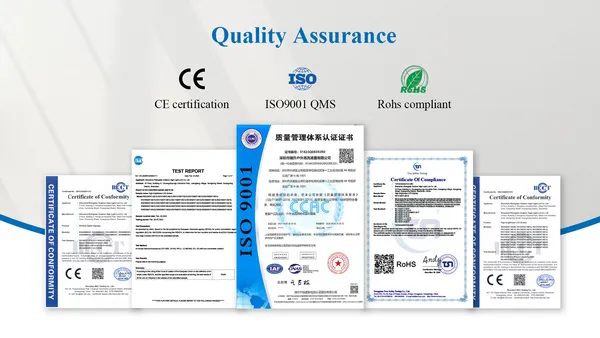
Our products undergo rigorous quality assurance, including 100% factory inspection and a 72-hour high-temperature aging test before shipment. Every display is backed by a robust warranty and 24/7 technical support, giving you peace of mind from prototype to mass deployment.

