**Quick Answers
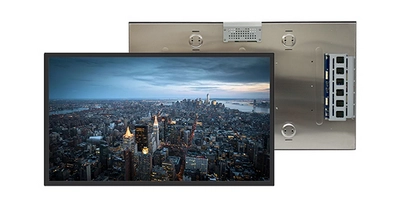
Why open frame displays for EV charging stations? An open frame display — an enclosure-free LCD module mounted on a rigid metal chassis — eliminates the plastic housing waste of standard monitors, enabling direct flush-mounting behind a single protective glass panel. This achieves IP65/IP66 sealing with fewer failure points and reduces the display assembly depth by up to 40%.
What prevents outdoor EV charger displays from blackening in the sun? Standard LCD panels blacken when their liquid crystal exceeds the clearing point (typically 70°C). Industrial open frame displays use Hi-Tni liquid crystal with a clearing point of ≥110°C, combined with an aluminum chassis acting as a direct heat sink, preventing thermal blackening under sustained solar loading.
How does open frame architecture reduce long-term operating costs? By separating the protective front glass (IK10-rated) from the display module, field technicians can replace the display or driver board from the rear access door without breaking the front IP seal — reducing Mean Time to Repair (MTTR) from hours to minutes.
The global transition toward electromobility has transformed Electric Vehicle Supply Equipment (EVSE) from rudimentary electrical conduits into sophisticated, cloud-connected interactive nodes. For EV charging station manufacturers, the human-user interface represents both the primary point of customer engagement and the component most vulnerable to environmental degradation and mechanical failure.
Traditional display integrations rely on standard enclosed monitors, which introduce thermal management bottlenecks, integration constraints, and high operational expenditure through field failures. This article analyzes the outdoor open frame display architecture as a dedicated paradigm for EVSE manufacturing, examining structural integration, thermal dynamics, optical optimization, and long-term total cost of ownership.
For a foundational overview of open frame display architecture and its general advantages across industries, see the companion article: Open Frame Display: The Screen Your Users Never Notice.
1. The Architectural Challenge of EV Infrastructure
From Power Delivery to Digital Interaction Hubs
First-generation EV chargers required minimal user interaction — often a basic LED segment screen or physical status indicators. Modern DC fast chargers (DCFC) and high-power Level 2 AC chargers operate as multi-purpose digital hubs handling:
Dynamic, multi-language user guidance and real-time charging telemetry
Secure, encrypted payment processing
Dynamic grid integration data and utility tariff communication
High-definition programmatic advertising
This shift demands expansive, high-resolution touch displays deployed in some of the most brutal outdoor environments — solar radiation, temperature extremes from -20°C to 70°C, rain, humidity, dust, and vandalism. When a display fails, the entire charger becomes functionally inoperable from a consumer perspective, leading to lost revenue and expensive field maintenance.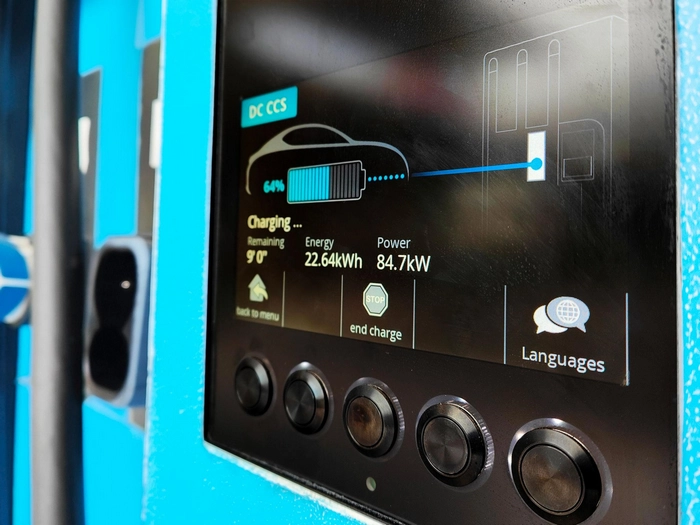
The outdoor open frame display architecture addresses these challenges at the structural level. Browse the full outdoor open frame display solutions for application-specific configurations.
2. Structural Integration and Design Freedom
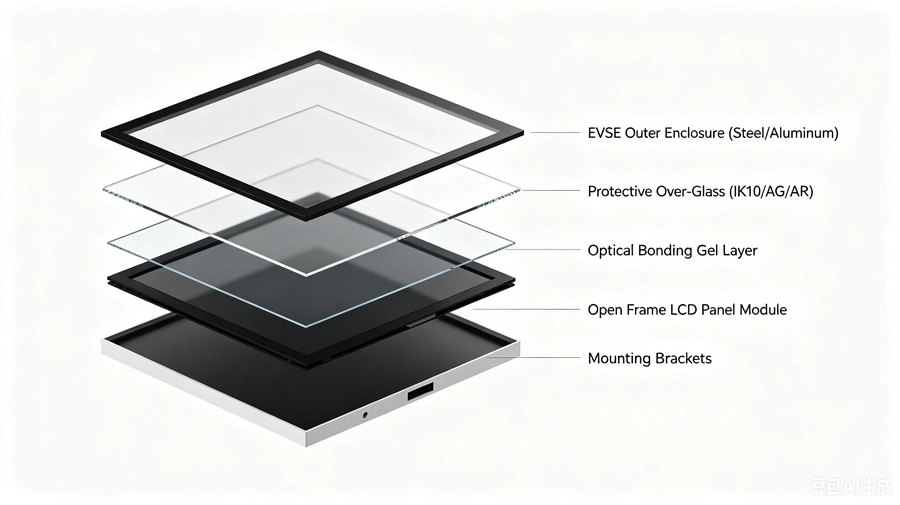
Standard enclosed monitors include a plastic or thin-metal bezel and rear housing designed for VESA mounting. For an EVSE manufacturer, this creates severe design liabilities. The open frame display architecture eliminates these external cosmetic shells, exposing the raw industrial chassis.
Flush Mount Integration
Modern EV charging stations require sleek, monolithic aesthetics. Open frame displays allow true flush-mounting behind the station's main front facade — typically a sheet of CNC-machined tempered glass. By utilizing adjustable mounting brackets, structural engineers position the LCD panel directly against the rear surface of the protective cover glass, eliminating front crevices, raised bezels, and uneven seams.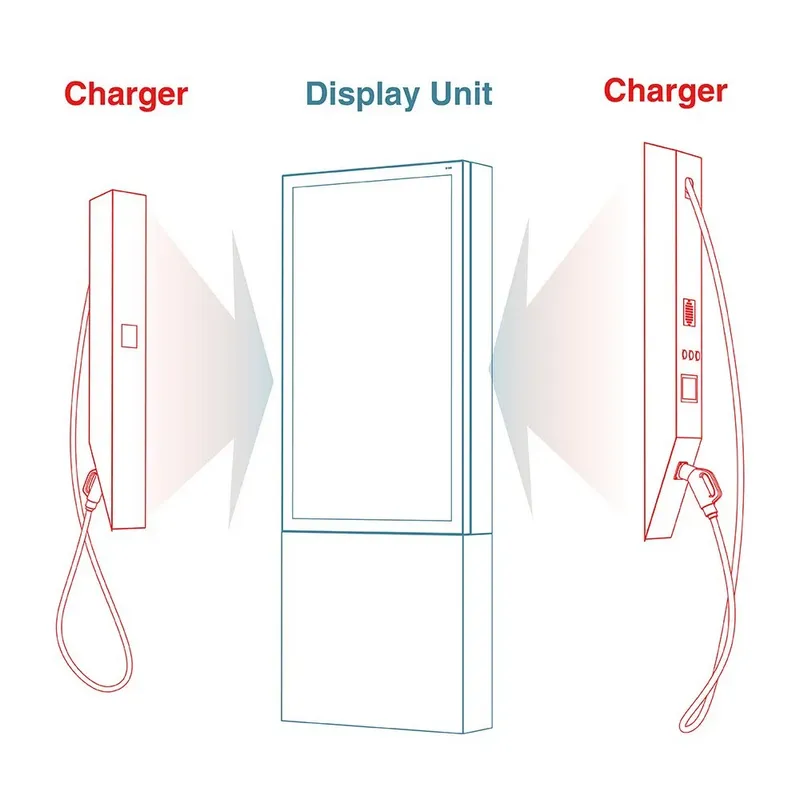
Ingress Protection (IP65/IP66)
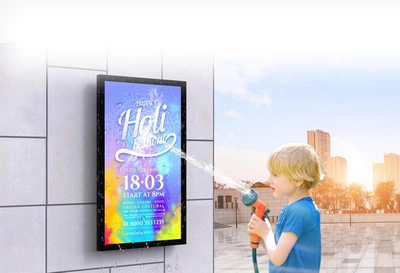
With an open frame design, the front-facing seal is established directly between the flat protective outer glass and the EVSE chassis using industrial-grade closed-cell EPDM gaskets. The open frame display sits securely inside this sealed environment, achieving IP65 or IP66 front-panel protection without requiring bulky sealing enclosures around the monitor itself.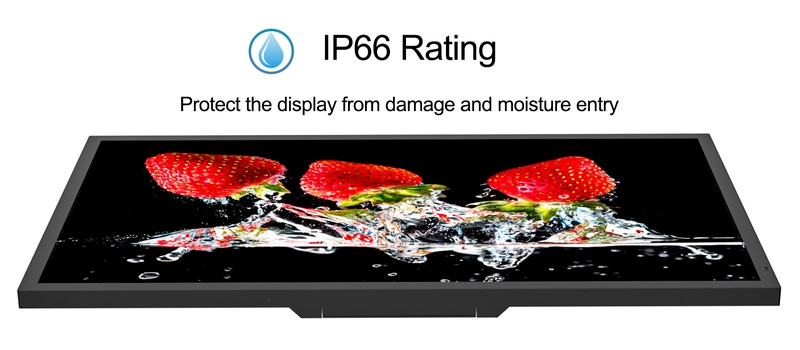
IK10 Impact Resistance
Standard commercial displays are highly susceptible to point-impact fractures. Open frame architecture separates the defensive layer from the display layer. OEMs integrate thick, chemically strengthened protective glass (4–6mm) into the charger's outer housing, with the open frame monitor mounted securely behind it. When optically bonded, this assembly withstands impacts exceeding 20 joules — IK10 rating — without transmitting destructive force to the LCD module.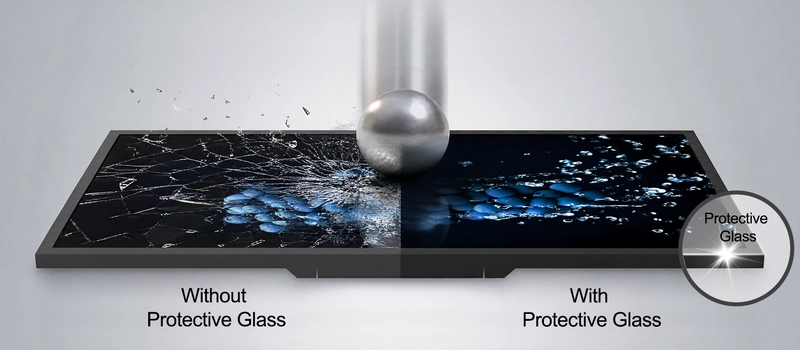
3. Thermal Dynamics and the Liquid Crystal Blackening Problem
The Clearing Point Failure Mode
One of the most persistent failure modes of outdoor displays is solar blackening. Standard liquid crystals undergo a phase transition from an anisotropic crystalline state to an isotropic liquid at a specific temperature — the clearing point (Tni). For standard commercial panels, this occurs at approximately 70°C. Once crossed, the liquid crystals lose orientation properties, producing localized or total black patches. Prolonged exposure permanently damages the alignment layers.
Hi-Tni Liquid Crystal Solution
Industrial open frame displays use Hi-Tni (High Temperature Nematic) liquid crystal with a clearing point of ≥110°C — a 40°C safety margin over standard panels. Combined with the open frame's aluminum chassis, which acts as a direct thermal conductor, heat from the LCD panel is conducted away through the mounting brackets to the charger's enclosure, preventing temperature buildup at the liquid crystal layer.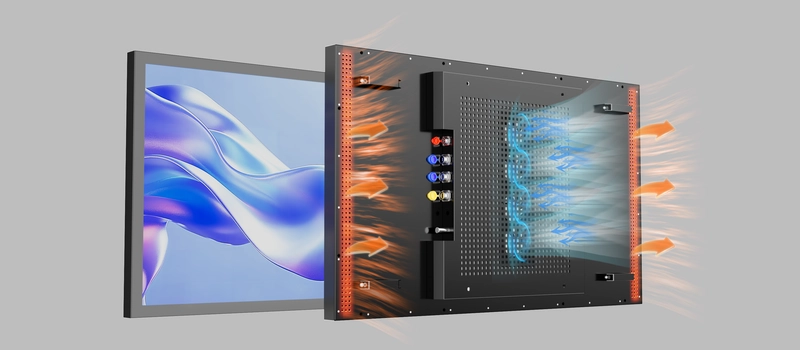
UV Degradation Prevention
Prolonged exposure to UV radiation (particularly wavelengths below 380nm) degrades LCD polarizers and optical bonding materials, causing yellowing and delamination over time. Premium open frame displays incorporate UV-blocking formulations within the polarizers and optical bonding materials, maintaining color purity throughout the deployed lifespan.
4. Total Cost of Ownership (TCO) and Modular Maintenance
CapEx vs. OpEx Comparison
For EVSE manufacturers, product decisions cannot be based solely on initial BOM costs. The long-term financial viability of a charging network depends on minimizing operational expenditure over a multi-year deployment cycle.
| Cost Variable | Commercial Enclosed Monitor | Industrial Open Frame Solution |
|---|---|---|
| Initial Unit Cost (CapEx) | Low to Moderate | Moderate to High |
| Integration / Mechanical Fit Cost | High — requires custom mounting boxes and specialized sealing | Low — engineered with built-in flanges and standardized mounting points |
| Expected Field Lifespan | 18–24 months | 50,000+ hours (5–7+ years continuous operation) |
| Field Failure Rate | High — thermal shutdown, moisture ingress | Ultra-low — industrial components built for harsh environments |
| Field Replacement Cost | Extreme — requires unmounting full enclosure, re-gasketing, recalibrating | Low — modular swap via rear chassis access |
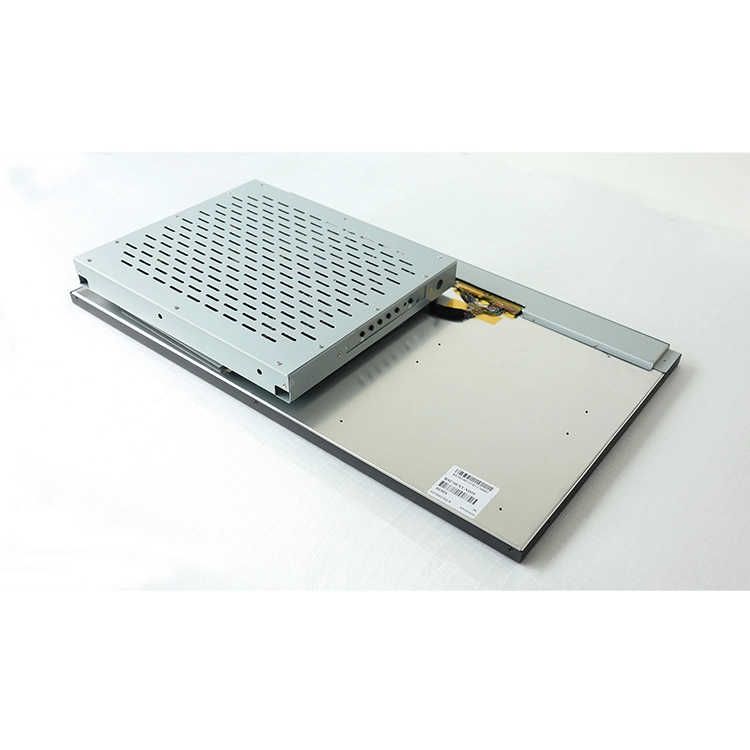
Modular Maintenance and MTTR
When a display component fails, open frame architecture drastically lowers Mean Time to Repair (MTTR). Because the module lacks an exterior casing, it can be accessed directly from the interior rear access door of the charging pile. Technicians can replace individual subsystems — the driver board, backlight inverter, or power module — without breaking the front environmental IP seal or removing the main protective glass. This reduces field maintenance time from hours to minutes.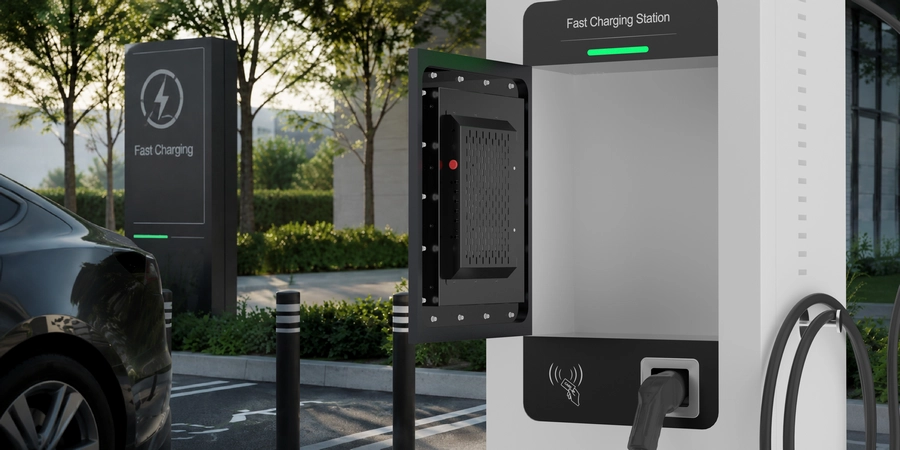
Form-Factor Stability
Consumer electronics operate on 12–18 month product lifecycles — a serious risk for EVSE manufacturers who design charging pile chassis around a specific monitor model. Industrial open frame displays guarantee form-factor stability for 5–7+ years, ensuring the physical dimensions, mounting points, and electrical pinouts remain unchanged across production batches.
Explore the full range of open frame monitor configurations designed for demanding outdoor and industrial deployments.
FAQ
Q: What is an outdoor open frame display?
An outdoor open frame display is an LCD module without a plastic housing, mounted on a rigid metal chassis with pre-drilled mounting flanges. It is designed for direct integration into custom enclosures rather than sitting inside a pre-built monitor shell.
Q: Why does an EV charger display need Hi-Tni liquid crystal?
Standard LCD panels blacken when internal temperatures exceed 70°C — a threshold easily crossed under direct solar loading inside a sealed charger enclosure. Hi-Tni liquid crystal raises the clearing point to ≥110°C, providing a 40°C safety margin that prevents permanent TNI blackening.
Q: How is IP65/IP66 sealing achieved with an open frame display?
The front seal is established between the charger's outer enclosure and the protective cover glass using a continuous EPDM gasket. The open frame module mounts behind this sealed assembly — no additional sealing around the monitor is required.
Q: What is the expected lifespan of an open frame display in an EV charger?
Industrial WLED backlights are rated for 50,000 hours to half-brightness — approximately 5.7 years of continuous 24/7 operation. Field lifespan depends on thermal management: adequate chassis conduction and proper ambient conditions prevent accelerated lumen depreciation.
Q: Can the display be replaced without breaking the charger's environmental seal?
Yes. Open frame architecture allows rear-access servicing. The technician accesses the module through the charger's rear door and swaps the driver board or display unit without disturbing the front IP seal or protective glass — MTTR in minutes, not hours.
About RisingStar — RisingStar specializes in outdoor open frame display solutions for EV charging infrastructure, transit systems, and industrial applications. Manufacturing in a 4,000 m² ISO 9001-certified facility with Class 10,000 cleanroom assembly. Grade A/A+ panels sourced from LG Display, AUO, BOE, Innolux, and Tianma. Every unit undergoes 100% factory inspection and 72-hour burn-in before shipment.
? ai@risinglcd.com · ? +86 158 8946 9208 · ? www.risinglcd.com