
You need a display for an outdoor installation. The spec calls for sunlight-readable visibility. Your integrator says LED. Your procurement team says LCD — it's cheaper. Both are right. Both are wrong.
The choice isn't about which technology is better. It's about which technology fits your specific project — and the dividing line is clearer than most people think.
💡 Quick Answers — LCD vs LED Wall
When should I choose a high-brightness LCD?
When the screen is 100 inches or smaller, viewers stand within arm's reach to 15 feet, and you need fine detail (text, menus, maps, interfaces). LCD wins on pixel density, cost for smaller sizes, and close-up readability.When should I choose a direct-view LED wall?
When the screen is 100+ inches, viewers are 15+ feet away, or the installation is fully exposed to direct sun with no shade structure. LED wins on raw brightness (4,000–10,000+ nits), seamless large formats, and long-term energy efficiency at scale.What's the rough cost comparison?
For a 65-inch installation: LCD is typically 40–60% cheaper upfront. For a 200-inch installation: LED is typically 20–40% cheaper on a per-square-meter basis, and uses 30–50% less power. The crossover point is around 100–120 inches.
The Fundamental Difference
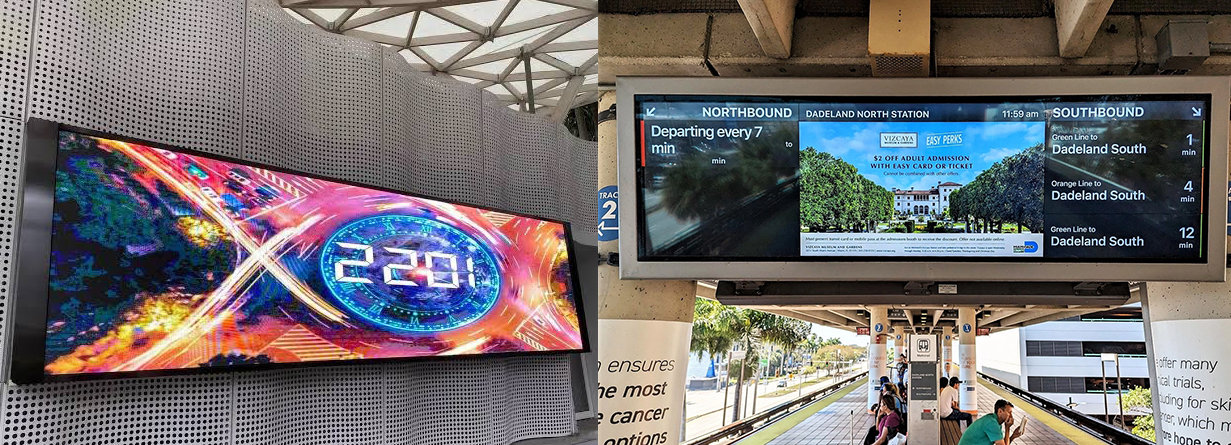
Both technologies produce a bright image. They do it in completely different ways, and that drives every trade-off.
| High-Brightness LCD | Direct-View LED Wall | |
|---|---|---|
| How it works | LED backlight shines through a liquid crystal panel with color filters | Each pixel is a self-emitting red/green/blue LED diode |
| Typical brightness | 1,000–5,000 nits | 4,000–10,000+ nits |
| Pixel pitch | Fine (0.2–1.5 mm, 100–200 PPI) | Coarse (1.5–10 mm, depending on viewing distance) |
| Viewing distance | 3–15 feet (close-up detail) | 15–500+ feet (large-format signage) |
| Seamless? | Bezel visible (0.5–3 mm between tiles) | Truly seamless — no visible grid |
| Max single panel size | ~85–110 inches | Unlimited (modular tiles) |
| Lifespan (L70) | 30,000–50,000 hours | 50,000–100,000 hours |
| Power (per m², at rated brightness) | 150–250 W | 80–150 W |
| Heat output | High (concentrated behind panel) | Moderate (distributed across surface) |
| Repair | Replace entire panel | Replace individual LED module |
The Decision Framework: Four Questions
Ask these four questions in order. The answer falls out naturally.
Question 1: How large is the installation?
Under 100 inches diagonal: LCD wins. Period. LED tiles at small sizes are expensive, have visible pixelation at close range, and offer no advantage. A 55-inch or 65-inch high-brightness LCD at 2,500–3,000 nits is the right tool for drive-thru menus, EV charger interfaces, transit kiosk screens, and retail storefront windows.
100–150 inches: Both are viable. This is the crossover zone. An LCD video wall (multiple tiled panels) can work here, but bezels become visible and cost rises sharply. LED at 2–4 mm pixel pitch is competitive and increasingly common.
Over 150 inches: LED wins decisively. Beyond ~100 inches, single LCD panels become prohibitively expensive, heavy, and fragile. LED tiles scale linearly — a 200-inch wall costs roughly the same per square meter as a 100-inch wall, while an LCD of that size would require a custom panel that barely exists in the market.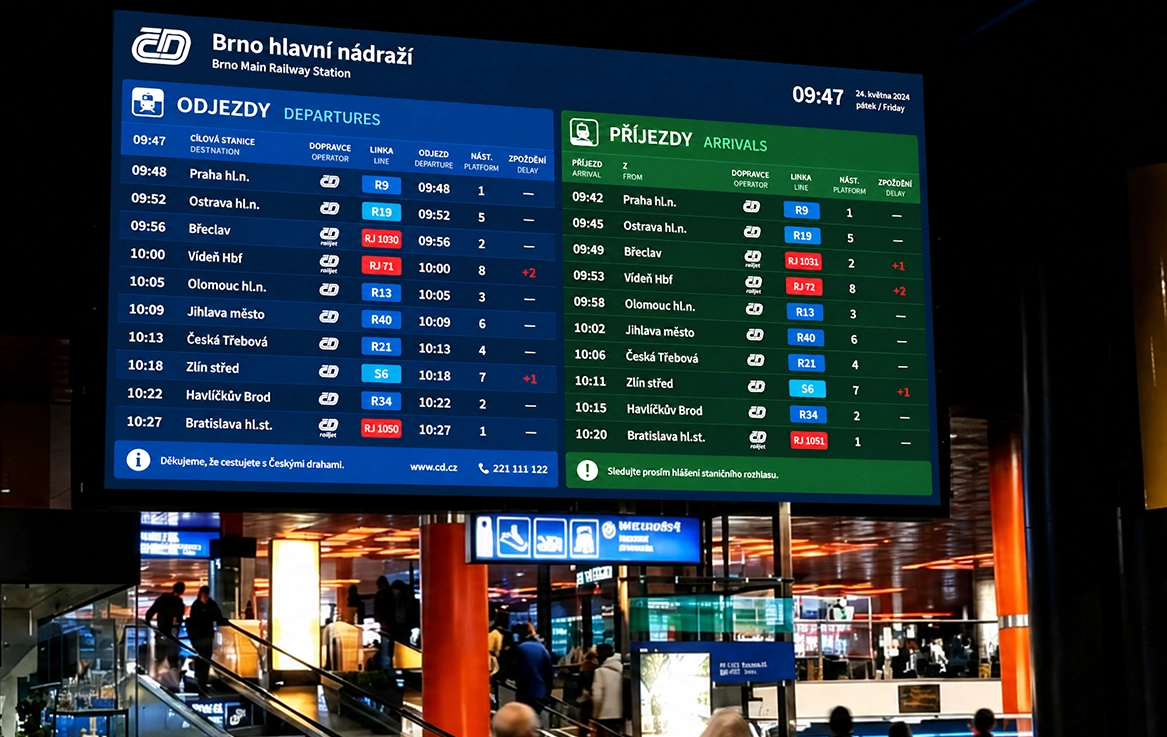
Question 2: How far away will viewers stand?
LCD's killer feature is pixel density. A 55-inch LCD at 4K has 81 pixels per inch. An LED wall at 4 mm pixel pitch has 0.6 pixels per inch — 135× coarser.
This matters enormously at close range. For a drive-thru menu board viewed from 5 feet, you need fine text. LCD delivers it. LED at that distance shows visible pixel grids — individual red, green, and blue dots become apparent.
The rule of thumb: if viewers are within 1.5× the screen diagonal, you need LCD-grade pixel density. For a 55-inch screen, that's within ~7 feet. For a 100-inch screen, within ~12 feet. Beyond that, LED pixel pitch becomes acceptable.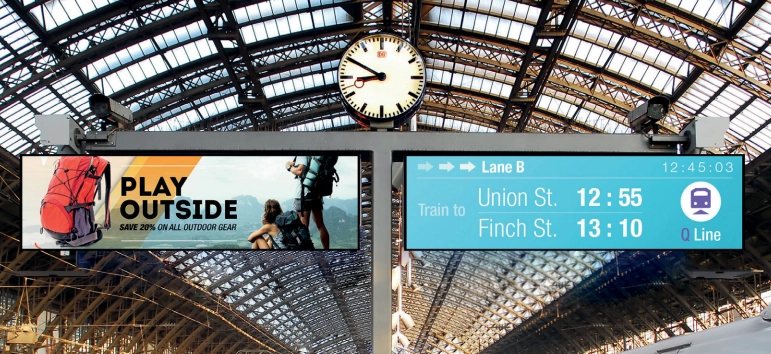
Question 3: What's the lighting condition?
This is where the brightness numbers get real.
| Environment | LCD (adequate) | LED (adequate) |
|---|---|---|
| Shaded / covered outdoor | 1,000–1,500 nits | 2,000–3,000 nits |
| Direct sun, general | 2,000–3,000 nits | 4,000–6,000 nits |
| Desert / tropical / extreme | 3,500–5,000 nits | 6,000–10,000+ nits |
LCD can hit 5,000 nits, but it costs significantly more, generates substantially more heat, and requires active cooling. LED hits 6,000–10,000 nits as a standard offering with passive cooling and lower total power draw.
If your installation is fully exposed to direct sun with no shade structure, LED has a genuine performance advantage — not just on paper, but in real readability.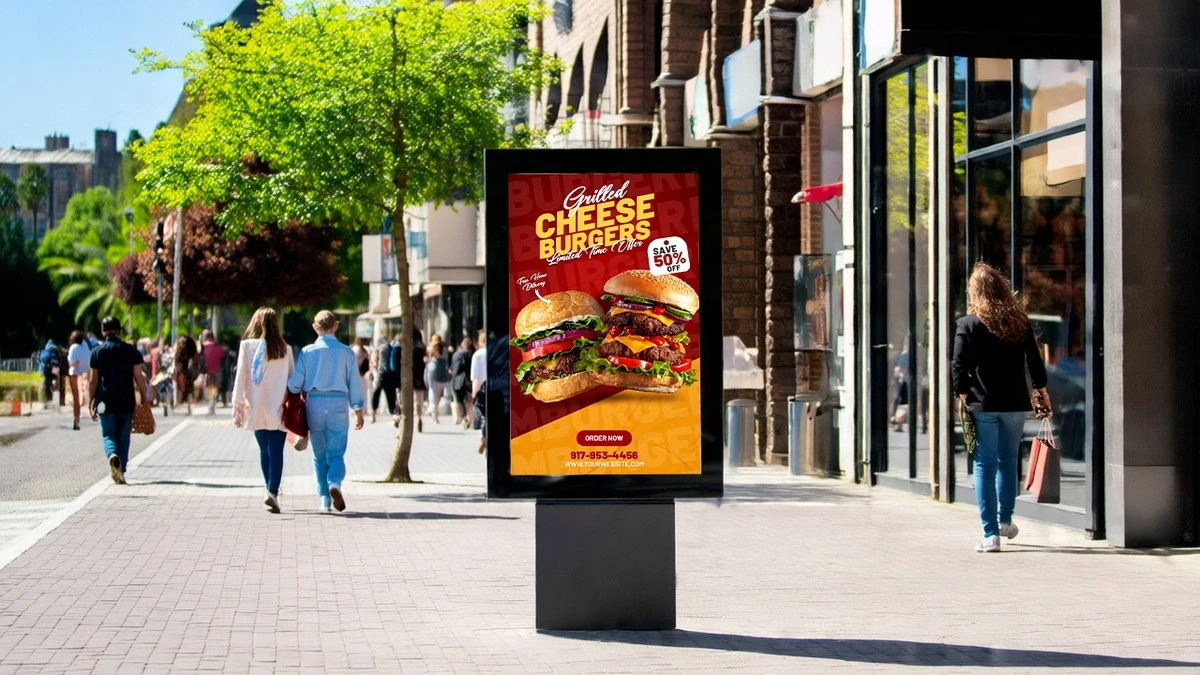
Question 4: What's the total budget — including 5-year operating cost?
Upfront cost favors LCD for small installations. Operating cost favors LED for large ones.
Typical 5-year TCO for a 65-inch outdoor installation:
| Cost Component | High-Brightness LCD (3,000 nits) | LED Wall (6 mm pitch, equivalent area) |
|---|---|---|
| Hardware | $5,000–8,000 | $12,000–18,000 |
| Installation | $1,500–3,000 | $3,000–5,000 |
| 5-year electricity (24/7) | $2,500–4,000 | $1,200–2,000 |
| Maintenance reserve | $1,500–3,000 (panel replacement at year 4–5) | $800–1,500 (module replacement) |
| 5-year total | $10,500–18,000 | $17,000–26,500 |
LCD wins on total cost for this size.
Typical 5-year TCO for a 200-inch outdoor installation:
| Cost Component | LCD Video Wall (tiled) | LED Wall (4 mm pitch) |
|---|---|---|
| Hardware | $25,000–40,000 | $18,000–28,000 |
| Installation | $5,000–8,000 | $4,000–7,000 |
| 5-year electricity (24/7) | $8,000–12,000 | $4,000–6,000 |
| Maintenance reserve | $5,000–8,000 | $2,000–4,000 |
| 5-year total | $43,000–68,000 | $28,000–45,000 |
LED wins decisively at this scale.
The Hidden Costs Nobody Compares
Both technologies have costs that don't appear on the quote:
LCD hidden costs:
Bezel grid: visible in tiled installations, breaks image continuity
Thermal management: active cooling fans add cost, complexity, and a failure point
Panel replacement: if one LCD tile fails, you replace the whole panel — not a module
Brightness uniformity drift: LCD backlights age unevenly. After 2 years, one corner may be 20% dimmer than the other
LED hidden costs:
Pixel pitch limits close-up detail: text must be larger, UI must be simpler
Controller complexity: each LED tile needs a controller. More tiles = more controllers
Power distribution: more separate power runs, more circuit planning
Calibration: LED walls need per-module brightness calibration to avoid visible seams
The Quick Decision Matrix
| If your project is... | Choose | Why |
|---|---|---|
| Drive-thru menu board, 32–55" | LCD | Close viewing, fine text, lower cost |
| EV charger interface, 10–21" | LCD | Close viewing, integrated touch, compact |
| Transit kiosk, 32–55" | LCD | Close viewing, rugged, proven in transit |
| Retail storefront window, 55–85" | LCD | Close-to-medium viewing, good brightness |
| Street-level billboard, 150"+ | LED | Distance viewing, extreme brightness, energy efficient |
| Stadium perimeter, 200"+ | LED | Distance, extreme brightness, seamless |
| Building facade, 100–300"+ | LED | Distance, custom shapes, weatherproof modules |
| Gas station canopy, 55–100" | Either | Depends on viewing distance and canopy shade |
The Bottom Line
LCD and LED are not competitors. They're tools for different jobs.
LCD is the right tool when viewers stand close, read fine detail, and the screen is under ~100 inches. It's cheaper upfront for small installations and delivers superior pixel density.
LED is the right tool when viewers stand far, the screen is large, or the environment demands extreme brightness. It scales to any size, uses less power per square meter, and lasts longer.
The integrator who tells you one is always better hasn't done the math for your specific project.
RisingStar manufactures high-brightness LCDs from 7" to 110" at 500–5,000 nits, and partners with certified LED integrators for large-format outdoor LED wall projects. We'll help you choose the right technology for your deployment — not just the one we manufacture.
📧 ai@risinglcd.com · 💬 +86 158 8946 9208 · 🌐 www.risinglcd.com

