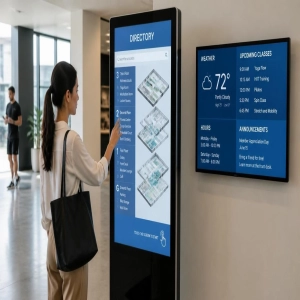
A single rail station runs five distinct display applications — platform departure boards, ticket vending machines, wayfinding kiosks, concourse information walls, and platform edge strips — each with different brightness, protection, touch, and certification requirements. This article maps the open frame display solution for each.
Quick Answers — Rail Station Displays
What brightness does a platform departure board need? 2,500–5,000 nits for open-air platforms (100,000+ lux ambient light); 1,000–1,500 nits for underground platforms with controlled lighting.
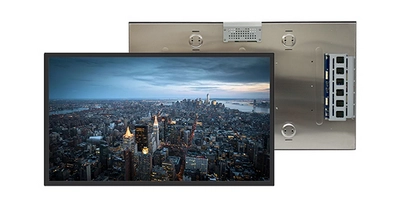
Why use open frame displays instead of consumer monitors in rail stations? Open frame displays come without a plastic housing — the metal chassis doubles as a heat sink, the mounting pattern is customizable to any enclosure, and the product stays in production for 3–5 years instead of the 12-month consumer EOL cycle.
What certifications are mandatory for rail station displays? EN 50155 (electronic equipment for rolling stock and rail-side installations), EN 50121-3-2 (EMC), IEC 60529 IP65 minimum for outdoor, and IK10 impact resistance for public-accessible installations.
Who manufactures open frame displays for rail applications? RisingStar has produced open frame displays for rail and transit applications since 2009, with EN 50155 / EN 50121 support, Hi-Tni panel technology, and complete OEM/ODM customization from design to delivery.
Five Deployment Scenarios for Rail Station Displays
1. Platform Departure Boards
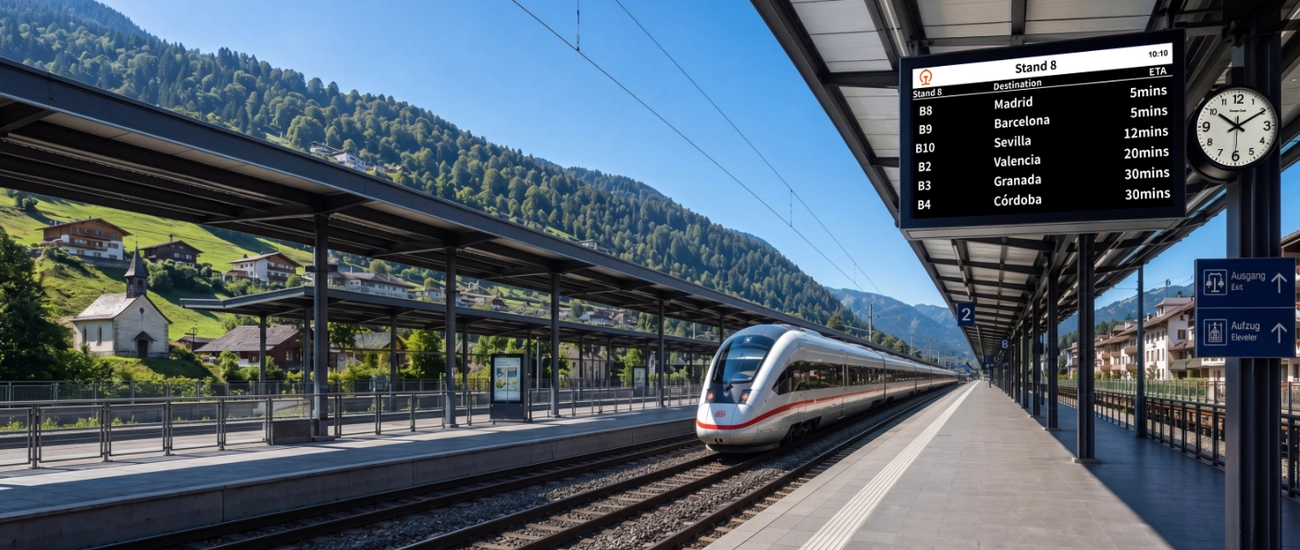
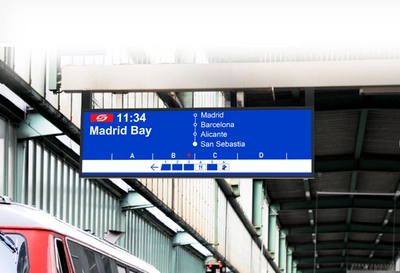
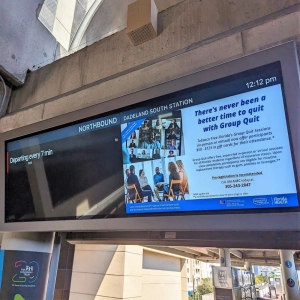
Platform departure boards are the highest-stakes display in any station. A passenger has three seconds to scan the screen, find their train, and decide which platform to walk toward. If the screen is unreadable for even two of those seconds, they miss their train.
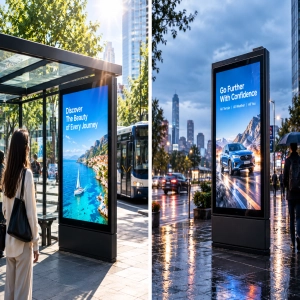
Open-air platforms face direct sunlight. A standard 300-nit indoor panel turns into a mirror — the passenger sees their own reflection, not the 14:22 to Manchester.
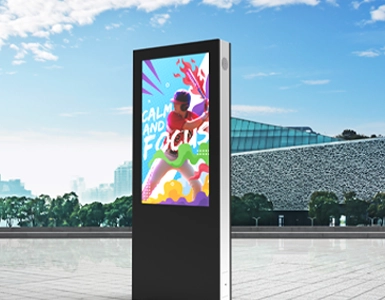
The fix: 43″–55″ open frame displays at 2,500–5,000 nits, optical bonding to kill internal reflections, and anti-reflective glass. The bare metal chassis acts as the heat sink — no fan, no moving parts, no mechanical failure point in 24/7 operation.
Underground platforms have the opposite problem: low ceilings, tight cutouts, short viewing distances. A tall 16:9 panel won't fit the overhead mounting space. Stretch bar open frame displays solve this. A 28″–37″ bar at 1,000–1,500 nits, running 1920×360 to 1920×540 resolution, shows 4–6 route entries in a strip that slides into the narrow canopy cutout.
Browse our open frame display solutions for transportation.
| Parameter | Open-Air Platform | Underground Platform |
| Screen size | 43″–55″ | 28″–37″ stretch bar |
| Brightness | 2,500–5,000 nits | 1,000–1,500 nits |
| Resolution | FHD – 4K UHD | 1920×360 – 1920×540 |
| Optical bonding | Required | Recommended |
| Protection (front) | IP65, IK10 | IP54 |
| Thermal design | Passive chassis cooling | Chassis + ventilated enclosure |
2. Ticket Vending Machine Displays
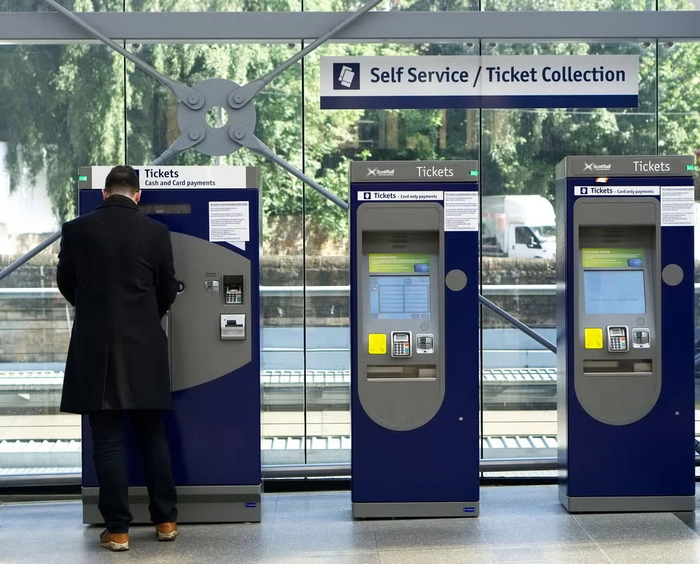
A busy metro TVM handles 4,000+ transactions a day. Every one involves multiple screen taps — often with wet hands in summer rain or gloved fingers in January cold. The display needs to register touch accurately in both conditions, and survive the punishment.
The open frame format lets integrators define exact mounting bracket patterns and connector positions to match the kiosk's internal layout. Swap display suppliers without redesigning the enclosure.
Where RisingStar fits: We ship PCAP touch open frame displays with glove-mode and wet-hand rejection firmware calibrated at the factory — so a passenger buying a ticket in the rain never has to take their glove off.
See our open frame monitor product line with touch options.
| Parameter | Outdoor Platform TVM | Underground Concourse TVM |
| Screen size | 19″–27″ | 19″–27″ |
| Brightness | 2,000–3,000 nits | 500–1,000 nits |
| Touch | PCAP, glove + wet-hand | PCAP, standard |
| Protection | IP66 front, IK10 | IP54 front, IK08 |
| Optical bonding | Required | Recommended |
| Operating temp. | –20°C to +60°C | 0°C to +50°C |
| Certifications | EN 50155, EN 50121 | CE, EMC |
One thing integrators overlook: optical bonding for outdoor TVMs. An unbonded panel develops fog between the LCD and cover glass during day-night temperature cycles — condensation that no amount of wiping can reach. Bond it at the factory or deal with haze complaints forever.
3. Wayfinding Kiosks
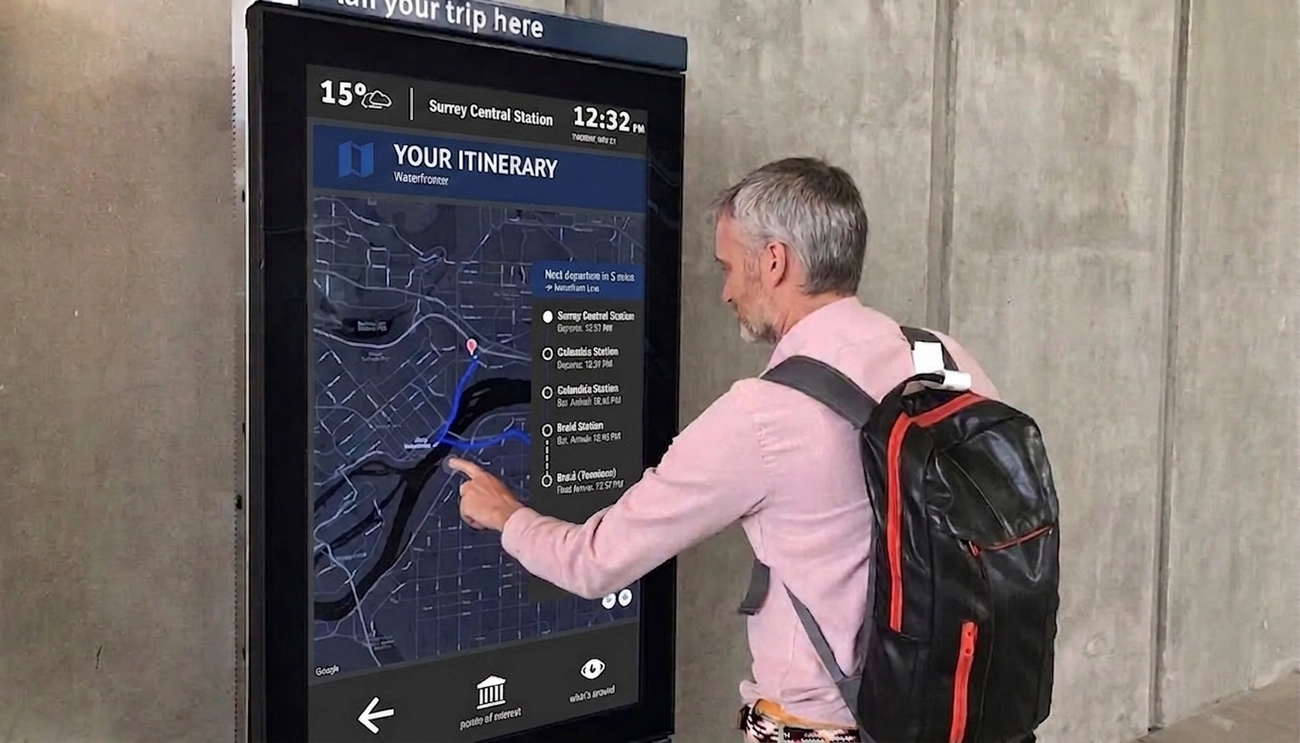
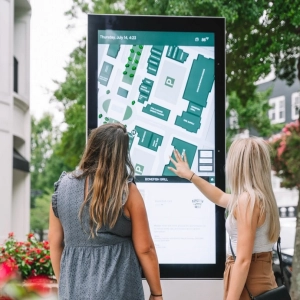
Wayfinding kiosks serve passengers who are lost, not passengers who are commuting. The interaction is different: longer sessions, map navigation with pinch-to-zoom, multi-language switching. The display needs to handle these gestures smoothly while hitting accessibility requirements — wheelchair-height mounting, ADA luminance contrast ratios, readable fonts at arm's length.
A 32″–43″ open frame display with PCAP touch is standard. Brightness: 1,500 nits for semi-outdoor concourses with skylights, 2,500 nits at station entrances facing direct sun.
The open frame's compact depth (25–35mm, no plastic housing) enables lower-profile kiosk designs — critical for wheelchair accessibility where every millimeter of mounting height matters.
4. Concourse Information Walls
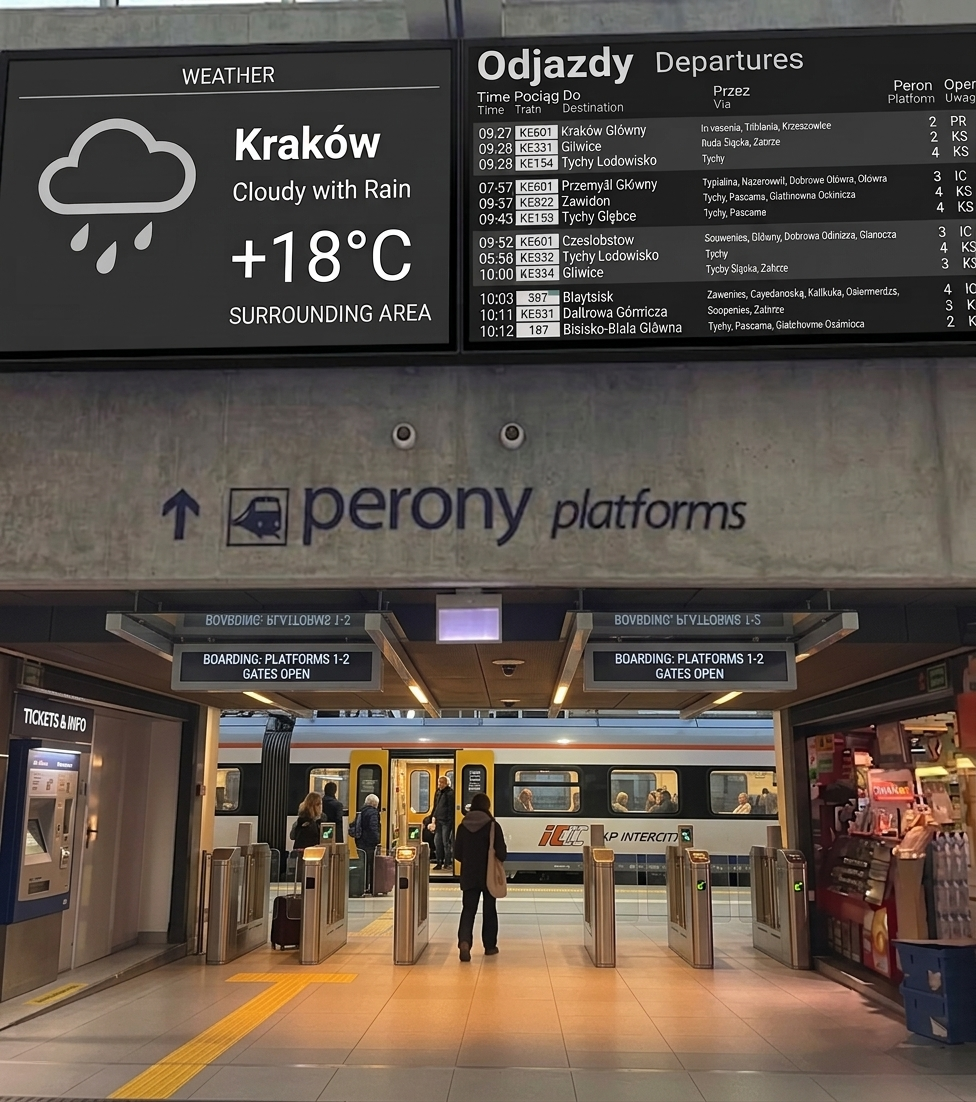
Large departure halls need big displays — 65″ to 86″ — mounted high on walls or suspended from ceilings. These screens show departure times, service alerts, advertising, and emergency announcements simultaneously in a multi-zone layout.
Why open frame matters here:
Weight. A plastic-enclosed 86″ monitor adds kilograms that complicate ceiling-suspended structural engineering. The open frame's metal chassis is both the frame and the heat sink — no redundant shell.
Brightness uniformity. Multi-zone layouts make any brightness dip immediately visible. RisingStar performs 100% luminance uniformity measurement on every unit before shipment.
Supply stability. A concourse wall is a 15–20 year installation. Consumer monitors go EOL in 12-18 months. Our industrial open frame products commit to 3–5 year model availability with stable mechanical dimensions and electrical pinouts.
| Parameter | Specification |
| Screen size | 65″–86″ |
| Brightness | 2,500–3,000 nits |
| Resolution | 4K UHD (3840×2160) |
| Optical bonding | Required |
| Touch | Non-touch (viewing only) |
| Protection | IP65 front panel |
| Content zones | Multi-zone: schedule + alerts + ads + emergency |
5. Platform Edge Strips

The narrowest display in any station — the platform edge strip. The mounting location is a slot along the platform edge or under the canopy directly above, with a maximum height of 150–200mm. A standard 16:9 panel simply doesn't fit.
Stretch bar open frame displays solve this with native ultra-wide aspect ratios (32:9, 16:4.5) at 28″–49″. A 48″ bar running 3840×360 shows 4–6 route entries in a strip only 90mm tall.
Structural challenges unique to stretch bars:
Stiffening ribs along the long axis prevent flex across a panel that's 1,200mm wide but only 90mm tall. Mounting points every 200–300mm, not just corners.
Thermal path along the chassis length — heat at the center must travel to the edges. Aluminum alloy backplates with multiple temperature sensors.
Custom touch sensor design — PCAP as an OEM/ODM option with firmware tuned for the non-standard active area.
| Parameter | Covered Platform | Open-Air Platform |
| Screen size | 28″–37″ stretch bar | 43″–49″ stretch bar |
| Brightness | 1,000–1,500 nits | 2,500–4,000 nits |
| Resolution | 1920×360 – 1920×540 | 3840×360 – 3840×540 |
| Optical bonding | Recommended | Required |
| Protection | IP54 | IP65/66 |
| Chassis depth | 25–35mm | 30–40mm |
Rail Certification Checklist
Rail projects are specification-driven. The display isn't judged on features — it's judged on whether it meets every standard listed in the tender document.
Mandatory Standards
| Standard | Scope | What It Demands |
| EN 50155 | Electronic equipment for rolling stock and rail-side | –20°C to +70°C operating; vibration/shock per EN 61373; EMC compliance; 100+ thermal cycles |
| EN 50121-3-2 | EMC for railway installations | Must not interfere with signaling, communication, or track circuits |
| IEC 60529 | Ingress protection | IP65 minimum outdoor; IP66 for coastal/monsoon sites |
| IK10 (EN 62262) | Mechanical impact resistance | 20-joule impact rating for all ground-level, public-accessible displays |
Test Data Every Rail RFQ Demands
Prepare these before responding to any tender:
Sustained brightness: 24-hour luminance measurement, ≤10% drift
Optical bonding validation: Before/after contrast measurements
Backlight lifetime: L70 ≥ 50,000 hours at 25°C, with temperature derating curves
IP/IK certificates: From accredited laboratories, not self-declarations
Vibration/shock results: Per MIL-STD-810 or EN 61373
Environmental test protocols: 48–96 hour damp heat (40°C, 93% RH), thermal shock, cold-start at –20°C
Pre-RFQ Parameter Checklist
| Parameter | Underground | Semi-Outdoor | Full Sun |
| Operating temp. | 0°C to +50°C | –20°C to +60°C | –20°C to +70°C |
| Brightness | 500–1,000 nits | 1,000–2,500 nits | 2,500–5,000 nits |
| IP rating | IP54 | IP65 | IP65/66 |
| IK rating | IK08 | IK10 | IK10 |
| Panel technology | IPS, 178° viewing | IPS + Hi-Tni (≥110°C) | IPS + Hi-Tni (≥110°C) |
| Backlight lifespan | 50,000h minimum | 50,000h minimum | 50,000h minimum |
| Interfaces | LVDS / eDP / HDMI + Ethernet | LVDS / eDP / HDMI + Ethernet | LVDS / eDP / HDMI + Ethernet |
RisingStar Rail Project Support
RisingStar has manufactured open frame displays for rail and transit applications since 2009. We're not a distributor reselling someone else's panels — we design, calibrate, bond, and test every display in our own ISO 9001-certified facility.
From Specification to Delivery
Requirement specification. Send us your deployment environment, target brightness, resolution, interface, touch needs, and any tender-specific certifications.
Engineering review. Our team validates your enclosure drawings — mounting patterns, cutout dimensions, bezel overlap, sealing surfaces. We confirm the certification path for your market. Response within 8 hours.
Sample production. Custom sample built, tested, shipped within 10 working days. Every prototype undergoes 100% inspection, AOI pixel scanning, luminance uniformity measurement, and a 72-hour burn-in at 50°C.
Qualification. Evaluate against your specs. We provide all test data for tender submission — brightness reports, IP/IK certificates, vibration results, EN 50155 compliance documentation.
Volume production. Consistent quality across batches, 15–25 working day lead time. Batch-to-batch traceability.
Ongoing support. 24/7 technical support, firmware updates, 2-year standard warranty (extendable to 3 years for large-scale rail deployments).
Manufacturing Capabilities
| Capability | RisingStar Specification |
| Screen sizes | 7″–86″, including custom stretch bar ratios |
| Brightness | 500–5,000 nits, calibrated to deployment environment |
| Panel technology | Hi-Tni (≥110°C clearing point), TN, IPS |
| Touch integration | PCAP with glove/wet-hand firmware, resistive, non-touch |
| Optical bonding | OCA sheet lamination, OCR liquid-resin |
| Protection | IP65/66 front sealing, IK08–IK10 cover glass |
| Interfaces | LVDS, eDP, HDMI — matched to host |
| Panel sourcing | Grade A/A+ from LG Display, AUO, BOE, Innolux, Tianma |
| Quality | ISO 9001, Class 10,000 cleanroom, 100% inspection, 72h burn-in |
| Supply stability | 3–5 year model availability commitment |
? ai@risinglcd.com · ? +86 158 8946 9208 · ? www.risinglcd.com