
Outdoor displays don't fail randomly. They fail predictably — because the specification was written for an indoor panel and deployed in an outdoor environment. In our field-support records, 80% of failures in the 12–24 month window trace back to one of five engineering oversights. Each is preventable. Each is a specification mistake, not a manufacturing defect.
💡 Quick Answers — Why Outdoor Displays Fail
Why does my outdoor display go black in summer? Standard LCD panels have a liquid crystal clearing point of 85°C. In a sealed outdoor enclosure under direct sun, internal temperatures reach 90–120°C. The liquid crystals lose their molecular ordering and the panel goes uniformly black. This is permanent. The fix is Hi-Tni liquid crystals rated for 110°C.
Why does my outdoor display yellow after one year? Standard polarizers use iodine-dye bonds that break under UV exposure. Outdoor UV levels are 10× indoor levels. The fix is UV-resistant polarizers with UV-cut cover glass.
Why is my outdoor display dimmer after 18 months? LED backlights degrade when the junction temperature exceeds 85°C. In poorly ventilated enclosures, LED lifespan drops from 50,000 hours to 15,000 hours. The fix is thermal derating and ambient auto-dimming.
1. Thermal Blackening: The 85°C Trap
Standard LCD panels are rated for an 85°C clearing point — the temperature at which liquid crystals lose their ability to modulate light and the display goes black. In an outdoor enclosure under direct sun, internal temperatures routinely exceed this threshold.
| Deployment Scenario | Internal Enclosure Temperature | Standard LCD Clearing Point | Result |
|---|---|---|---|
| Shaded EV charger, moderate climate | 55–70°C | 85°C | Safe margin |
| Street-level kiosk, no cover | 85–100°C | 85°C | Blackening in summer |
| Desert installation, direct sun | 100–120°C | 85°C | Immediate failure |
The failure is permanent. Once the clearing point is exceeded, the panel must be replaced. The cost of a truck roll, technician, and replacement panel is 3–5× the original purchase price.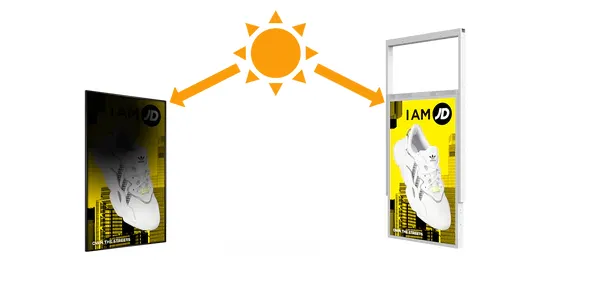
Prevention: Specify Hi-Tni (High-Temperature Nematic Isotropic) liquid crystals with a clearing point of 110°C. This creates a 20–30°C thermal margin above worst-case internal temperatures. Paired with an aluminum alloy 6061 chassis (thermal conductivity ~167 W/m·K) and thermal interface pads, the panel survives sustained solar loading without blackening.
For a high-brightness display deployed at an EV charging station or street-level kiosk, the specification is not "bright enough." The specification is "thermally safe enough." A 2,500-nit panel with standard liquid crystals will fail in summer. A 2,500-nit panel with Hi-Tni 110°C liquid crystals will not.
2. Seal Degradation: The Gasket Nobody Checks
Outdoor displays are sealed against water and dust using perimeter gaskets. The material matters.
| Gasket Material | UV Resistance | Freeze/Thaw Performance | Expected Seal Life |
|---|---|---|---|
| Polyurethane foam | Cracks in 6 months | Fails after 3–5 cycles | 6–12 months |
| Silicone foam | Yellows, hardens | Marginal after 10 cycles | 12–18 months |
| EPDM rubber | 10+ year UV rating | Survives 100+ cycles | 5+ years |
Standard consumer displays use foam or adhesive-tape gaskets. These materials compress set permanently after 6–12 months of sustained pressure. After the first winter freeze/thaw cycle, they lose 40–60% of compression force. Water enters through the bezel gap. The failure is invisible from the front until the first heavy rain causes internal condensation or electrical short.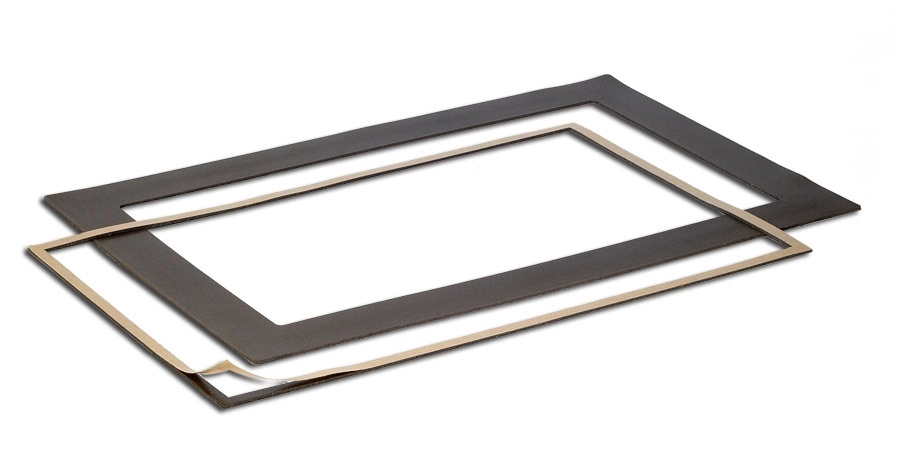
Prevention: Specify EPDM rubber gaskets and a CNC-machined aluminum chassis with flatness tolerance of ±0.1 mm. The gasket is only half the solution — the mounting surface must be flat enough to maintain uniform compression across the entire perimeter. Any warpage creates a leak path.
Every outdoor waterproof display is tested under full IEC 60529 conditions before shipment, with EPDM gaskets and precision-verified chassis flatness.
For a detailed breakdown of IP rating selection and seal design, see How to Choose the Right IP Rating for Your Outdoor Display.
3. Polarizer Yellowing: The UV Time Bomb
LCD panels use polarizing films made of polyvinyl alcohol (PVA) doped with iodine. UV radiation breaks these iodine-dye bonds. The result: white areas acquire a yellow/brown tint, the display appears dimmer, and color accuracy degrades.
Standard polarizers are rated for indoor UV exposure (<10 W/m²). Outdoor environments receive 50–100 W/m² of UV. The UV dose accumulates linearly: a panel receiving 8 hours of direct sun per day accumulates 3× the annual UV dose of an indoor panel in just one month.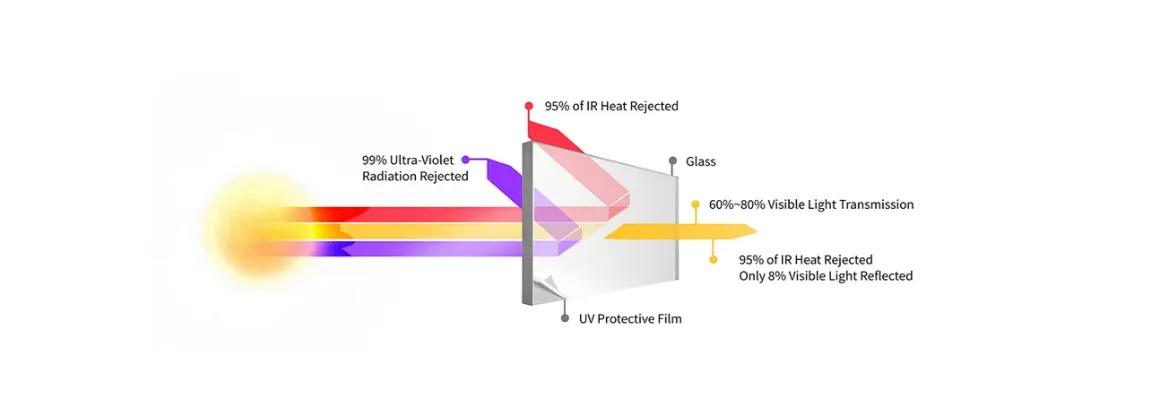
The degradation is invisible for 6–12 months, then visible at 12–18 months, and unacceptable at 18–24 months. The failure is often misdiagnosed as backlight degradation because the display appears dimmer. But replacing the backlight does not fix the polarizer. The correct repair is panel replacement.
Prevention: Specify UV-resistant polarizers with dichroic dye (instead of iodine). Add UV-cut cover glass that blocks 99% of UV-B before it reaches the polarizer. The combination extends polarizer life from 12 months to 5+ years in outdoor environments.
4. Backlight Degradation: The Dimming You Don't Notice
High-brightness LCDs use LED backlights to achieve 1,000–5,000 nits. LED output decreases over time due to thermal degradation and phosphor aging. The industry metric is L70 — the time at which the backlight reaches 70% of initial luminance.
| LED Junction Temperature | L70 Lifespan | Calendar Time (24/7) |
|---|---|---|
| 65°C (excellent cooling) | 50,000–70,000 hours | 5.7–8 years |
| 85°C (standard design) | 30,000–40,000 hours | 3.4–4.5 years |
| 105°C (poor enclosure) | 15,000–20,000 hours | 1.7–2.3 years |
The backlight dims uniformly. Because the human eye adapts to gradual brightness changes, the degradation is invisible for 12 months. At 18 months, the display is noticeably dimmer. At 24 months, it no longer meets the original specification. At 36 months, it is unusable in direct sunlight.
Prevention: Two engineering solutions:
Thermal derating: Aluminum PCB substrates with thermal vias conduct heat from the LED junction to the chassis, maintaining junction temperature below 85°C.
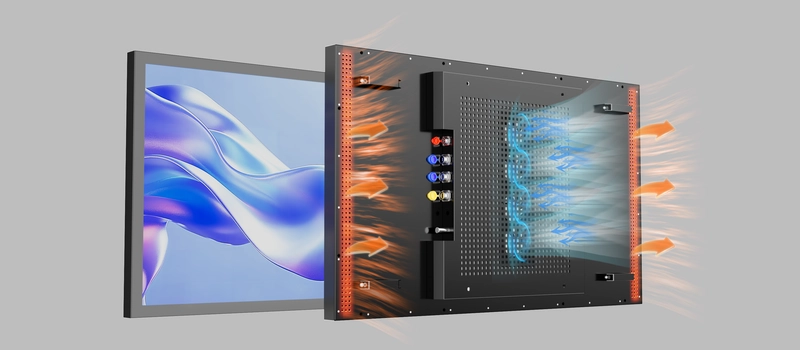
Ambient auto-dimming: A photosensor reduces backlight brightness at night (from 2,000 nits to 500 nits), reducing thermal load by 75% and extending effective lifespan by 30–50%.
5. Cold-Start Inversion: The Winter Surprise
Liquid crystal response time increases as temperature drops. At 0°C, response time is 20–30 ms. At −10°C, it is 50–100 ms. At −20°C, the liquid crystal viscosity is too high to switch within the frame time — the display shows image inversion, ghosting, or smearing.
This is not a permanent failure. The panel recovers when warmed. But for EV chargers, gas pumps, or transit kiosks in northern climates, the display is unusable for the first 10–30 minutes of operation on cold mornings. The failure is often reported as "the display is broken" because the user sees a garbled image.
Prevention: Specify panels with Aluminum PCB substrates with thermal vias and thermal interface pads for bidirectional thermal management. In cold environments, the same thermal path that conducts heat away in summer conducts backlight heat back into the liquid crystal layer, raising the panel temperature above the cold-start threshold without additional heating elements. For extreme cold climates, consult your supplier about the minimum operating temperature rating and whether additional enclosure heating is needed.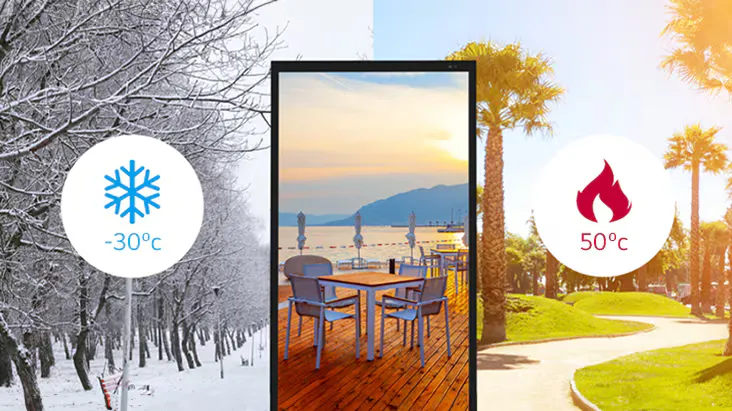
The Cost of Prevention vs. The Cost of Failure
| Prevention Spec | Cost Adder | Failure Cost (Panel + Install + Truck Roll) | ROI |
|---|---|---|---|
| Hi-Tni 110°C liquid crystals | +15% | 3× panel cost | 20:1 |
| EPDM gasket + CNC flatness | +5% | 3× panel cost | 60:1 |
| UV-resistant polarizer | +10% | 3× panel cost | 30:1 |
| Thermal derating + auto-dimming | +8% | 3× panel cost | 37:1 |
| Al PCB + thermal interface pads for cold-start | +5–10% | 3× panel cost | 30:1 |
For deployments with 50+ displays, a systematic specification upgrade prevents $100,000+ in replacement costs.
What to Request from Your Supplier Before You Order
Send this checklist. If your supplier cannot answer these five questions, the panel is not engineered for outdoor deployment:
What is the liquid crystal clearing point? (Must be ≥110°C for outdoor.)
What gasket material is used? (Must be EPDM with compression-set data.)
Is the polarizer UV-resistant? (Must have QUV aging test protocols or UV-stabilized rating.)
What is the LED L70 at 85°C junction temperature? (Must be ≥30,000 hours.)
What is the minimum operating temperature? (Must be ≤ your site's lowest ambient temperature.)
Manufactured in a 4,000 m² ISO 9001-certified facility with Class 10,000 cleanroom assembly, RisingStar produces outdoor LCD displays with full OEM/ODM customization capability. Every panel undergoes 100% factory inspection and 72-hour burn-in at 50°C to eliminate early-life failures before shipment.
Explore outdoor waterproof displays and high-brightness display solutions. For related reading, see our sunlight readable LCD technology guide and IP rating selection guide.

