Outdoor displays don't fail because the technology is wrong. They fail because the specification doesn't match the environment.
If you're specifying a display for an EV charger, gas pump, or outdoor self-service kiosk, you've already narrowed the field to one technology. High-brightness LCD is the standard platform for close-viewing outdoor applications — not because it's the only option, but because it's the only one that simultaneously delivers the brightness, pixel density, environmental protection, and cost structure these deployments require. (The industry terminology confusion — "LED monitor" vs. "LED wall" vs. "OLED" — is well-documented elsewhere. This guide focuses on why LCD dominates, and how to specify it correctly.)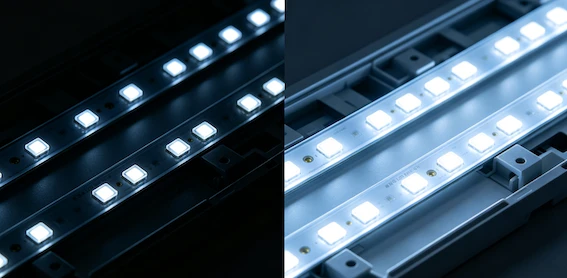
💡 Quick Answers — Specifying Outdoor LCD Displays
Why isn't OLED used for outdoor kiosks? OLED's organic emissive materials have a sustained full-screen brightness ceiling of ~800–1,000 nits, below the 1,500+ nits required for direct-sun readability. Organic compounds also degrade permanently under UV exposure and sustained high brightness, leading to visible burn-in within 5,000–15,000 hours.
Why doesn't direct-view LED work for kiosk displays? Direct-view LED requires pixel pitch of P1.25 or finer to render text legibly at 0.5–1 meter viewing distance. At that pitch, cost per square meter is 8–10× higher than an equivalent LCD, and pixel density still doesn't match LCD's 141–218 PPI for crisp UI elements.
What makes a sunlight readable LCD work outdoors? Three engineering layers: (1) a high-brightness LED backlight scaled to 1,000–5,000 nits, (2) a Hi-Tni liquid crystal layer with clearing point raised to 110°C to prevent thermal blackening, and (3) optical bonding (OCA) to eliminate internal reflections and boost perceived contrast by 50%+.
1. The Architecture That Scales to Sunlight
LCD is not a single technology. It's a platform architecture where the backlight, liquid crystal panel, and optical stack are engineered independently for the target environment.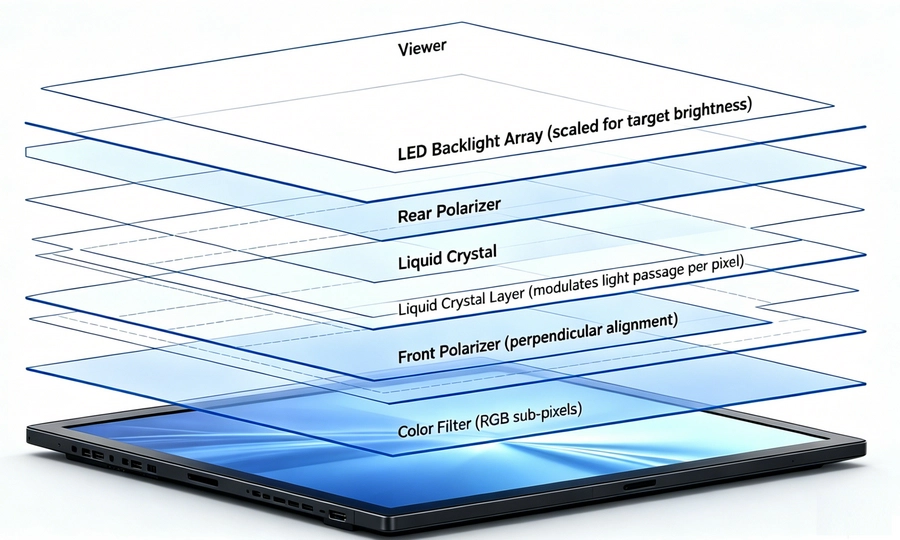
How the Image Is Formed
The liquid crystal is a light valve. It doesn't emit light. It controls how much of the backlight reaches the viewer. This is the fundamental advantage for outdoor deployment: the backlight power scales independently of the panel.
Need 1,500 nits for a shaded EV charger under a canopy? Standard LED backlight array. Need 3,000 nits for a street-level kiosk with no overhead cover? Increase the LED count, boost the drive current within thermal limits, and optimize the light guide plate for maximum extraction efficiency. The LCD panel itself — the light valve — doesn't change.
RisingStar manufactures sunlight readable LCD displays from 7" to 110" with backlight configurations ranging from 1,000 to 5,000 nits, matched to the deployment environment. The panel is the same. The optical stack is engineered for the specific thermal and ambient light load.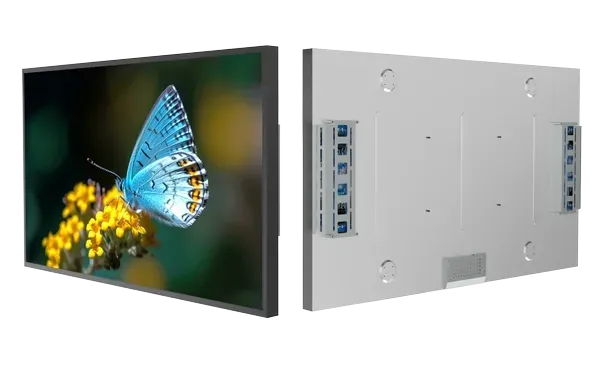
2. Thermal Management: Why Screens Go Black in the Sun
This is the most common failure mode in outdoor displays, and it's entirely preventable.
The Problem: Clearing Point Collapse
Liquid crystals are temperature-sensitive. At a specific temperature — the clearing point — the crystals lose their ordered molecular structure and can no longer modulate light. The display goes uniformly black. For standard LCD panels, this happens at 85–90°C. In a sealed outdoor enclosure under direct solar loading, internal temperatures routinely exceed this threshold.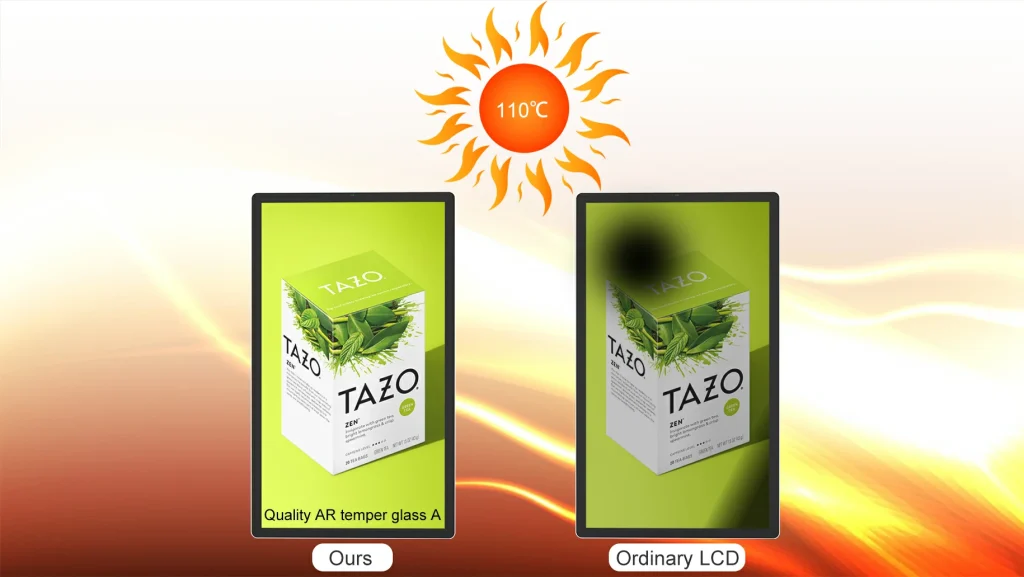
| Deployment Scenario | Typical Internal Temperature | Standard LCD Clearing Point | Result |
|---|---|---|---|
| Shaded EV charger (canopy) | 70–85°C | 85°C | Marginal; seasonal overheating in summer |
| Street-level kiosk, no cover | 90–110°C | 85°C | Immediate blackening in direct sun |
| Marine/Coastal, high ambient | 85–100°C | 85°C | Blackening within hours of direct exposure |
| Desert/military installation | 100–120°C | 85°C | Immediate failure; irreversible damage |
The Solution: Hi-Tni Liquid Crystals
Hi-Tni (High-Temperature Nematic Isotropic) formulations raise the clearing point to 110°C or higher. The liquid crystals maintain their molecular ordering and light-modulation capability at temperatures that would destroy standard panels.
RisingStar's outdoor-configured displays use Hi-Tni liquid crystals rated for 110°C clearing point, with thermal management via aluminum alloy 6061 chassis (thermal conductivity ~167 W/m·K), thermal interface pads, and passive heat dissipation paths designed to keep the panel below the operating threshold even under sustained solar loading.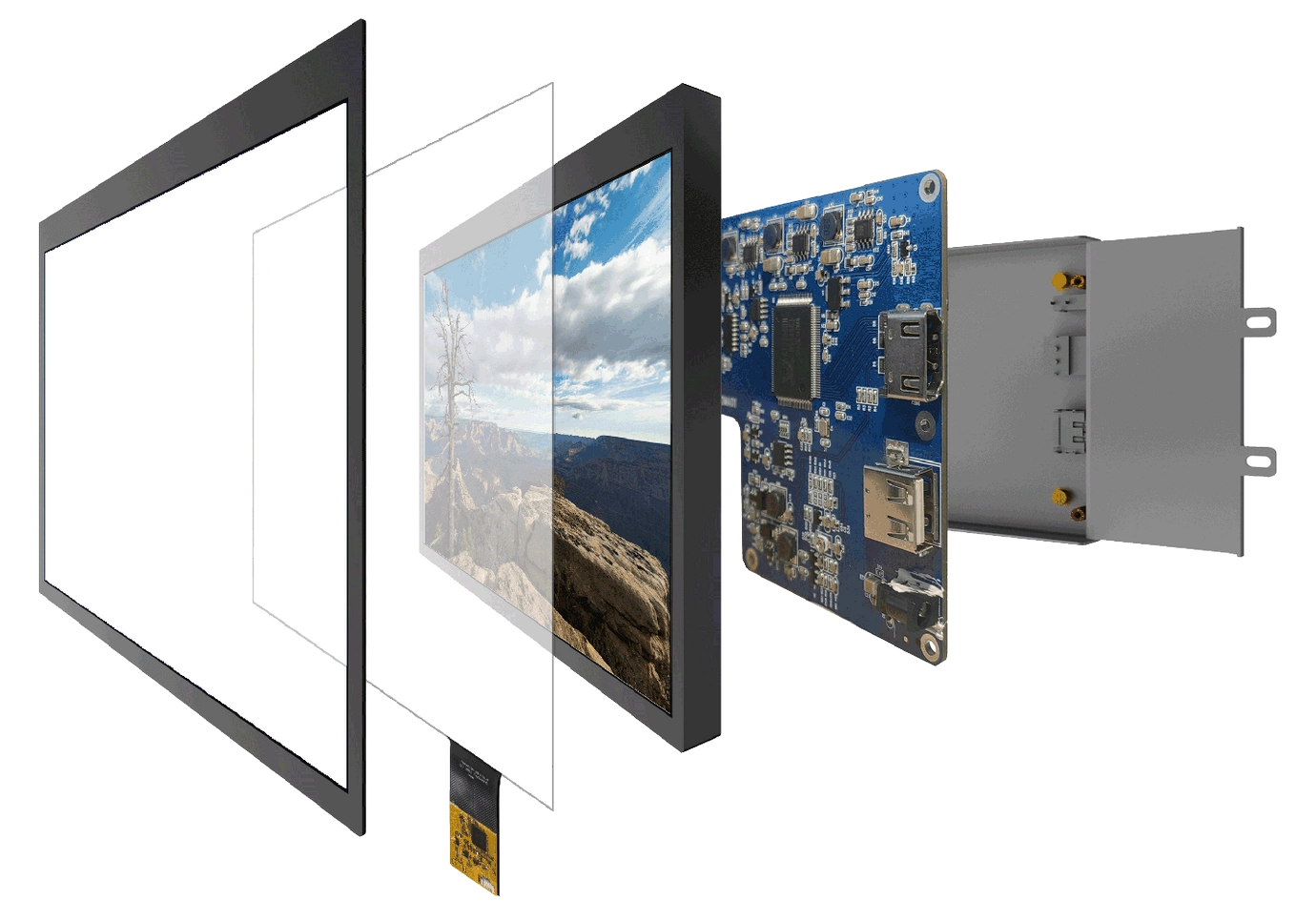
3. Optical Bonding: Eliminating the Air Gap
Standard LCD assemblies have an air gap between the cover glass and the LCD panel. In outdoor environments, this gap creates three problems:
Internal reflections: Light from the backlight reflects off the inner surface of the cover glass, reducing contrast and creating a "washed out" appearance.
Condensation: Temperature cycling causes moisture to condense in the gap, creating fogging that renders the display unreadable.
Parallax: The physical separation between the touch surface and the display plane causes touch registration errors, especially problematic for UI-driven kiosks.
Optical Bonding (OCA) Replaces the Air Gap with Optical-Grade Adhesive
A layer of optically clear adhesive (typically 0.5–1.0 mm) is laminated between the cover glass and the LCD panel. The refractive index of the adhesive (~1.47) closely matches both glass and the LCD's polarizer, eliminating internal reflections at the interface.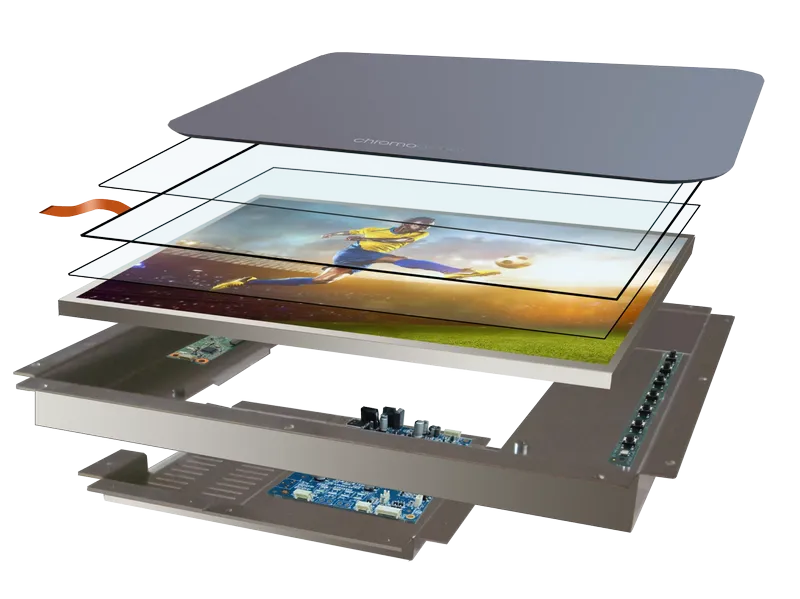
| Display Configuration | Internal Reflections | Perceived Contrast | Condensation Risk | Touch Accuracy |
|---|---|---|---|---|
| Standard (air gap) | 4–12% of backlight lost to internal reflections (varies by gap thickness and cover glass) | Baseline | High; temperature cycling causes fogging | Degraded by parallax |
| With optical bonding | <0.5% internal reflection loss | +50–80% vs. air gap | Eliminated; no cavity for moisture | Direct; touch plane coincides with image plane |
For outdoor deployments where readability depends on overcoming 100,000 lux of ambient sunlight, this contrast improvement is the difference between a readable display and a washed-out screen. RisingStar's outdoor displays include OCA optical bonding as standard on all sunlight readable configurations.
4. Brightness by Deployment: How Many Nits You Actually Need
Brightness is not a specification to maximize. It's an engineering parameter to match.
| Deployment Environment | Ambient Light Level | Recommended Display Brightness | Typical Configuration |
|---|---|---|---|
| Shaded EV charger (canopy) | 10,000–30,000 lux | 1,000–1,500 nits | Standard high-brightness with AR coating |
| Semi-outdoor kiosk (building entrance, overhang) | 30,000–60,000 lux | 1,500–2,500 nits | Optical bonding + AR coating + ambient light sensor |
| Street-level totem, no cover | 60,000–100,000 lux | 2,500–3,500 nits | Full optical stack + Hi-Tni 110°C + sealed enclosure |
| Direct equatorial sun, desert | 100,000+ lux | 3,500–5,000 nits | Maximum backlight configuration + active thermal management |
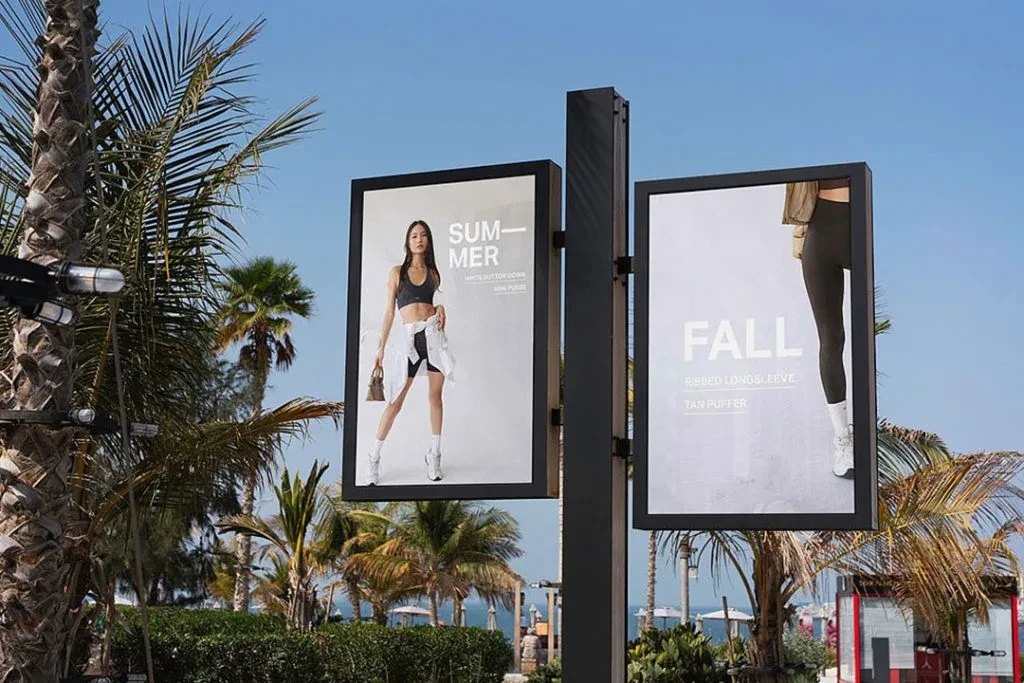
The 3× rule: Display brightness should be at least 3× the reflected ambient brightness reaching the viewer's eye. With AR coating (reflectivity reduced from 8% to <1%) and optical bonding, a 1,500-nit display can outperform a 2,500-nit display without optical treatment. The engineering of the optical stack matters as much as the raw brightness number.
For a 15.6-inch sunlight readable display deployed at an EV charging station, the specification depends on the canopy coverage. A unit under partial canopy (shaded from direct downpour but exposed to wind-blown spray) operates at 10,000–30,000 lux ambient. A 1,000–1,200-nit backlight with full optical bonding and AR coating provides sufficient contrast at 0.5–1 meter without the thermal load and cost of a 2,500-nit configuration. An open-air unit with no overhead cover faces 60,000–100,000 lux and requires 2,500–3,500 nits with Hi-Tni 110°C and sealed IP66 chassis. The specification is matched to the deployment, not maximized.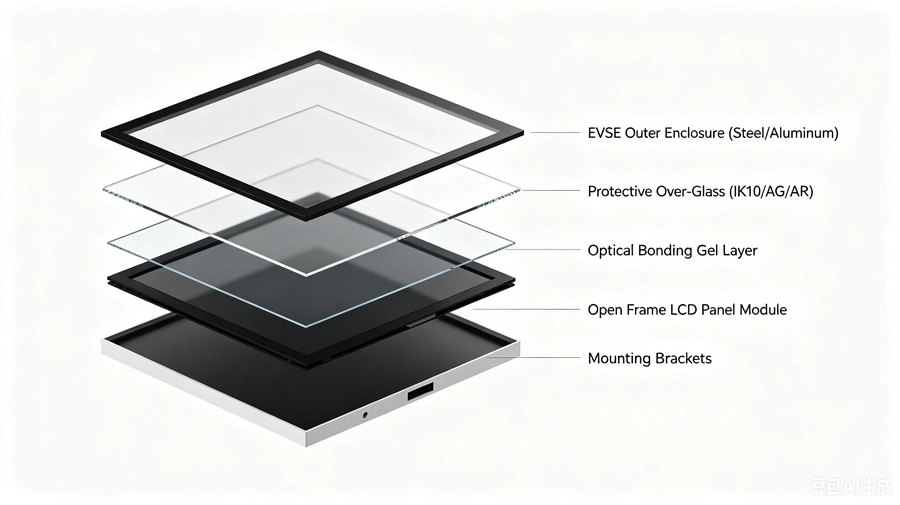
5. Environmental Sealing: IP65, IP66, and What They Actually Test
Outdoor displays face three environmental threats: water, dust, and thermal cycling. The IP rating defines the test conditions, but the test is only meaningful if the seal is engineered for the deployment's specific threat.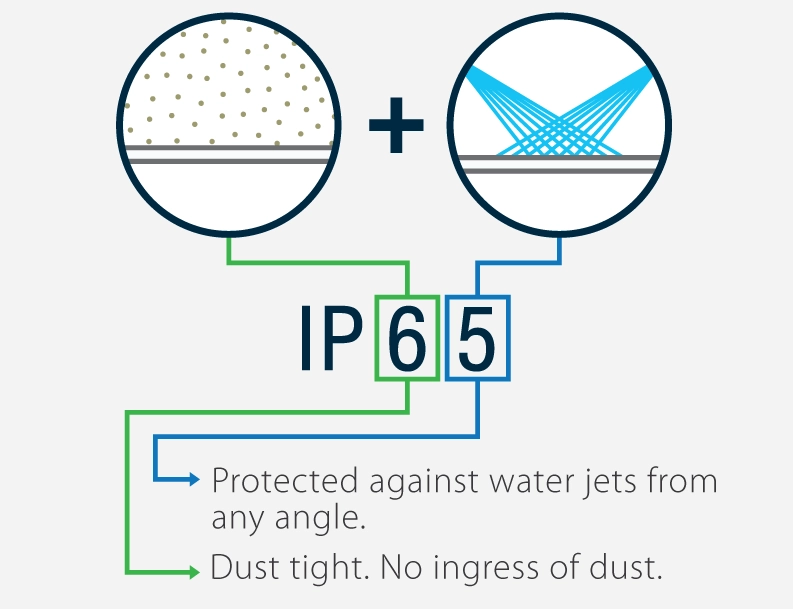
| IP Rating | What It Means | Test Conditions | Where It's Sufficient |
|---|---|---|---|
| IP65 | Dust-tight + water jets from any direction | 6.3mm nozzle, 12.5 L/min, 3 minutes | Gas stations under canopy, EV chargers with partial overhang, covered walkways |
| IP66 | Dust-tight + powerful water jets | 12.5mm nozzle, 100 L/min, 3 minutes | Street-level kiosks, open-air transit platforms, coastal installations, monsoon regions |
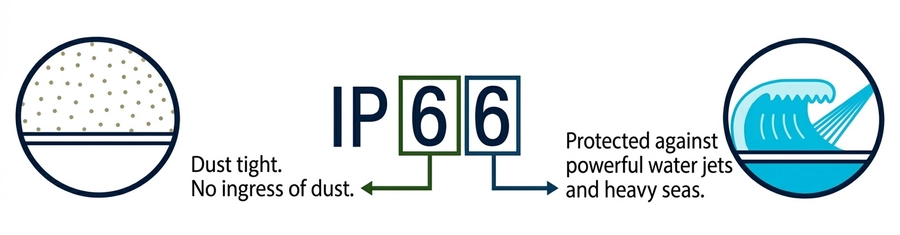
The critical component is the gasket seal. RisingStar uses EPDM gaskets (ethylene propylene diene monomer) rated for UV, ozone, and temperature extremes. Unlike generic foam seals that harden and crack after one thermal cycle, EPDM maintains compression across the mounting perimeter. The aluminum chassis is precision-machined with flatness verified to ensure uniform gasket compression — any warpage or uneven torque creates a gap where water enters.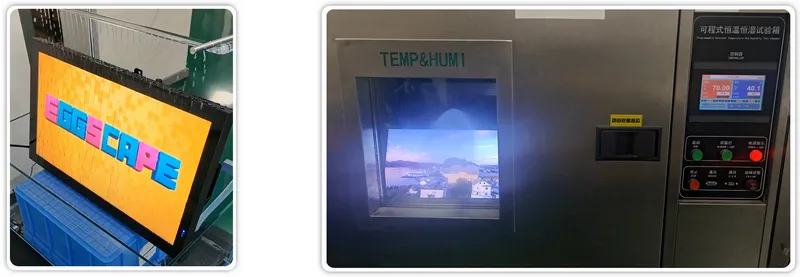
Every outdoor-configured display is tested under the full IEC 60529 test conditions before shipment, with zero water ingress.
For a detailed breakdown of how to select the right IP rating for your specific deployment environment, see How to Choose the Right IP Rating for Your Outdoor Display.
6. Pixel Density and Touch: Why Close-Viewing Demands LCD
Kiosk and EV charger displays are viewed at 0.5–1.5 meters. Users read text, navigate menus, and interact with touch UI elements. This distance imposes pixel density requirements that only LCD satisfies at practical cost.
| Display Size | Resolution | Pixel Density (PPI) | Text Legibility at 0.5m | Touch Parallax (with optical bonding) |
|---|---|---|---|---|
| 10.1" | 1280×800 | 149 PPI | Crisp | Zero (direct plane) |
| 12.1" | 1280×800 | 125 PPI | Crisp | Zero |
| 15.6" | 1920×1080 | 141 PPI | Crisp | Zero |
| 21.5" | 1920×1080 | 102 PPI | Readable | Zero |
| 32" | 1920×1080 | 69 PPI | Readable at 1m+ | Zero |
At 0.5–1 meter, the human eye can resolve individual pixels below ~120 PPI. LCD's pixel density in the 10–22 inch range is purpose-built for this interaction distance. Alternative technologies that rely on larger pixel structures — whether due to organic material patterning limitations or discrete LED packaging — cannot match this density at comparable cost and form factor.
RisingStar's outdoor displays include projected capacitive (PCAP) touch as standard, with optical bonding eliminating the parallax that degrades touch accuracy in air-gap assemblies. The touch layer is laminated directly to the cover glass, with the image plane directly behind it — no spatial offset, no registration error.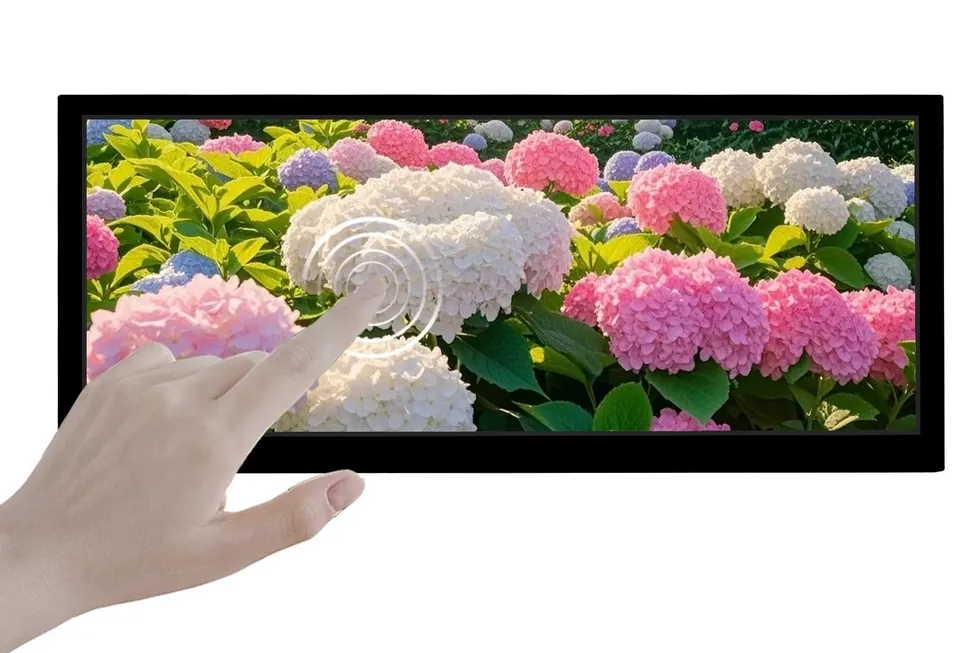
7. Lifespan and Total Cost of Ownership
Outdoor displays run 24/7. The degradation mechanism determines whether you plan maintenance or react to failure.
LCD's degradation is uniform and predictable: the LED backlight dims gradually over time. At 1,500 nits continuous operation, the backlight reaches 70% of initial brightness (L70) at approximately 30,000–40,000 hours. Because the degradation is uniform across the panel, there are no hot spots, ghost images, or localized failures. When the display eventually drops below usable brightness, the backlight module can be replaced without replacing the LCD panel — restoring the display to full performance.
| Parameter | LCD (High Brightness) | What It Means for Your Deployment |
|---|---|---|
| Degradation mode | Uniform backlight dimming | No visual artifacts; predictable replacement schedule |
| Practical lifespan at 1,500 nits | 30,000–40,000 hours | ~3.4–4.5 years at 24/7 operation |
| Maintenance | Backlight module replacement | Restores display to 100% brightness; panel re-used |
| Ambient light auto-dimming | Reduces nighttime brightness | Extends effective lifespan by 30–50% |
RisingStar's manufacturing process includes 100% factory inspection and 72-hour burn-in at 50°C to eliminate early-life failures before shipment. Every panel is verified for brightness uniformity, dead pixel count, and touch registration before leaving the facility.
8. Decision Checklist: Specifying Your Outdoor LCD Display
Before you finalize the specification, confirm these parameters against your deployment environment:
| Checklist Item | Your Environment | Recommended Specification |
|---|---|---|
| Maximum ambient light | __ lux | 1,000–1,500 nits (shaded) / 1,500–2,500 nits (semi-outdoor) / 2,500–5,000 nits (direct sun) |
| Overhead cover | Yes / No / Partial | IP65 (covered) / IP66 (exposed) |
| Maximum internal temperature | __ °C | Hi-Tni 110°C if >85°C expected |
| Viewing distance | __ meters | 10–15" for 0.5–1m / 15–22" for 1–1.5m / 32–55" for 2–4m |
| Touch required | Yes / No | PCAP with optical bonding (eliminates parallax) |
| Optical stack | Standard / Enhanced | OCA optical bonding + AR coating for outdoor; anti-glare for high-reflection environments |
| Operating hours | __ hours/day | 24/7 requires Hi-Tni + thermal management + auto-dimming |
Summary: Why LCD Is the Standard
High-brightness LCD dominates outdoor kiosk and EV charger applications because it is the only platform that simultaneously satisfies five requirements: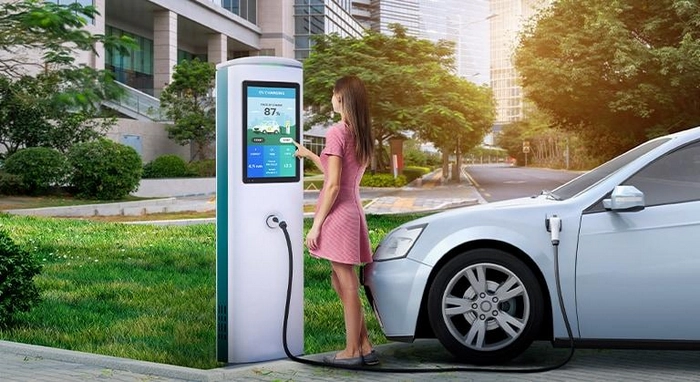
Brightness scalability: 1,000–5,000 nits by engineering the backlight independently of the panel
Thermal resilience: Hi-Tni liquid crystals (110°C clearing point) prevent sun-induced blackening
Contrast engineering: Optical bonding eliminates internal reflections and boosts perceived contrast by 50%+
Environmental sealing: IP65/IP66 with EPDM gaskets and CNC-machined aluminum chassis
Pixel density: 80–300+ PPI for crisp text and UI at arm's length, at moderate cost
For 90% of outdoor display deployments in the 10–55 inch range where users interact at close distance, there is no alternative that matches this combination of performance, durability, and cost structure.
Manufactured in a 4,000 m² ISO 9001-certified facility with Class 10,000 cleanroom assembly, RisingStar produces sunlight readable LCD displays with full OEM/ODM customization capability — from backlight brightness engineering to optical stack configuration to chassis mounting pattern design.
Explore configurations matched to your deployment environment: High Brightness Display Solutions · Outdoor Waterproof Displays · OEM/ODM Custom Engineering
📧 ai@risinglcd.com · 💬 +86 158 8946 9208 · 🌐 www.risinglcd.com