
A vending machine on a sunny train platform. An EV charger on an unshaded highway pull-off. A self-service ticketing kiosk in a glass-walled transit hall. The common thread: a 15.6-inch display that has to stay readable, responsive, and alive — no matter where it's installed.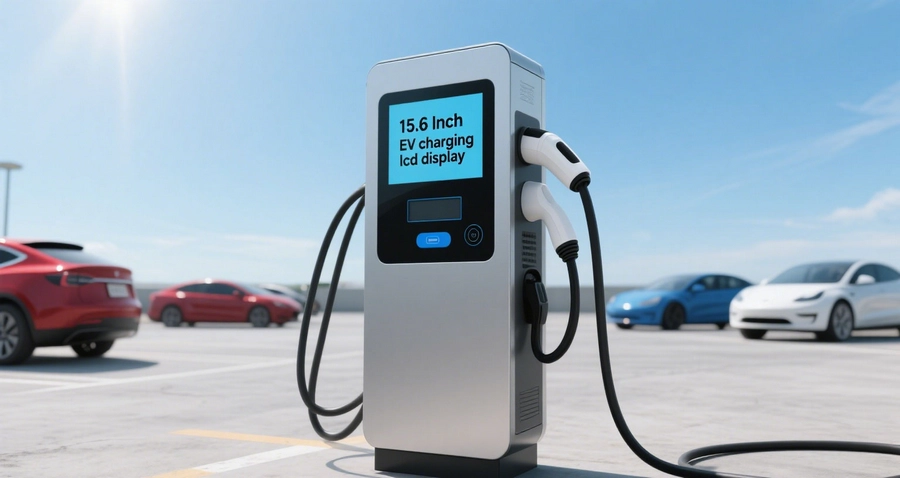
A 15.6 inch sunlight readable display isn't a commodity part. The right panel for a shaded bus shelter is the wrong panel for a desert charging station. This guide walks through how to match the right configuration to your deployment — without overpaying for brightness you don't need or under-specifying the thermal protection your environment demands.
Browse the full range: 15.6 Inch Sunlight Readable Display
**Quick Answers
A 15.6 inch high brightness display needs 1,000 nits minimum for partial-sun outdoor use and 1,500 nits for direct, unshaded sunlight. Brightness alone isn't enough — the panel must also use Hi-Tni liquid crystal to prevent thermal blackening.
The 15.6-inch form factor balances screen real estate (344×194 mm active area) with integration depth (~17 mm), fitting standard kiosk enclosures, EV charger pedestals, and industrial control cabinets.
Open frame architecture — the panel ships without a plastic housing, ready for direct integration into a custom enclosure — is the standard for OEM kiosk and HMI deployments. See RisingStar's 15.6 open frame monitor options for touch-integrated configurations.
Why 15.6 Inches?
At 344 × 194 mm of active area, a 15.6-inch display is large enough to show a full payment interface, route map, or machine diagnostic dashboard. At roughly 364 × 216 × 17 mm and about 1.25 kg, it's compact enough to fit inside standard kiosk enclosures and EV charging pedestals without dominating the internal volume.
The 15.6-inch panel size is also a high-volume consumer format, which means the LCD supply chain is deep and stable. Panel availability is predictable. Replacement modules are easy to stock. Nobody wants to design a product around a niche panel size that goes end-of-life in 18 months.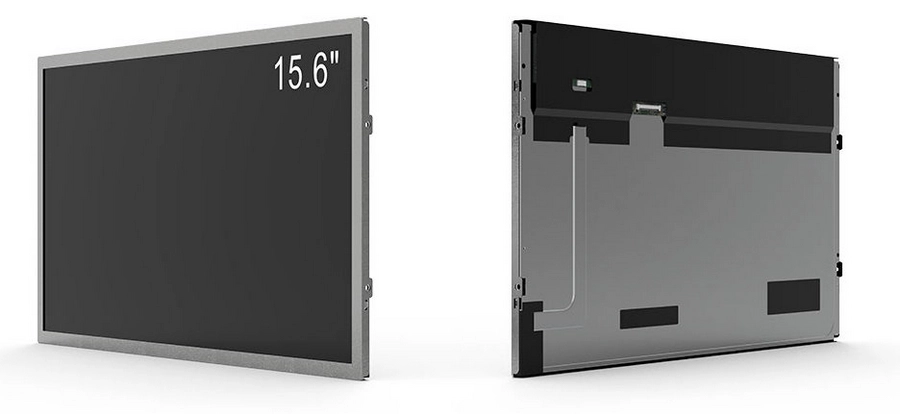
Brightness Selection: Match the Number to the Sun
| Brightness | What It Can Handle | Typical Application |
|---|---|---|
| 500 nits | Bright indoor, near windows | Indoor kiosk by a storefront, covered lobby info panel |
| 700–800 nits | Overcast outdoor, shaded areas | Covered bus stop, gas station under canopy |
| 1,000 nits | Partial sun, semi-outdoor | EV charger with partial shade, drive-thru menu |
| 1,500 nits | Direct midday sun, no shade | Exposed kiosk, desert installation, reflective surroundings |
Every panel in the 15.6-inch series uses WLED backlighting rated for 50,000 hours — roughly 5.7 years of continuous 24/7 operation to half-brightness. The surface finish is Anti-Glare (AG) matte with 3H hard coating as standard, scattering ambient reflections so the screen doesn't act like a mirror under sunlight.
For the mid-range workhorse configuration, the RS156ENT-NE10 delivers 500 nits in a cost-effective package for bright indoor and semi-outdoor use. When the deployment faces direct sun, the RS156XW-NE15 pushes to 1,500 nits with LVDS interface — readable at high noon with no shade.
Two Resolution Tracks: WXGA vs. FHD
RisingStar's 15.6-inch series splits into two families, and the choice comes down to what you're displaying and what you're plugging into.
WXGA (1366×768) — LVDS Interface
WXGA panels use TN LCD mode with LVDS 30-pin interface. Fast response time (8ms) means no motion blur on scrolling text or animated content. Viewing angles are 85/85/80/80° — fine for single-user applications like payment kiosks and vending machines, where one person faces the screen head-on. The LVDS interface is universal in embedded computing and connects directly to most industrial single-board computers without adapter boards.
FHD (1920×1080) — IPS, OEM/ODM Interface Options
FHD panels move to IPS LCD mode. IPS delivers 89° viewing angles in all four directions with true 8-bit color (16.7M colors) and 1000:1 contrast ratio — meaning someone standing to the side sees the same image quality as someone directly in front. Interface options include both LVDS and eDP, configurable per project as an OEM/ODM option.
For interactive touchscreen deployments, the RS156ENT-N10-OP open frame display with touch provides a fully integrated PCAP touch solution in the 15.6-inch format.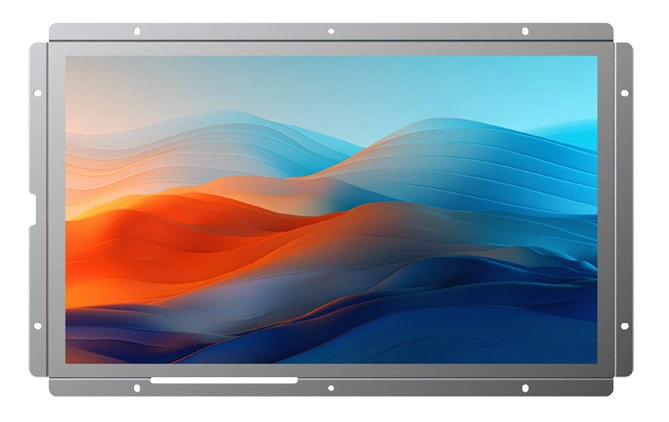
Hi-Tni: The Thermal Protection That Prevents Black Screens
Standard LCD panels use liquid crystal with a clearing point around 65–80°C — the temperature at which the ordered molecular structure collapses and the screen develops permanent black patches. In an outdoor enclosure under direct sun, a 1,000+ nit backlight combined with solar loading can push internal panel temperatures past this threshold within 30 minutes.
RisingStar's FHD series includes Hi-Tni (High Temperature Nematic) variants that raise the liquid crystal clearing point to ≥110°C, providing a 40–45°C safety margin over standard panels. The Hi-Tni variants operate reliably from -20°C to 70°C and can be stored from -30°C to 80°C. In a sealed outdoor enclosure under direct tropical sun, a Hi-Tni panel simply doesn't blacken.
For deployments that need the full thermal protection at higher brightness, the RS156ENT-N12 delivers 1,200 nits with Hi-Tni panel engineering, balancing luminance with thermal resilience for exposed outdoor sites.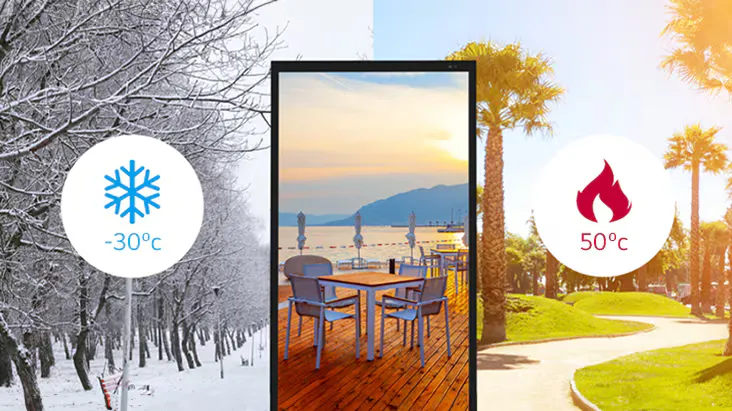
Quick Selection
| Application | Recommended Configuration | Panel Type | Brightness |
|---|---|---|---|
| Indoor kiosk / lobby | WXGA TN, LVDS | Standard | 500–700 nits |
| Semi-outdoor, shaded | WXGA TN, LVDS | Standard | 800–1,000 nits |
| Outdoor EV charger | FHD IPS, LVDS or eDP | Hi-Tni | 1,000–1,200 nits |
| Direct sun, exposed | WXGA or FHD | Hi-Tni | 1,500 nits |
Integration Checklist
Before finalizing a 15.6-inch outdoor display specification:
Interface match. WXGA uses LVDS 30-pin. FHD supports both LVDS and eDP — configurable as an OEM/ODM option. Verify your host board's output before selection.
Power budget. A 1,500-nit panel draws more backlight power than a 500-nit panel. Verify your PSU has adequate headroom.
Touch integration. The bare LCD modules ship without touch. PCAP touch overlays are available with glove-compatible and wet-hand rejection firmware tuning.
Enclosure sealing. The panel itself carries no IP rating. IP65 or better protection is achieved by sealing the module into the host enclosure with a continuous gasket and proper mounting torque.
Optical bonding. If the display faces temperature swings or sits behind protective glass, optical bonding eliminates the internal air gap where condensation forms and cuts surface reflection by up to 90%.
FAQ
Q: What brightness does a 15.6 inch sunlight readable display need?
1,000 nits minimum for partial-sun outdoor use. 1,500 nits for direct, unshaded sunlight — desert installations, tropical deployments, or south-facing exposures. 500–800 nits is sufficient for semi-outdoor and shaded installations.
Q: Should I choose WXGA or FHD?
WXGA (1366×768) with LVDS interface for cost-sensitive deployments where the display shows text, icons, and simple graphics — payment kiosks, bus stop boards, vending machines. FHD (1920×1080) with eDP interface for public-facing displays where image quality and off-angle viewing matter — EV charger touchscreens, retail kiosks, premium digital signage.
Q: What interfaces do 15.6-inch panels use?
WXGA panels use LVDS 30-pin. FHD panels use eDP 30-pin. LVDS is the mature industrial standard with broad embedded board compatibility. eDP is the modern standard on newer ARM and x86 single-board computers. Match the panel interface to your host board's output natively.
Q: Can I use the bare LCD module outdoors without an enclosure?
No. The bare LCD module is not waterproof and carries no IP rating on its own. The panel must be sealed into a host enclosure with a continuous gasket, proper mounting torque, and adequate thermal conduction to achieve IP65 or better protection.
Manufacturing & Support
RisingStar manufactures every 15.6-inch module in a 4,000 m² ISO 9001-certified facility in Shenzhen with Class 10,000 cleanroom assembly. Grade A/A+ panels are sourced directly from LG Display, AUO, BOE, Innolux, and Tianma — with 3–5 year supply commitments so your product line doesn't get blindsided by a discontinued panel.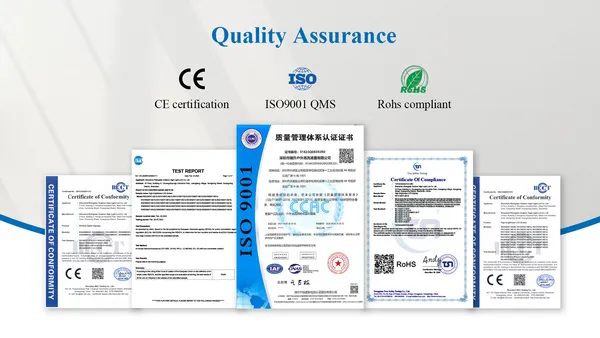
Every unit undergoes 100% factory inspection and a 72-hour burn-in test before shipping. Samples ship in 10 working days. Engineering response within 8 hours.
📧 ai@risinglcd.com · 💬 +86 158 8946 9208 · 🌐 www.risinglcd.com

