
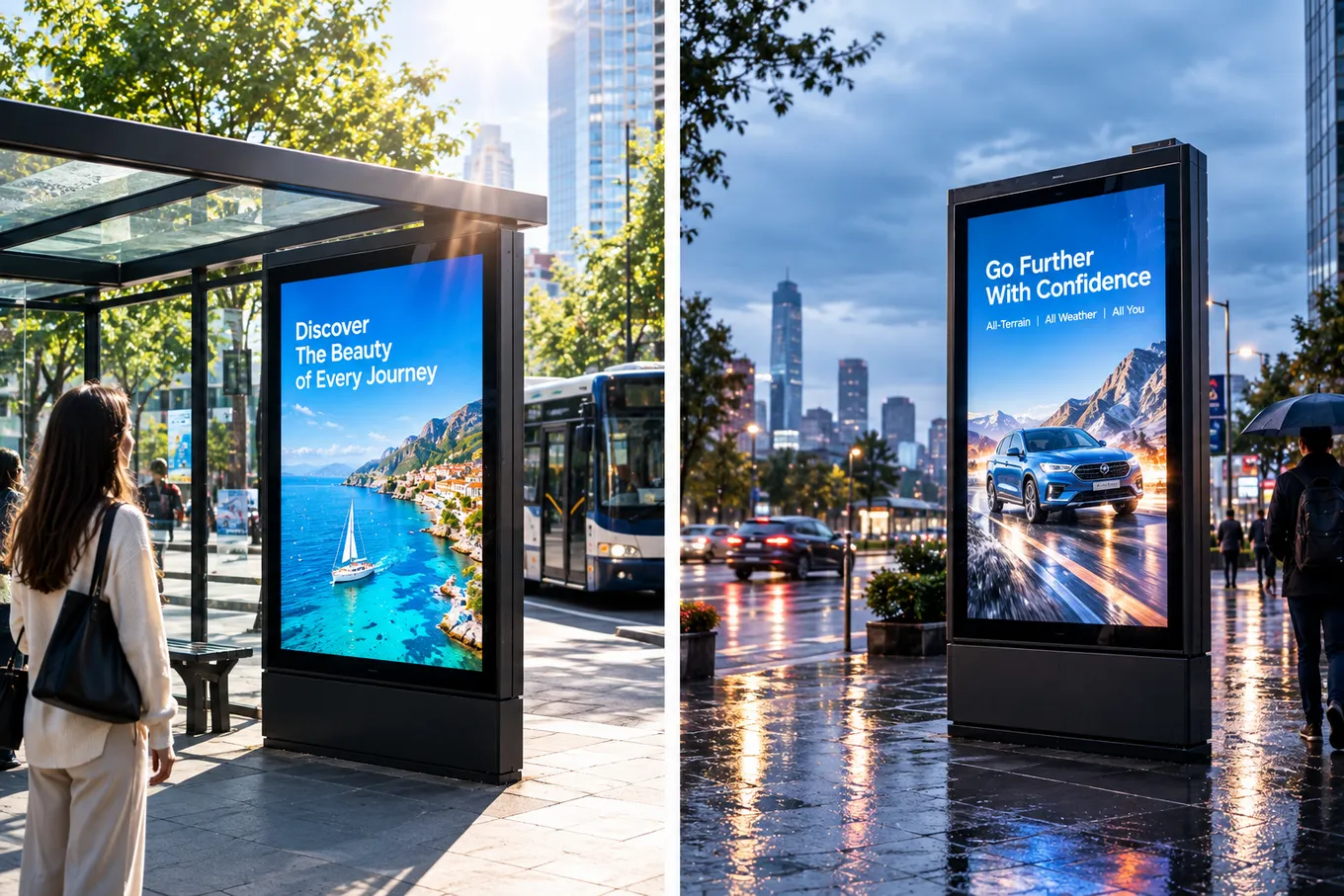
At 11 a.m. on a clear summer day, direct sunlight strikes a screen at roughly 60,000 to 100,000 lux. A standard indoor LCD running at 500 nits is effectively invisible against that background — the image is there, but the human eye cannot distinguish it from the glare. This is the core engineering problem of outdoor DOOH, and why "high-brightness outdoor LCD" is a distinct product discipline, not a marketing label.
What "High Brightness" Means in Engineering Terms
Brightness in outdoor displays is measured in nits (candela per square meter). A consumer TV runs 300–500 nits. A good indoor commercial display runs 700–1,000 nits. A sunlight-readable outdoor LCD starts around 1,500 nits, reaching 4,000–5,000 nits for full-sun positions.
The nits number is only meaningful relative to the light hitting the screen. The practical selection tiers are:
| Sun exposure of the screen | Ambient light at worst hour | Required LCD brightness |
|---|---|---|
| Shaded, under canopy/roof | 5,000–15,000 lux | 1,000–1,500 nits |
| Semi-outdoor, sheltered | 15,000–30,000 lux | 1,500–2,500 nits |
| Direct sun part of day | 30,000–60,000 lux | 2,500–4,000 nits |
| Full sun, no shade possible | 60,000–100,000 lux | 4,000–5,000 nits |
A common buyer mistake is assuming the tier can be picked once and left. A south-facing screen on a plaza at 40° latitude sees completely different sun loading from a north-facing screen under a building overhang on the same street. Specify for the worst hour of the worst season, then let auto-dimming step the backlight down at night. The same screen that needs 4,000 nits at noon should run 400–600 nits after dark to save power and avoid blinding pedestrians.
Brightness Is Only Half the Spec
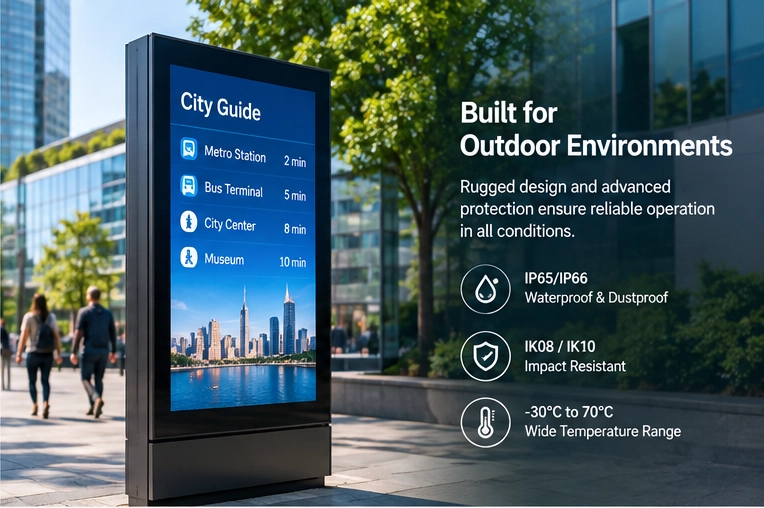
Two screens both rated at 2,500 nits can perform very differently in the same outdoor location. What matters is the light that reaches the viewer's eye after passing through the glass stack. Three optical engineering decisions determine real-world readability:
1. Optical bonding. An outdoor LCD normally has an air gap between the panel and its protective cover glass. That gap reflects light internally — in direct sun, internal reflection can cut effective contrast by more than half. Optical bonding fills the gap with an optically clear adhesive, eliminating the internal reflection layer. The result: the same 2,500-nit panel reads dramatically better in sunlight, while gaining structural strength and condensation resistance as a byproduct. For outdoor DOOH, bonding is not an upgrade; it is the baseline.
2. Anti-reflective and anti-glare treatment. The outer surface needs an AR (anti-reflection) coating to cut specular reflection, and usually an AG (anti-glare) layer to diffuse it. An untreated glass cover turns a high-nit screen into a mirror in bright conditions. AR/AG-treated glass keeps the image dominant against sky reflection.
3. Panel technology for heat. Brightness generates heat, and outdoor sun adds more. Consumer-grade LCD panels use liquid crystal that begins to fail — a permanent blackening defect appears — when panel surface temperature climbs under sustained solar load. High-brightness outdoor panels use industrial Hi-Tni liquid crystal with a higher clearing point, surviving the internal temperatures produced by direct-sun operation. This is the difference between a screen that degrades after one summer and one that still shows uniform color after years of noon exposure.
Thermal Design: The Quiet Determinant of Lifespan
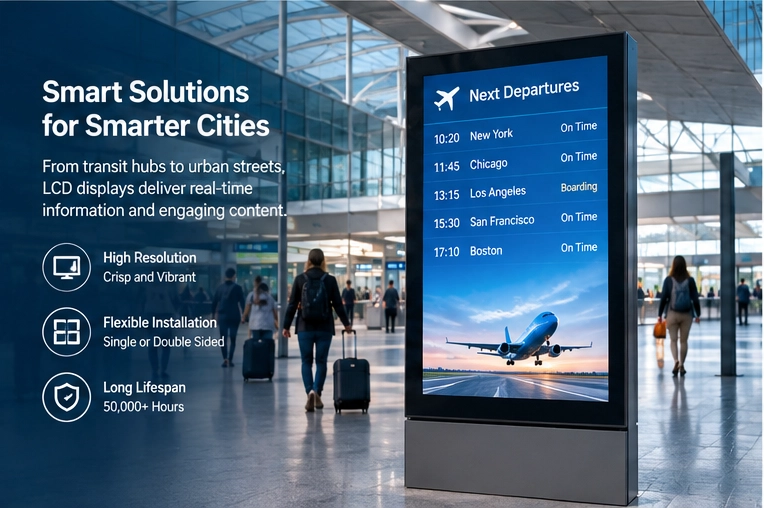
An outdoor LCD running at 4,000 nits consumes power in proportion to its light output, and most of that power becomes heat inside a sealed enclosure. Add solar gain on the housing and the internal temperature can exceed 70°C on a hot day. The thermal design — not the panel brand — decides whether the screen survives.
Three thermal specifications matter when comparing outdoor LCD units:
Operating temperature range. A true outdoor display is rated for continuous operation from -20°C to +70°C internal ambient. Displays rated only to 50°C will derate or fail in summer enclosures.
Heat path. The enclosure must conduct or actively exhaust heat from the backlight and driver boards. Passive finned designs suit moderate climates; forced-air or conditioned designs are used where duty cycle and sun loading demand it.
Backlight longevity at temperature. Industrial backlights are rated for long life — 50,000 hours is the working benchmark — but the rating is only valid at the operating temperature. Ask for the L70 figure at the temperature your enclosure will actually reach, not at 25°C lab conditions.
One trade-off worth understanding: a 5,000-nit screen running at full brightness 24/7 will age its backlight faster and cost more in power than a correctly dimmed 4,000-nit screen that steps down at night. The best outdoor LCD is not the brightest — it is the one whose brightness, optics, and thermal budget are matched to the site.
Environmental Protection: IP and Enclosure
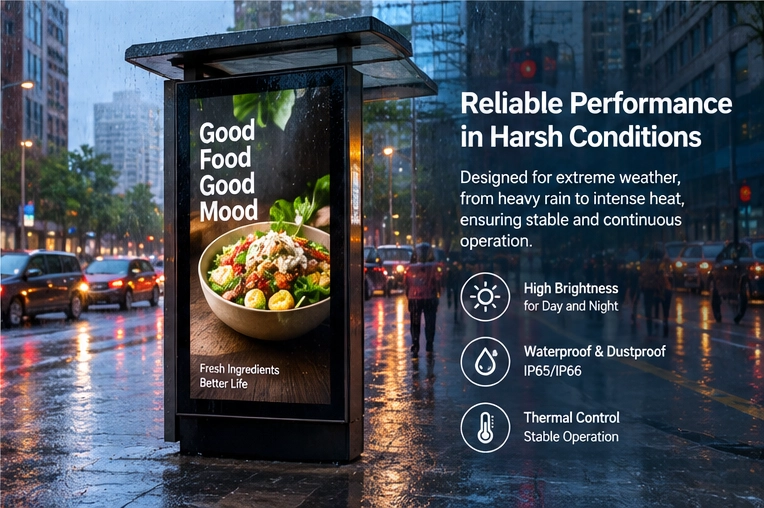
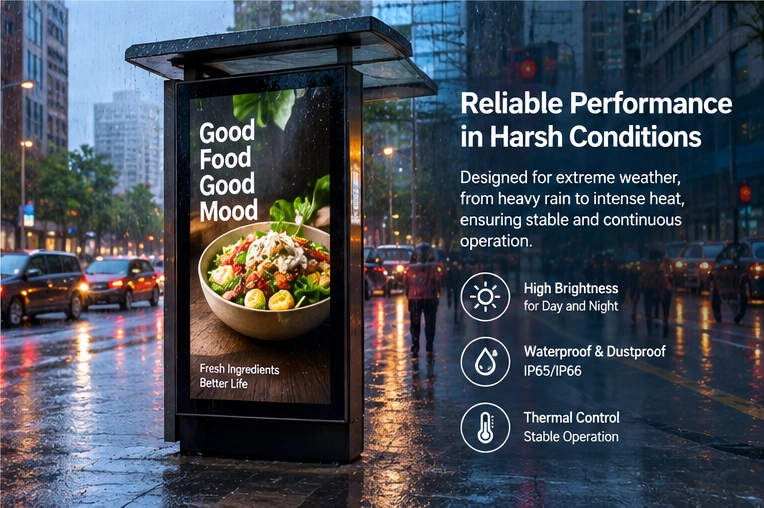
Outdoor LCD units for DOOH are typically rated IP65 (dust-tight, protected against water jets) or IP66 (protected against powerful jets). The rating covers the whole unit, not just the front face — rain finds seams, and a housing that is sealed on the front but open behind is not an outdoor display. For coastal locations, salt-spray resistance and corrosion-treated connectors materially extend life. For street-level or public positions, IK-rated glass (IK08–IK10, per IEC 62262) protects the front surface from impact.
Building an Outdoor DOOH Network: Practical Advice
For media owners deploying outdoor LCD DOOH, the pattern that works is:
Survey the sites first. Record sun orientation, shade, and expected ambient lux at each position before choosing a brightness tier.
Standardize on one or two tiers. Grouping screens into "full-sun 4,000-nit" and "sheltered 1,500–2,500-nit" classes keeps inventory manageable while avoiding the cost of over-specifying every screen to full-sun.
Demand bonded, AR/AG-treated, industrial-panel hardware. These three features separate a true outdoor LCD from an indoor screen in a weatherproof box.
Plan the service loop. Outdoor screens fail; the question is how fast they are detected and fixed. Displays with remote diagnostics — reporting temperature, backlight hours, and fault state — let a small field team maintain a large network.
Sourcing High-Brightness Outdoor LCDs
RisingStar manufactures sunlight-readable outdoor LCDs from 7 to 110 inches, with brightness from 1,500 to 5,000 nits, optical bonding, AR/AG-treated glass, industrial Hi-Tni panels for heat resistance, and IP65/IP66 fully sealed enclosures rated for -20°C to +70°C operation. Every unit is 100 percent factory-inspected and aged 72 hours before shipment. ISO 9001 certified.
Send your site conditions — sun orientation, shade, coastal or inland climate — to ai@risinglcd.com and our engineers will confirm the brightness tier and optical stack for each location before you commit. Browse the outdoor high brightness display product line to review current configurations and specifications.
