Programmatic digital out-of-home (pDOOH) changes how media owners sell screen time: instead of booking a fixed campaign for a fixed month, an advertiser buys impressions in real time, targeted by audience and triggered by data. That business model places a specific set of demands on the display hardware underpinning it. A screen network that cannot deliver reliable, measurable, remotely controlled playback cannot participate in programmatic trading no matter how good its ad server is.
What Programmatic Buying Requires from the Screen
pDOOH differs from traditional OOH in three ways that directly affect the display:
Shorter campaigns, faster changes. Creative rotates by audience segment, time of day, weather, or live events. Screens must accept and display new content on short notice — minutes, not days — without manual intervention at each location. Audience-based targeting. The network sells specific screens or screen groups to reach specific audiences. Each screen must be addressable and report its state, so the ad server knows what is available and what actually played. Measurement and attribution. Advertisers pay for impressions that can be verified. The network must prove a screen was on, showing the correct creative, at the correct time.These three requirements translate into concrete display hardware capabilities. Media owners evaluating screens for a pDOOH network should look past the panel spec to how the display behaves as part of a networked inventory system.
Uptime Is Inventory
In traditional DOOH, a screen down for a day costs one day of a booked campaign. In pDOOH, a screen that is offline or unstable quietly drops out of programmatic supply — with no working screen there is no inventory to sell, so there is nothing for advertisers to bid on. Uptime is not a maintenance metric in a programmatic network; it is the difference between having inventory to sell and having screens that look like inventory but never transact.
Display hardware contributes to uptime in three ways:
Industrial reliability. Screens rated for 24/7 operation with industrial backlights and thermal management fail less often than commercial displays. Every field failure avoided preserves a week of sellable inventory. Remote monitoring. The display should report operational state — power, temperature, backlight hours, content status — to the network's management system. A media owner who learns about a dark screen from a monitoring alert instead of a client complaint can fix it before revenue is impacted. Predictable failure. Hardware that fails gracefully with diagnostics is better for a programmatic network than hardware that fails silently. When a screen must be serviced, the operator should know which unit, where, and why before dispatching a technician.
Brightness Uniformity Is Ad Quality
Programmatic advertisers increasingly buy by audience and verified playback, but the creative still has to look right. Brightness uniformity across the network determines perceived quality:
A campaign running across 200 screens looks professional only if every screen renders the creative at consistent brightness and color. Screen-to-screen drift — one panel dimmer than its neighbor after a year of use — is immediately visible and devalues the whole network's inventory. Auto-dimming with ambient sensors keeps each screen at the right level for its environment, day and night. Without it, screens either glare after dark or wash out in daylight, and the "same" impression is not actually the same across the network.For media owners, the practical spec is panels binned for brightness and color consistency, combined with ambient-light auto-dimming so every screen holds its appearance through the day.
Content Delivery and the Player
pDOOH content reaches the screen through a media player, which pulls playlists from the network's CMS; the CMS in turn receives line items from the SSP/DSP trading stack. The display's role is to be a clean, standard playback surface:
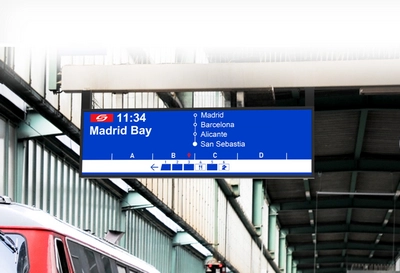
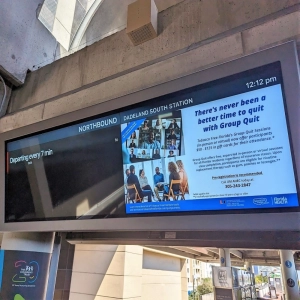
Standard interfaces. The display should connect through standard video interfaces (HDMI, eDP, LVDS) to a media player, so the network is not locked to a proprietary display-and-player bundle. Format flexibility. Programmatic creative arrives in standardized aspect ratios. Landscape 16:9 dominates pDOOH inventory, but networks with portrait or stretch-format screens can command different rates — and those screens need the same reliable playback as standard formats. Split-screen capability. A growing share of pDOOH sells the screen in zones — an ad plus a live data feed (weather, time, transit) or multiple ad slots on one panel. Screens used for zoned content must maintain sharp, synchronized rendering across zones.Proof-of-Play and Measurement
Programmatic transactions settle on proof that the impression was delivered. The display contributes to that proof in two ways:
Accurate playback logging. The player logs every creative shown with timestamps; the display's job is to be on and showing that creative exactly as scheduled. A screen whose content drifts out of sync — late loops, stuck frames, unplanned reboots — corrupts the playback log and the settlement data. Support for audience measurement. Many pDOOH networks layer on audience analytics (footfall, dwell, demographics) using cameras or sensors. The display enclosure should accommodate sensor hardware cleanly, with mounting and cable routing designed in from the start. Measurement is only as good as the hardware platform it runs on.The Hardware Decision for pDOOH Networks
When a media owner asks whether a screen is "programmatic-ready," the question is really about four capabilities: can the network keep it on, control it remotely, present content uniformly, and prove what it showed? These are not exotic features; they are the baseline of a networked display. Screens built for digital signage networks — with remote management, ambient-light dimming, standard interfaces, and industrial reliability — are the ones that fit into pDOOH supply.
| pDOOH requirement | What it means for the media owner | Hardware capability needed |
|---|---|---|
| Sellable uptime | Offline screens vanish from programmatic supply | 24/7 industrial rating, remote diagnostics |
| Uniform ad quality | Same creative looks identical on every screen | Brightness-binned panels, ambient-light auto-dimming |
| Short creative cycles | New ads go live in minutes, not days | Remote CMS updates, player compatibility |
| Verified delivery | Settlement depends on proof the ad ran | Accurate playback logging, no drift or unplanned reboots |
Two practical notes for buyers:
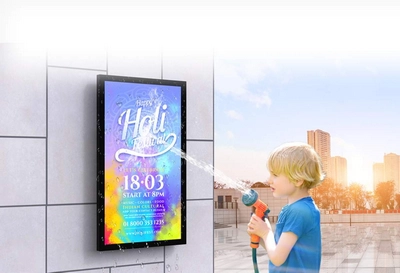
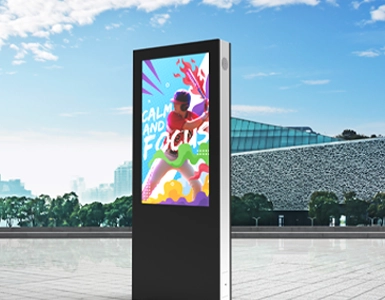
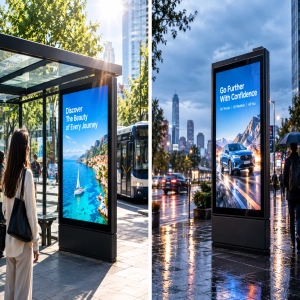
Ask for the monitoring interface. Confirm the display supports the remote diagnostics and control protocol the network's CMS expects, before committing to a panel that cannot report its own state. Match the brightness to the venue, not the brochure. A programmatic network that includes both an indoor mall screen and an outdoor bus-shelter screen needs two brightness tiers, each correctly specified — and the outdoor tier must also survive the weather, not just produce the nits. Uniformity within a tier is what protects ad quality.Sourcing Screens for pDOOH Networks
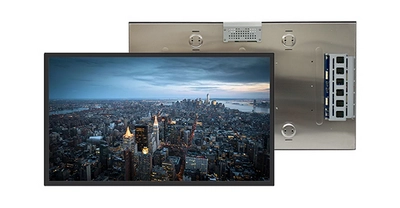
RisingStar builds high brightness display LCDs for programmatic digital signage networks from 7 to 110 inches, with brightness from 500 to 5,000 nits, ambient-light auto-dimming, remote-management-ready interfaces, and industrial reliability rated for 24/7 operation in -20°C to +70°C environments. For street-level placements, our outdoor waterproof display line adds sealed, all-weather enclosures so the screen keeps transacting through rain, dust, and temperature swings. Every unit is 100 percent factory-inspected and aged 72 hours before shipment. ISO 9001 certified.
<!-- obsidian -->
If you are building or converting a screen network for programmatic DOOH, send your venue list and player architecture to ai@risinglcd.com and our engineers will confirm the brightness tier and interface configuration for each screen class. Review the LCD digital signage and sunlight readable display product lines for current options.