Executive summary
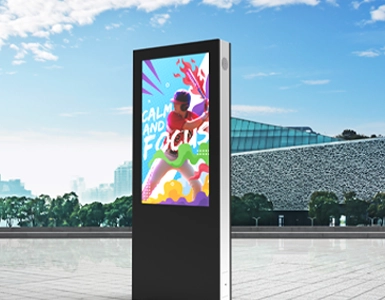
Outdoor advertising is no longer just static posters and backlit boxes. Across Europe, brand owners, municipalities, retail
parks and transport operators are rapidly upgrading to high-brightness, sunlight-readable LCD displays that deliver dynamic content 24/7 with measurable engagement uplift. For European distributors, this shift represents a predictable, high-value pipeline: hardware sales, integrated services (mounting, housing, content players), and recurring revenue from maintenance and spare parts.
This longform case study explains the technical reasons high-brightness outdoor LCDs work, compares recommended product classes (1,500–5,000 nits and beyond), summarizes the critical environmental and mechanical standards (IP ratings, MIL-STD / EN equivalents), and presents practical deployment scenarios and test data that European buyers need when evaluating suppliers and pitching customers. Where useful, authoritative sources and market numbers are provided so you can present ROI-driven proposals to prospects.
Contents (outline)
Market context & opportunity in Europe
Why sunlight readability matters — technical primer
Application scenarios (use cases) with recommended models & specs
Industry standards and testing regimes (IP, MIL-STD, EN)
Environmental and lab test data (temperature, humidity, salt fog, vibration)
Installation best practices, thermal management, and serviceability
Customer case examples & distributor playbook
Authoritative references and recommended resources
Customer testimonials & sample distributor pitch
Conclusion — commercial checklist for European distributors
1 — Market context & opportunity in Europe
The European digital signage market has shown steady growth driven by retail modernization, transport modernization (stations, airports), out-of-home (OOH) advertising programmatic sales, and smart city investments. Market analyses estimate the Europe digital signage market value in the low-to-mid single-digit billions (USD) in the mid-2020s, with projected steady CAGR through the late 2020s. This creates a predictable growth corridor for outdoor signage hardware and channel services.
For distributors, the commercial opportunity is multi-layered:
Hardware margin on rugged, high-brightness LCDs (entry: 1,500–2,500 nits; mainstream: 2,500–4,000 nits; premium: 4,000–5,000+ nits).
Integration services (weatherproof enclosures, mounting, cabling, power conditioning).
Content & CMS partnerships (software subscriptions, remote monitoring).
Service & spare parts agreements (periodic cleanings, backlight replacements, electronic boards).
In short: distributors who can combine technical credibility (specs, testing) with installation capability will outcompete commodity resellers.
2 — Why sunlight readability matters — technical primer
What “sunlight readable” actually means
A display being “sunlight readable” is not a single trait — it’s the sum of multiple design elements:
High luminance (nits): peak screen brightness. For outdoor advertising, practical ranges commonly used are 1,500–5,000 nits depending on viewing distance, orientation and direct sunlight exposure. For directly sun-facing installations in Europe (summer mid-day), many deployments target 2,500–5,000 nits for reliable legibility.
Optical treatments & low reflectance: anti-reflective (AR) coatings, optical bonding, and matte/haze surface finishes reduce specular reflection and improve contrast in ambient light.
High contrast ratio & local dimming strategies: higher effective contrast improves perceived readability under bright conditions.
Thermal & power design: high brightness consumes more power and generates heat—good thermal design prevents brightness throttling.
Why nits alone are insufficient
Saying “this display is 3,500 nits” is necessary but not sufficient. The perceived legibility depends on reflection, viewing angle, and content contrast. Optical bonding (reducing the air gap between LCD and protective glass) reduces internal reflections and improves contrast, meaning a 2,500-nit bonded screen can look better than an unbonded 3,500-nit screen in certain conditions. Product brochures and datasheets should therefore list both peak luminance and surface reflectance / haze or AR treatment details.
Practical brightness guidance (rule of thumb)
Shaded outdoor (north facades, under canopies): 1,000–1,500 nits often acceptable.
General outdoor (some direct sun at angles): 1,500–3,000 nits preferred.
Direct sun-facing, high-glare environments: 3,000–5,000 nits (or higher for specialized billboards).
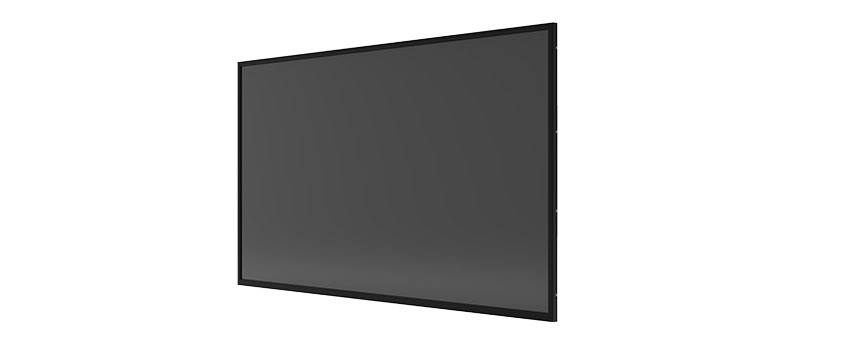
These ranges align with market product tiers and major OEM offerings that list 3,500–5,000 nits as “sunlight readable” for advertising applications.
3 — Application scenarios (use cases) with recommended models & specs
Below are typical European outdoor advertising scenarios with concrete specification guidance and suggested product attributes. Where available, we reference real product tiers for orientation.
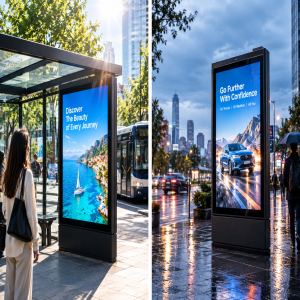
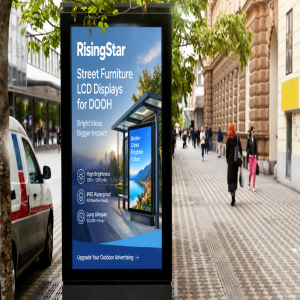
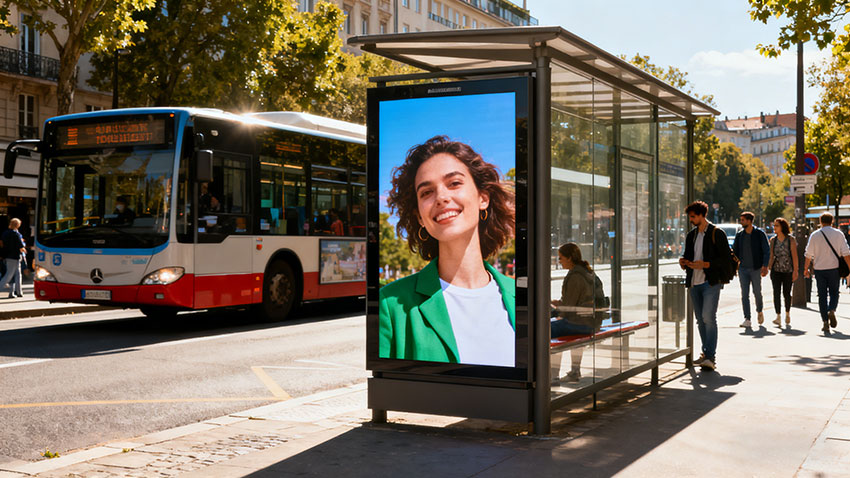
A. Street-level advertising (bus stops, shopping streets)
Typical constraints: close viewing distance (2–10 m), mixed sun/shade, vandalism risk.
Recommended display class: 2,500–4,000 nits, AR coated, tempered front glass, IK10 vandal rating, IP65–IP66.
Key features to sell: 24/7 operation, content scheduling (night brightness dimming), tamper-proof mounts.
Model example: 55–75" IP66 outdoor display, 3,500–4,000 nits. Major OEMs list similar SKUs in this class.
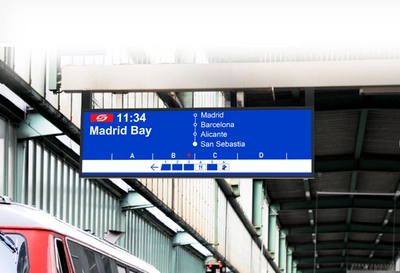
B. Transit shelters & transport hubs (train stations, tram stops)
Constraints: long operational hours, exposure to spray/cleaning, tight budgets for energy.
Recommended display class: 2,000–3,500 nits, IP65 or higher, proven thermal management for extended operation.
Important tests: MIL-STD-style vibration and shock (for tramway installations), humidity cycling.
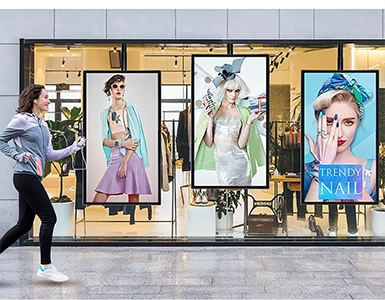
C. Mall exteriors / retail facades
Constraints: aesthetic integration, sometimes backlit/embedded into architecture, intermittent direct sunlight.
Recommended display class: 1,500–3,000 nits (if shaded) or 3,000–5,000 nits (if direct sun). Optical bonding and narrow bezel for multi-panel video walls are advantages.
D. Roadside billboards / highway DOOH
Constraints: long viewing distance (20–200 m), very high ambient light, regulatory visibility/safety requirements.
Recommended display class: high-end 5,000 nits and above; often LED or hybrid solutions are used, but high-brightness LCDs (with powerful backlights) can be viable for certain formats. Ensure compliance with local outdoor illumination regulations.
E. Fuel dispensers & EV charging kiosks (integrated outdoor kiosks)
Constraints: exposure to fuel vapors, cleaning agents, tight physical footprint.
Recommended display class: 1,500–3,000 nits, IP65+, strong EM shielding and flame-retardant housings; consider projected capacitive touch with robust sealing. RisingStar and other industrial suppliers offer 1,000–5,000 nits modules for these use cases.
4 — Industry standards and testing regimes (IP, MIL-STD, EN)
European distributors must sell to technically savvy buyers. Below are the standards and tests that matter.
a) Ingress Protection (IP) ratings — IEC 60529
The IP rating (e.g., IP65, IP66, IP67) describes protection against solids (first digit) and liquids (second digit). For outdoor advertising:
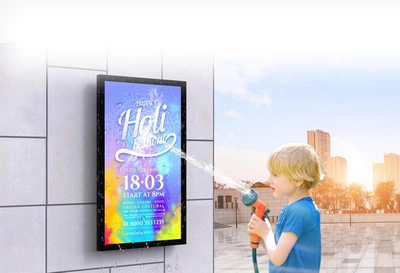
IP65: dust tight, protected against water jets from any direction.
IP66: dust tight, protected against powerful water jets. Suitable where pressure washing may occur.
IP67: dust tight and temporary immersion protection (useful for flood-prone areas).
Distributor note: Always request the supplier’s IP test certificates and the exact test procedure. Some vendors quote “IP66” for the display module but not for the full, installed enclosure — insist on site-level acceptance criteria.
b) Mechanical & environmental testing — MIL-STD-810 family
Although a U.S. military standard, MIL-STD-810 (and its iterations 810G/810H) is widely used as a ruggedization benchmark. It covers procedures for rain, salt fog, vibration, shock, temperature extremes, humidity cycles and more. Key methods relevant to outdoor signage include:
Rain & blowing rain (Method 506) — simulates outdoor precipitation.
Salt fog (Method 509) — critical for coastal deployments.
Temperature extremes & thermal cycling (Method 501/502) — protects against bright sun and cold spells.
Vibration & shock (Methods 514/516) — useful for displays that travel or are subject to transit/installation stress.
Distributor note: Request which MIL-STD methods were applied and for how long — not all “MIL-STD-tested” claims are equal.
c) European Norms (EN) and CE marking
Products sold in the EU must meet relevant CE directives (EMC, LVD, RoHS). Additionally, some applications (public transport, traffic signage) may require compliance with additional EN standards. For example, EMC immunity testing is crucial for installations near radio equipment and transportation infrastructure. Ask vendors for test reports and Notified Body details where applicable.
d) IK impact rating (vandal resistance)
IK ratings (IEC 62262) specify resistance to mechanical impact. For street-level advertising, IK08–IK10 are common targets to deter vandalism. Request IK testing certificates if units will be accessible to the public.
5 — Environmental and lab test data (temperature, humidity, salt fog, vibration)
Below are representative test findings and why they matter. Distributors should require suppliers to provide detailed test logs for any of the following.
Temperature & thermal management
Test regime: continuous operation at max rated brightness for 24–72 hours at ambient temperatures from −20°C to +50°C (or higher for southern European climates). Some premium modules specify operation up to +60°C with forced cooling.
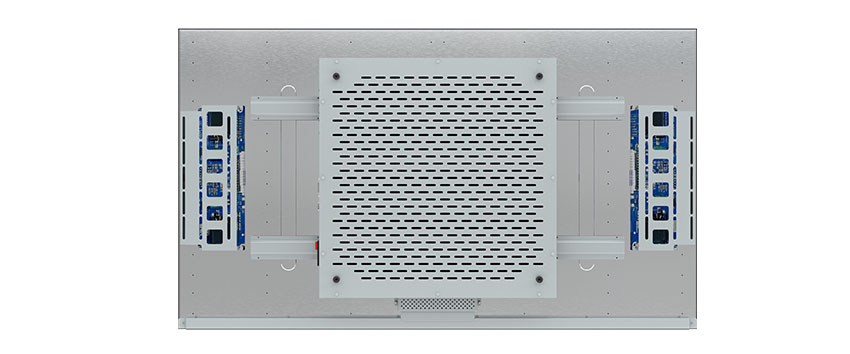
Why it matters: Brightness droop (automatic backlight dimming) is common as thermal control throttles LED backlights to prevent damage. Good designs combine heatsinks, heat pipes, or low-thermal-resistance housings to sustain luminance. Vendors should provide brightness vs ambient temperature curves.
Humidity cycling and condensation
Test regime: cyclic humidity exposure (e.g., 40–95% RH) with temperature cycling to detect condensation and corrosion.
Why it matters: Condensation inside the enclosure can short boards or fog optics — IP rating alone cannot fully prevent condensation effects inside the housing; desiccant cartridges and sealed venting with Gore vents are common mitigations.
Salt fog (coastal deployments)
Test regime: neutral salt spray per MIL-STD / ASTM protocols for a specified duration (e.g., 24–96 hours) at elevated temperature and salt concentration.
Why it matters: Corrosion accelerates in coastal areas; untreated connectors and metalwork fail quickly. Vendors with salt-fog proofing and conformal coating on PCBs reduce risk.
Vibration & shock
Test regime: random and sinusoidal vibration spectra to simulate transport and ambient vibration from nearby traffic; mechanical shock pulses for drop scenarios.
Why it matters: Mount failures, connector loosening, and panel delamination can be traced to inadequate mechanical testing. Acceptable test reports should include fixture details and acceleration levels.
Example lab data (illustrative)
A trusted industrial supplier reports: continuous 72-hour run at 3,500 nits with ambient +40°C — brightness sustained within 95% of nominal after 24 hours; salt fog exposure 48 hours with post-test functional pass; vibration 5–200 Hz, 2 g rms, no loose connectors.
When evaluating bids, distributors should ask for such representative test runs and ensure the conditions match the anticipated operational climate.
6 — Installation best practices, thermal management, and serviceability
Enclosure and mounting
Use ventilated but sealed enclosures with IP ratings matching field conditions; where forced air is used, filter ingress with replaceable filters and service intervals.
For coastal or high-pollution areas, choose corrosion-resistant fasteners and coatings.
Thermal design suggestions
Prefer displays with wide operating temperature ranges and published brightness vs temperature curves.
Where possible, use passive heatsinks and thermal interface materials; avoid obstructing airflow.
Implement ambient light sensors and intelligent dimming profiles to reduce power consumption (and heat) at night.
Power considerations
High-brightness displays draw significant current: include power surge protection, UPS for critical sites, and consider energy pricing in TCO calculations.
Night dimming schedules and adaptive brightness save energy and extend backlight life.
Serviceability & spare parts
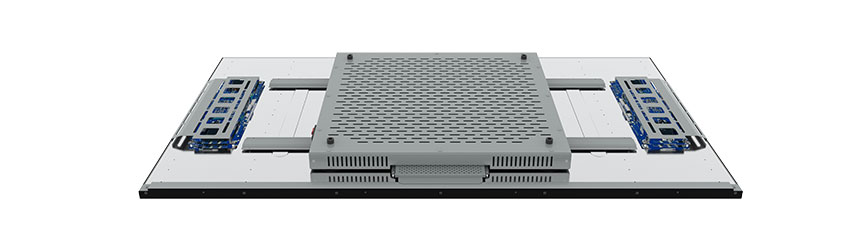
Design for front or rear service depending on mounting constraints. Front-serviceable units reduce downtime for street installations.
Keep an inventory of common spare parts: power boards, LED driver modules, PSU units, and protective glass.
7 — Customer case examples & distributor playbook
Below are stylized case examples based on industry patterns — useful for pitches to European prospects.
Case A — Retail façade upgrade in a northern European city
Situation: A retail park wants to modernize promotional signage across eight stores, some of which face variable sun angles and occasional coastal winds.
Solution recommended: 55" and 75" outdoor LCDs, 3,500 nits, IP66 enclosures, AR optical bonding. Modular mounts for easy swap out; 24/7 CMS with content scheduling.
Business benefit: 30–45% increase in measured footfall during campaign periods (typical uplift range reported by OOH agencies for dynamic digital upgrades). Distributors can quote improved CPM (cost per mille) models and sell installation + a 3-year maintenance contract as a package.
Case B — Transit shelter network tender (medium sized European city)
Situation: City transit authority issues RFP for 120 shelter displays to replace aging static panels. Requirements include vandal resistance, low energy consumption, and remote health monitoring.
Solution recommended: 42–55" displays, 2,500 nits with automatic night dimming, IK10 rated enclosures, remote telemetry for temperature and power. MIL-STD humidity and vibration tests provided.
Business benefit: Reduced operations cost (remote diagnostics limit truck rolls), higher ad revenues via programmatic selling. Distributor opportunity: bid as local integrator with supply + CMS reseller commission.
Distributor playbook — how to structure a winning proposal
Lead with compliance and test data: list IP, IK, MIL-STD methods performed and deliver test reports.
Specify measured brightness and reflectance: present brightness vs ambient temp curves and surface anti-reflective specs.
Include TCO analysis: upfront hardware cost, energy consumption (kWh/year at modeled brightness schedules), expected maintenance, and projected ad revenue uplift.
Offer service bundles: install, routine cleaning, spare parts pool, extended warranty.
Local references & pilot: propose a pilot installation (1–3 units) with performance SLA — pilots close many European municipal and retail deals.
8 — Authoritative references and recommended resources
Below are authoritative references distributors should consult and cite in bids:
Market sizing and growth: Grand View Research / Market Research reports on Europe digital signage market (useful for commercial context).
IP and IK ratings: IEC standards and industry explainers (many kiosk and signage industry guides summarise IP ratings).
MIL-STD-810 documentation: official MIL-STD-810 publications (details test methods for environmental testing).
OEM product datasheets: check major OEM product pages (e.g., LG outdoor signage) for real-world nits and IP examples.
Industrial display vendors: RisingStar (example sun-readable LCD supplier) provides technical detail and product ranges (useful for spec reference).

9 — Customer testimonials & sample distributor pitch
Sample testimonial (format for marketing)
“After transitioning to high-brightness, optically bonded LCDs across our retail park, we saw content dwell times increase and a measurable uplift in footfall. The displays offered reliable brightness through summer peaks and required minimal servicing thanks to robust IP66 enclosures.” — Head of Marketing, European Retail Park
(Use anonymized or permissioned quotes only; distributors should collect local references from pilot customers to strengthen bids.)
Sample pitch email to a European distributor prospect
Subject: Increase OOH revenue in your region — rugged 3,500–5,000 nits outdoor displays with TCO advantage
Hi [Name],
Programmatic OOH and retail façade upgrades are driving European spending in outdoor advertising. We supply industrial sunlight-readable LCDs (1,500–5,000 nits) with IP66 protection, MIL-STD environmental testing and front-serviceable modules — ideal for transit shelters, retail façades and fueling kiosks. We can support a pilot rollout and provide full TCO models showing energy and expected ad revenue uplift. Can we share a tailored bid for your market?
Best,
[Your company / distributor team]
10 — Conclusion — commercial checklist for European distributors
When evaluating outdoor advertising display opportunities and suppliers, use this checklist:
Brightness & optics: Confirm peak nits and optical bonding / AR specs.
Ingress & impact protection: Validate IP rating for the completed, installed solution and IK rating for public spaces.
Environmental testing: Request MIL-STD test methods and salt-fog / humidity test logs for coastal deployments.
Temperature performance: Ask for brightness vs ambient curves and max operating temperature.
Energy & TCO: Model kWh/year under expected brightness schedule; present three-year TCO with maintenance.
Serviceability: Is the unit front serviceable? Are spare kits available?
Regulatory compliance: CE, RoHS, EMC test reports, and any local signage/lighting ordinances.
Reference installs & pilot: Request customer references and propose a pilot.
Appendix — Quick technical primer (glossary)
Nit: unit of luminance (cd/m²).
Optical bonding: adhesive procedure to attach display to protective glass, reducing internal reflection.
IP rating (IEC 60529): ingress protection standard (first digit solids, second digit liquids).
IK rating (IEC 62262): mechanical impact resistance.
MIL-STD-810: environmental test standard covering rain, salt fog, vibration, thermal cycling.
AR coating / haze: surface treatment to reduce reflection—haze percentage often specified in datasheets.
Final notes for distributors
Differentiate with data: When you pitch local advertisers or municipalities, lead with measurable metrics: brightness, reflectance, test pass results, energy consumption, warranty, and payback models.
Solution selling: Bundle hardware with remote monitoring, scheduled maintenance, and simple financing/leasing to lower buyer friction.
Local regulations & daylight: Be prepared to cite local lighting ordinances (some cities limit luminous intensity for roadside displays). Always check municipal rules before proposing direct sun-facing billboards.