 English
 Deutsch
 Français
 Español
 Italiano
 한국어
한국어
 日本語
日本語
 Português
 Suomi
Suomi
 Dansk
Dansk
 Polski
A single metro line—even when segmented across different operators or rolling stock interlining—can encompass between 80 and 200 displays: from platform-edge next-train boards and concourse directories to ticket-vending kiosks and street-level entrance totems. The operating environments are extreme and divergent: underground platforms sit at 200 lux in stable, climate-controlled conditions, while entrance totems face 100,000+ lux of direct midday sun and unfiltered humidity. Every three-minute interval, train-induced vibrations test the mechanical integrity of every mounting bracket, connector, and fastener across the network.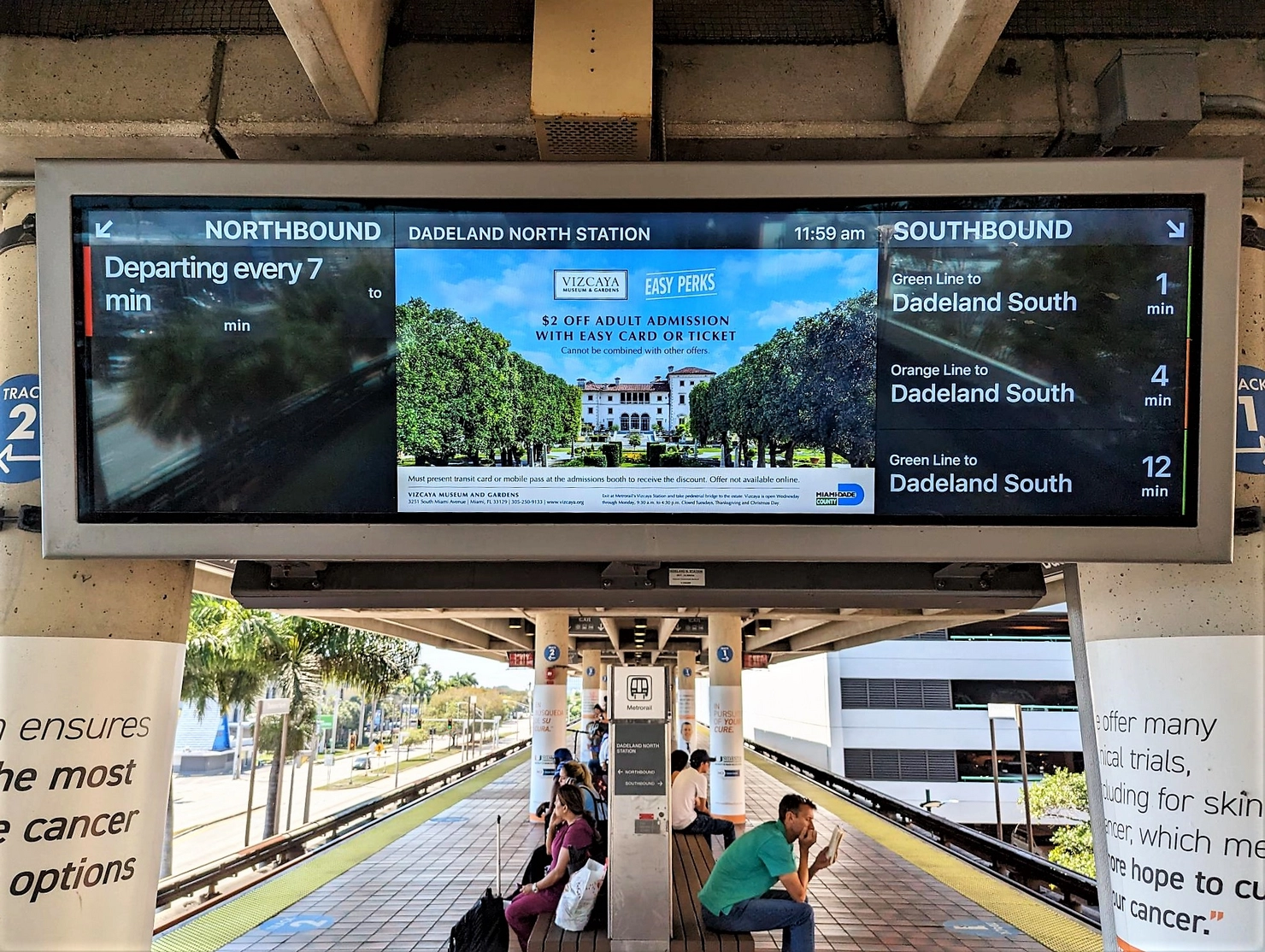
A "one-size-fits-all" hardware specification for metro PIDs is a recipe for failure. A display optimized for an indoor mezzanine will blacken, fog, or shake loose within a single summer when deployed at a street-level entrance. This guide maps the hardware decisions required to keep a metro PID network readable, online, and maintainable across the diverse zones of a modern station.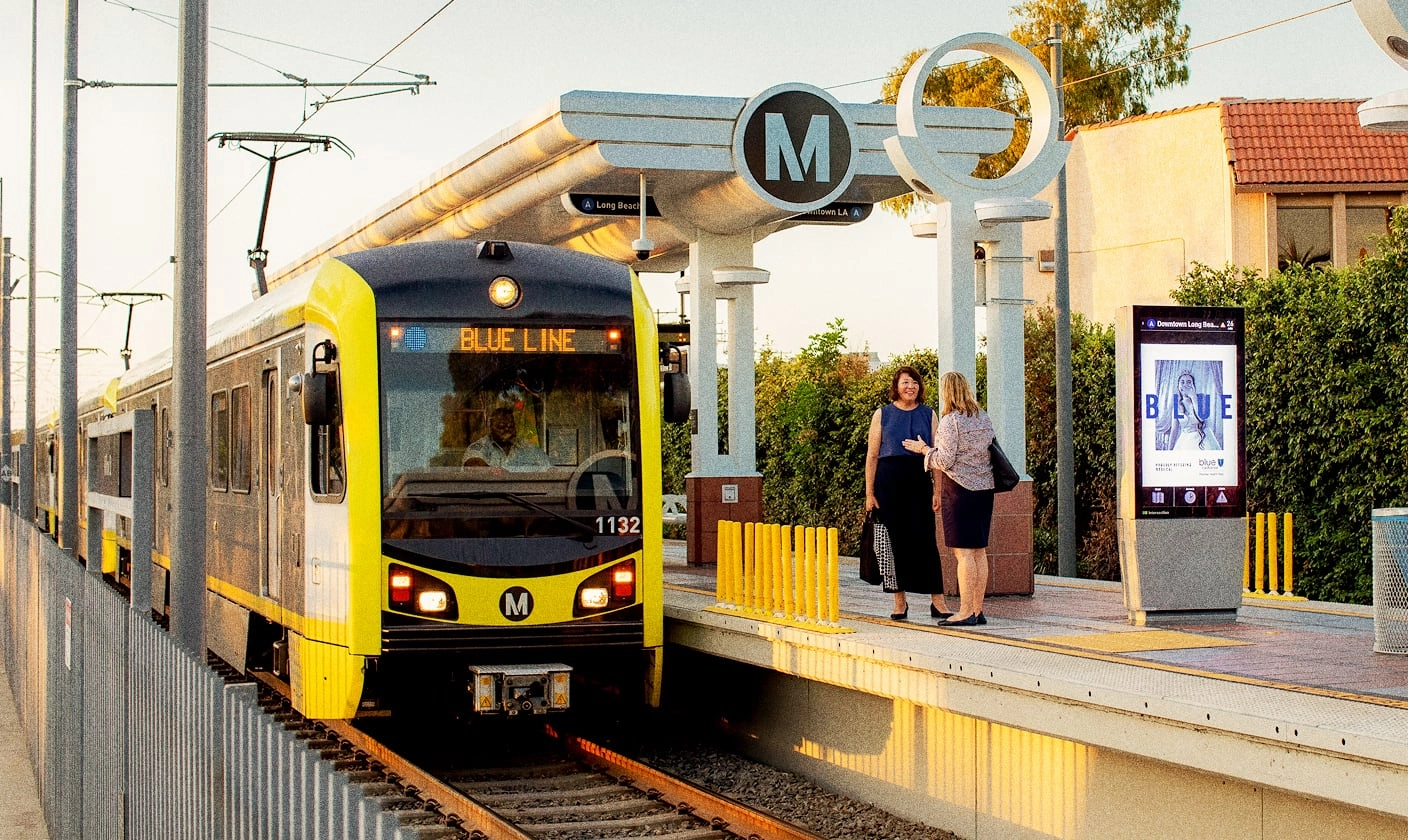
💡 Quick Answers — Metro LCD Display & Metro PID Selection
1. What brightness does a metro LCD display need?
Underground platforms & concourses: 1,000–1,500 nits.
Semi-outdoor entrances: 1,500–2,500 nits.
Fully exposed entrances: 2,500–5,000 nits with solar-resilient panels.
Note: All high-brightness units must incorporate ambient light sensors for 24/7 dimming to prevent light pollution and ensure driver safety.
2. What form factor is used for metro PID?
Platform-edge and ceiling-mounted PIDs typically use stretch-bar LCDs (e.g., 1920×360, 3840×360, 1920×720). Standard 16:9 panels rarely fit the narrow, precise architectural cutouts above platform screen doors or bulkhead signage areas.
3. Why does a metro LCD display blacken?
Standard liquid crystal clears at ~70–80°C. Direct solar loading quickly pushes surface temperatures past this point, causing irreversible "blackening defects."
The Fix: Specify Hi-Tni (High-Temperature) panels that raise the clearing point to ≥110°C, paired with active cooling or heat-pipe dissipation to protect internal electronics.
4. What IP and impact rating are standard?
IP65/IP66: Essential for front-side protection against high-pressure cleaning and monsoon rain.
IK10: Mandatory for any ground-level or within-reach installation to withstand vandalism.
Critical Requirement: All sealed IP-rated enclosures must include industrial-grade breather vents to equalize pressure and prevent internal condensation.
5. How do you prevent vibration damage?
A connector that works on the bench will "walk itself out" in a station within 500 train cycles if not secured.
Best Practices: Use locking connectors (screw-lock HDMI, USB, and DC power), through-hole board mounting for controller PCBs, thread-locking compound on all fasteners, and EPDM vibration-dampening gaskets at the panel-to-enclosure interface.
The Three Zones of a Metro Station
Before specifying any metro LCD display, the network has to be broken into environmental zones. Mixing them up is the most common — and most expensive — error in a metro PID project.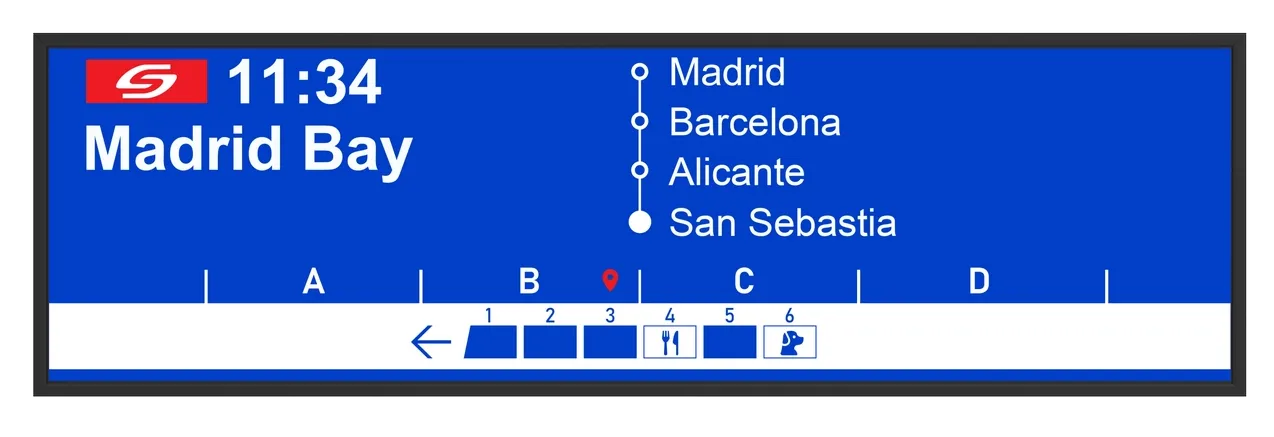
| Zone | Location | Ambient Light | Primary Threat |
|---|---|---|---|
| A — Fully Indoor | Underground platforms, mezzanines, ticket halls | 200–500 lux fluorescent | Dust, humidity, vibration, 24/7 uptime |
| B — Semi-Outdoor | Covered entrances, vented concourses, skybridge walkways | Variable, sun-exposed part of day | Glare, temperature swing, condensation |
| C — Fully Outdoor | Station entrances, street-level totems, open-air platform ends | 100,000+ lux direct sun | Solar blackening, rain, vandalism |
A display engineered for Zone A fails in Zone C not because it is defective, but because it is the wrong panel for the job. The rest of this guide works through the engineering choices that match each zone.
Vibration: The Failure Mode Nobody Designs For
Before diving into brightness and form factor, there is a harder problem that kills metro LCD displays silently: vibration.
Every passing train sends a low-frequency shockwave through the station structure. Platform-edge displays mounted above the screen doors feel it directly — the train is three meters away. Ceiling-hung concourse boards feel it through the structural steel. Over months, that vibration does three things:
Connectors walk themselves loose. A standard HDMI or USB connection relies on friction alone. Friction loses to 20,000 train cycles. The connector backs out half a millimeter — enough to lose signal intermittently. Screw-lock HDMI, screw-lock USB Type-B, and locking DC power barrels are not optional on a metro PID network. They are the minimum. RisingStar ships all metro-configured displays with physically locking connectors as standard.
PCB components fatigue at the solder joints. Surface-mount connectors on a standard controller board crack at the joint under sustained low-frequency vibration. Through-hole mounting on the interface PCB — where the connector pins pass through the board and are soldered on the opposite side — withstands this. Verify that your metro LCD display uses through-hole board construction for all external connectors, not just the HDMI port.
Chassis fasteners back out. The M3 and M4 screws holding the display chassis to the mounting bracket see micro-rotation with every train pass. Thread-locking compound (Loctite or equivalent) on every chassis fastener prevents this. EPDM gaskets between the panel and the enclosure serve double duty — sealing against moisture and dampening the transmission of structural vibration into the display chassis. RisingStar's open frame displays for metro PID ship with thread-locked fasteners and EPDM vibration-dampening gaskets as standard on all transit-qualified units.
If a metro LCD display passes your bench test but fails in the station after three months of operation, vibration is the most likely root cause. Spec for it at the component level, not the enclosure level.
Brightness: The First Non-Negotiable
Brightness is the single most important parameter on a metro PID network. A platform-edge board that is unreadable at 8 a.m. on a clear day is worse than no display at all — it trains passengers to ignore every screen in the station.
| Display Location | Required Brightness | Panel Technology |
|---|---|---|
| Underground platform PID | 1,000–1,500 nits | Standard IPS / ADS |
| Concourse directory, ticket hall | 1,000–1,500 nits | Standard IPS / ADS |
| Covered entrance, skybridge | 1,500–2,500 nits | IPS with anti-glare |
| Open-air entrance totem | 2,500–4,000 nits | Solar-resilient Hi-Tni |
| Desert / tropical entrance | 4,000–5,000 nits | Solar-resilient Hi-Tni + optical bonding |
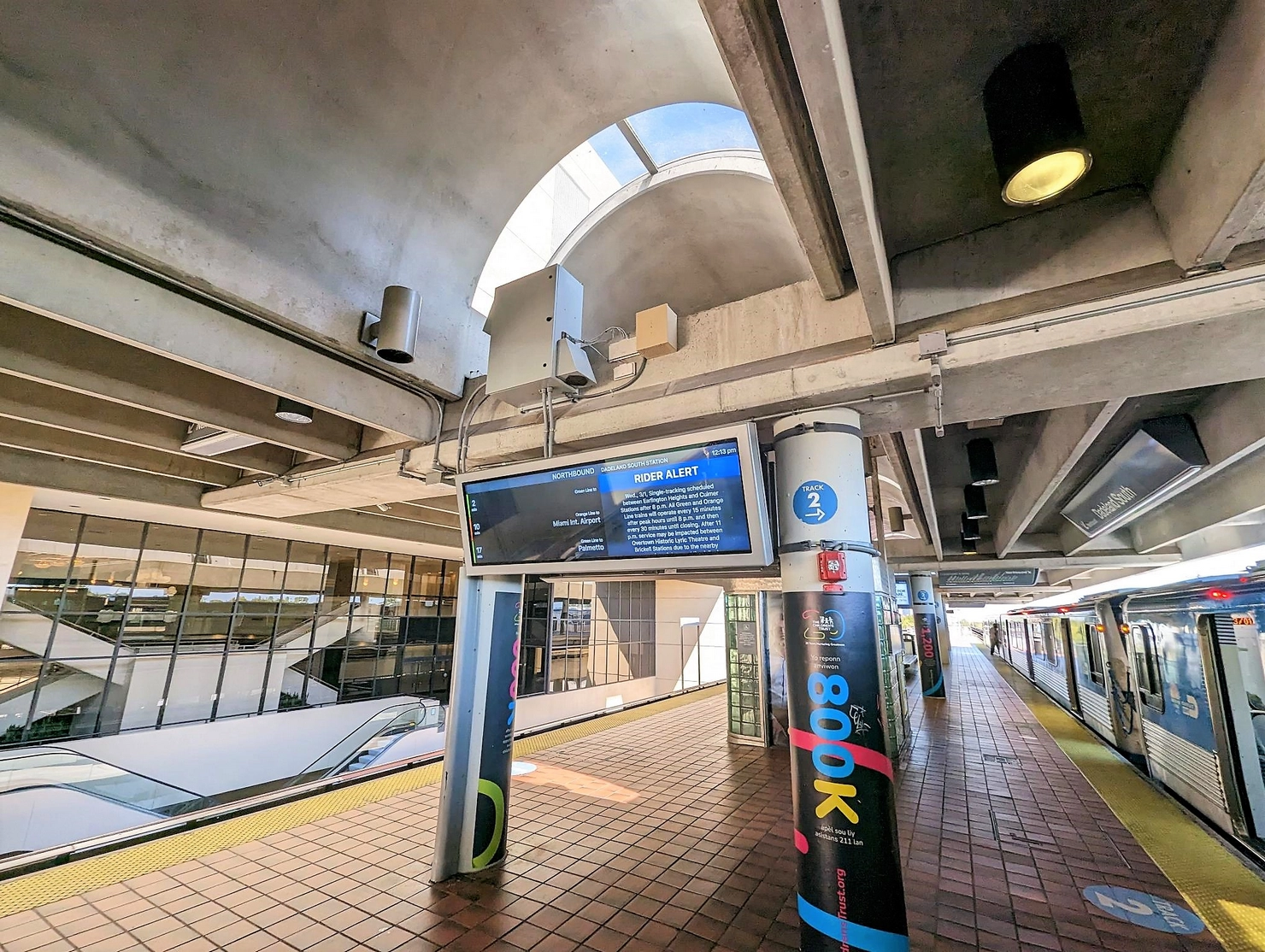
For Zone C, brightness alone is not enough. A standard panel driven to 4,000 nits still clears at ~70–80°C, and a sun-loaded entrance totem routinely hits that surface temperature. The panel blacks out exactly when brightness is needed most. Solar-resilient Hi-Tni panels — formulated with a higher liquid-crystal clearing point (≥110°C) — are mandatory for any metro LCD display exposed to direct solar radiation. This is the difference between a panel that survives a desert summer and one that is returned as RMA in August.
For unshaded station entrances in desert or tropical deployments, our stretch bar high-brightness TFT LCD panels are built around solar-resilient panels that maintain image integrity under sustained solar loading.
Form Factor: Why Metro PID Uses Stretch-Bar LCD
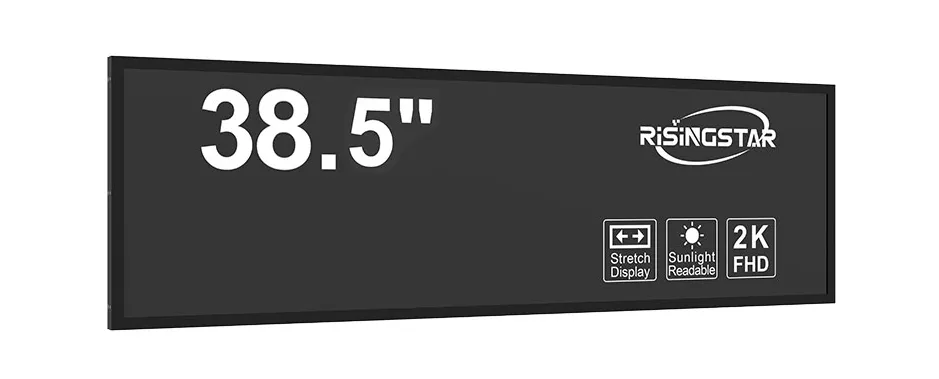
Standard 16:9 panels do not fit a metro PID network. The physical constraints are unforgiving:
Platform screen door header — a narrow horizontal slot, typically 280–400 mm tall, running the width of the platform. A 16:9 panel wastes most of that width and crowds the doors.
Ceiling-mounted route line — a linear strip showing the next three stops. The passenger reads left-to-right while walking; a wide, short format is the only shape that works.
Onboard ceiling / side panel — curved car interiors leave no room for a rectangular monitor.
This is why stretch-bar LCD — panels with custom aspect ratios like 1920×360, 3840×360, 1920×720, and 2880×480 — has become the default metro LCD display format for in-station PID. The glass is cut and re-driven from a full Tier-1 panel; it is not a cropped 16:9 unit. At RisingStar, these are produced in our 4,000㎡ ISO 9001-certified facility with Grade A/A+ open-cell sourced directly from LG Display, AUO, Innolux, BOE, and Tianma, so the stretch-bar panel inherits the same brightness, lifespan, and color uniformity as the standard panel it was cut from.
The trade-off: stretch-bar tooling and minimum order quantities are higher than standard sizes. For a network with 60+ identical platform headers, the unit economics work. For a single-station pilot, a standard 32" or 43" panel in a custom housing is often the more honest engineering choice.
For the standard-size panels that complement stretch-bar installations — concourse directories, ticket kiosks, and wayfinding terminals — browse our open frame monitor product line with sizes from 7" to 86" and brightness up to 5,000 nits.
Sealing, Optical Bonding, and the Failure Modes Nobody Talks About
Three failu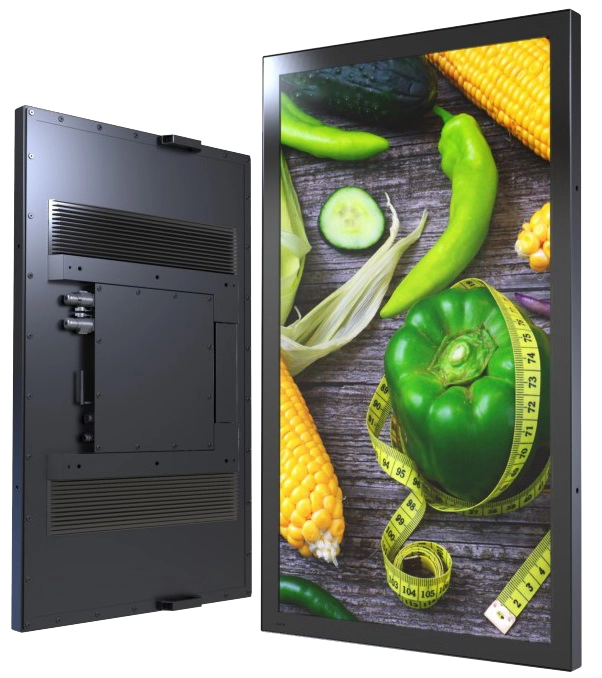 re modes dominate metro PID field returns, and none of them are brightness-related:
1. Internal fogging. An unbonded metro LCD display on a Zone B or C location fogs internally within weeks. The underground-to-surface temperature cycle condenses moisture between the LCD and the cover glass — a haze layer no external wipe can reach. Optical bonding (OCA sheet or OCR liquid resin) eliminates the air gap and removes the condensation surface entirely. It also cuts reflection by roughly 80%, which materially improves daytime legibility without adding a single nit of backlight power.
2. Gasket failure at the panel-to-enclosure seam. Water does not enter through the display face. It enters through the seam where the metro LCD display meets the kiosk or totem enclosure. Generic foam seals degrade under UV within one summer. EPDM gaskets rated for continuous outdoor exposure are the minimum, and the assembly should be verified under actual IP65/IP66 water-ingress testing — not a supplier datasheet claim.
3. Backlight decay from fixed-brightness 24/7 operation. A metro PID board running full brightness at 2 a.m. on an empty platform burns through its backlight half-life for no reason. Integrated ambient light sensors with auto-brightness adjustment extend the up-to-50,000-hour industrial-grade backlight toward its rated life and cut energy cost — a meaningful line item across a 200-display network.
Integration: Interface, Touch, and CMS Connectivity

A metro LCD display is not a standalone device — it is a node on a station-wide PID network. The interface choices made at spec time determine whether the display talks to the CMS cleanly for the next 5 years.
| PID Application | Recommended Interfaces | Why |
|---|---|---|
| Platform-edge next-train board | HDMI in + HDMI out (loop-through), dual RJ45, locking DC power | Daisy-chain across platform; dual network for data + backup; locking power resists train vibration |
| Concourse directory, totem | HDMI, USB, RS-232 | RS-232 for centralized remote management across dozens of units |
| Interactive ticket / wayfinding kiosk | HDMI + screw-lock USB touch + locking DC | Locks prevent vibration and cleaning-crew disconnect; PCAP with glove/wet-hand firmware |
| Entrance totem with ambient sensor | HDMI, USB, external ALS port, locking connectors throughout | Auto-brightness adapts 0–5,000 nits to the street; every connector physically locked |
For the interactive ticket and wayfinding kiosks that process thousands of transactions daily, PCAP touch with hardened firmware — glove mode, wet-hand rejection, palm rejection, water-drop rejection — is the only touch technology that survives public transit duty cycles. Resistive touch is not in the conversation for metro PID.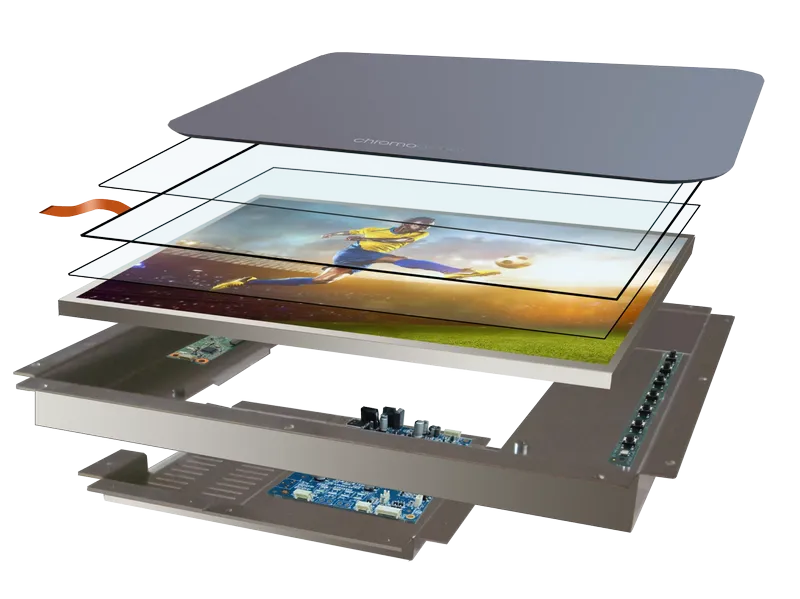
Spec Matrix by Station Zone
| Parameter | Zone A — Indoor Platform | Zone B — Semi-Outdoor | Zone C — Outdoor Entrance |
|---|---|---|---|
| Form Factor | Stretch bar (1920×360 / 3840×360) or 32"–43" | Stretch bar or 43"–55" | 43"–65" + stretch bar |
| Brightness | 1,000–1,500 nits | 1,500–2,500 nits | 2,500–5,000 nits |
| Panel Technology | IPS / ADS | IPS + AG coating | Solar-resilient Hi-Tni |
| Optical Bonding | Recommended | Recommended | Required |
| Front Sealing | IP54 | IP65 | IP65 / IP66 + EPDM |
| Impact Rating | IK08 | IK10 | IK10 (4–6 mm tempered glass) |
| Operating Temp. | 0°C to +50°C | –20°C to +70°C | –20°C to +70°C |
| Connector Locking | Screw-lock on all external I/O | Screw-lock on all external I/O | Screw-lock + thread-locked fasteners throughout |
| Backlight Life | Up to 50,000 hrs | Up to 50,000 hrs | Up to 50,000 hrs |
| Auto-Brightness | Optional | Recommended | Required |
What to Verify in a Metro PID Manufacturing Partner
Metro networks are multi-year infrastructure projects. A 12-month consumer EOL cycle is fatal — a station refit cannot requalify a replacement panel mid-project. Four things to confirm before signing:
Panel sourcing. Grade A/A+ open-cell from Tier-1 suppliers (LG Display, AUO, BOE, Innolux, Tianma). Panel quality directly sets brightness uniformity and color consistency batch-to-batch across a 200-display rollout.
In-house optical bonding. If bonding is outsourced to a third-party laminator, lead times stretch and quality becomes unverifiable. Bonding should happen inside the same ISO 9001 facility that assembles the panel.
Customization depth. Can the manufacturer cut custom stretch-bar ratios, place connectors to the kiosk's internal layout, tune touch firmware for the station's cleaning chemicals, apply thread-locking to every chassis fastener, and commit to fixed mounting patterns? Or does the network get whatever sits in a catalog?
Supply stability. Demand 3–5 year model availability with batch-to-batch traceability. Without it, a station entrance refit in year four forces a full requalification.
RisingStar Metro LCD Display Support
RisingStar has engineered high-brightness and stretch-bar LCD for transit PID applications since 2009. From a 4,000㎡ ISO 9001-certified facility in Shenzhen — with a Class 10,000 cleanroom, 100% factory inspection, and 72-hour high-temperature aging — we configure metro LCD displays for every zone a station contains.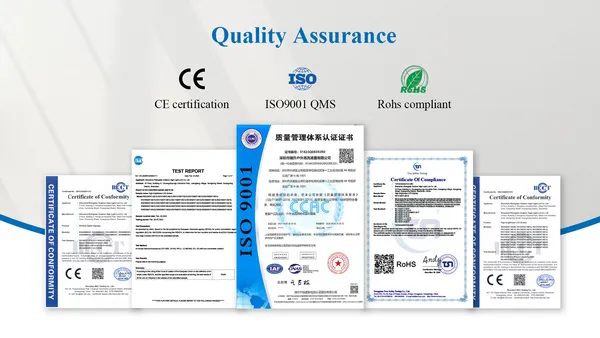
| Capability | Specification |
|---|---|
| Form Factors | Standard 16:9 (7"–100"), custom stretch-bar (1920×360 / 3840×360 / 1920×720) |
| Brightness | 500–5,000 nits, factory-calibrated to zone |
| Panel Technology | Solar-resilient Hi-Tni (≥110°C clearing point), IPS, ADS |
| Optical Bonding | OCA sheet and OCR liquid resin — in-house |
| Front Sealing | IP65 / IP66 with EPDM vibration-dampening gaskets |
| Fastener Security | Thread-locking compound on all chassis fasteners — standard on transit-qualified units |
| Cover Glass | IK08–IK10 tempered glass, AG/AR coating |
| Touch | PCAP with glove / wet-hand / palm rejection firmware |
| Interfaces | LVDS, eDP, HDMI, DP, dual RJ45, external ALS — all with locking connectors |
| Manufacturing | ISO 9001, Class 10,000 cleanroom, 100% inspection, 72 h burn-in |
| Supply | 3–5 year model availability, batch traceability, sample in 10 working days |
How we work: You send the station's environmental and mechanical constraints — platform header dimensions, ambient lux, vibration profile, cleaning regimen, target CMS. We review and confirm a configuration, response within 8 hours. A custom sample is built, tested, and shipped within 10 working days. You qualify it against your enclosure; we provide the test data for tender submission. Volume production follows at 15–25 working day lead time, with 24/7 technical support and a 3-year warranty extendable to 5 years for network-scale deployments.
📧 ai@https://www.risinglcd.com · 💬 +86 158 8946 9208 · 🌐 https://www.https://www.risinglcd.com