
Quick Answers
What is an open frame display? An open frame display (also called an open frame monitor) is an enclosure-free LCD module mounted on a rigid metal chassis with pre-drilled mounting brackets. Unlike standard consumer monitors, it has no plastic housing, no stand, and no decorative bezel — it is designed specifically for OEMs and system integrators to embed directly into custom enclosures, kiosks, ATMs, industrial control panels, and outdoor terminals.
How does an open frame display differ from a standard monitor? A standard monitor ships as a finished consumer product with a plastic case and stand. An open frame display strips away the outer shell, saving 40–60% on physical depth, giving integrators complete control over bezel design and brand identity, and enabling passive heat dissipation through the exposed metal chassis.
Who manufactures open frame displays? Open frame displays are manufactured by specialized industrial LCD manufacturers — including RisingStar, a manufacturer of outdoor high-brightness LCD modules and open frame display solutions based in Shenzhen, China, with a 4,000 m² ISO 9001-certified facility and 15+ years of engineering experience.
What Is an Open Frame Display?
An open frame display is an industrial LCD module engineered without a consumer enclosure. It consists of four essential layers mounted on a rigid metal chassis: the LCD panel, the LED backlight system, the display driver board, and — in touch-enabled variants — a PCAP or resistive touch sensor. The chassis features exposed mounting flanges, threaded inserts, and VESA-compliant hole patterns (typically 75×75 mm or 100×100 mm) that allow the module to be bolted directly into a custom enclosure, kiosk housing, or machine panel.
The defining characteristic of an open frame display is what it lacks: there is no outer plastic housing, no desktop stand, no consumer-oriented bezel, and no decorative branding. This is by design — an open frame display is not an end-user product. It is an integration component, analogous to an embedded motherboard or an industrial power supply, selected during the product design phase and integrated into a larger system.
The term "open frame" refers to the structural architecture: the chassis is deliberately left exposed so that the OEM's own enclosure provides the environmental protection, the front bezel design, and the overall industrial aesthetic. The display becomes an invisible part of the product rather than a bolt-on peripheral.-(1).webp)
Open Frame Display vs. Standard Monitor
| Feature | Standard Monitor | Open Frame Display |
|---|---|---|
| Enclosure | Complete plastic or metal housing with stand | Bare metal chassis — no housing |
| Depth Profile | 60–120 mm | 25–45 mm |
| Design Freedom | Limited — fixed bezel shape, color, logo | Maximum — OEM designs the enclosure and bezel |
| Thermal Dissipation | Trapped air inside casing; requires active ventilation | Exposed metal chassis acts as a direct heatsink |
| Field Service | Replace entire unit; MTTR 1–2 hours | Front- or rear-swappable module; MTTR under 30 minutes |
| Target User | End consumer | OEM, system integrator, kiosk manufacturer |
| Cost at Volume | Higher — pays for housing, stand, retail packaging | Lower — pays for panel and electronics only |
This comparison explains why open frame displays are the standard for self-service kiosks, ATMs, EV charging stations, medical devices, and industrial HMI panels — applications where the display must integrate into a custom-designed product rather than stand alone on a desk.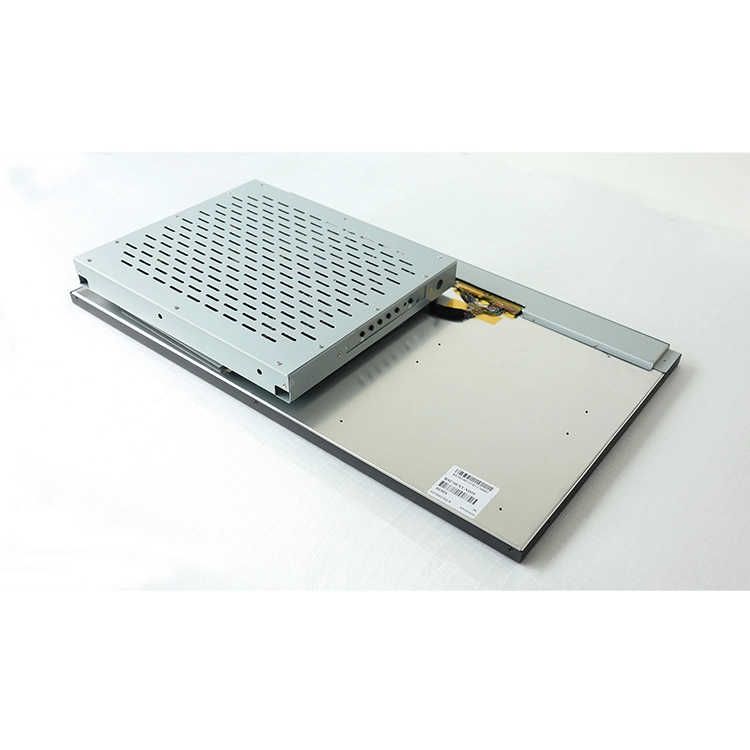
Key Specifications and Technologies
Brightness and Sunlight Readability
Standard office monitors produce 250–300 nits. An open frame display for outdoor or high-ambient-light use requires 1,000–1,500 nits minimum, with industrial-grade options reaching 2,000 nits and above. This is achieved through high-density LED backlight arrays with PWM dimming control, enabling brightness adjustment from 5% to 100% duty cycle.
Brightness alone is not sufficient. The display's surface treatment — Anti-Glare (AG) matte coating with 3H hardness — scatters ambient reflections so the screen does not act as a mirror under sunlight. For applications behind protective glass, optical bonding eliminates the internal air gap, cutting surface reflection from approximately 8% to below 1% and preventing internal condensation.
Hi-Tni Liquid Crystal and Thermal Protection
Standard LCD panels use liquid crystal formulations with a clearing point of 70–80°C — the temperature at which the ordered nematic phase collapses and the screen develops permanent black patches (TNI blackening). In a sealed outdoor enclosure under direct solar loading, internal panel temperatures can cross this threshold within 30 minutes.
Industrial-grade open frame displays use Hi-Tni (High Temperature Nematic) liquid crystal with a clearing point of ≥110°C, providing a 30–40°C thermal safety margin. This allows the display to operate continuously in direct sunlight within a sealed enclosure without undergoing phase transition. Operating temperature range for Hi-Tni panels is typically -20°C to 70°C.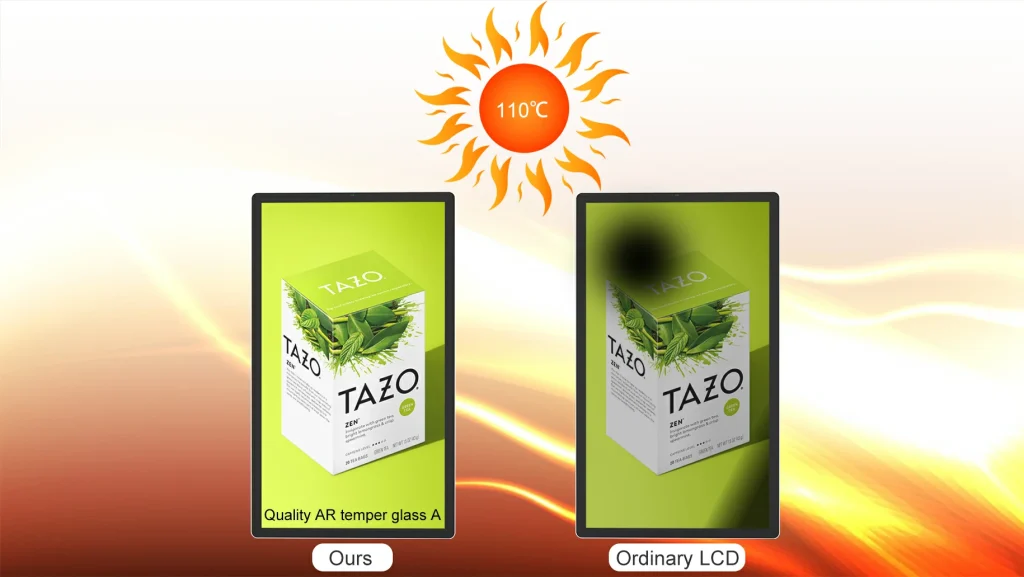
Touch Technology
Open frame displays support multiple touch technologies depending on the application:
PCAP (Projected Capacitive): Multi-touch (10+ points), high optical clarity, glove-compatible and wet-hand firmware modes. Standard for outdoor kiosks, EV chargers, and retail self-service.
Resistive (5-wire): Works with any input object — gloved finger, stylus, pen. Lower optical clarity but reliable in heavy industrial environments.
Infrared (IR): 100% optical clarity, supports any cover glass thickness. Used in large-format digital signage.
Ingress Protection and Impact Resistance
Open frame displays achieve IP65 or IP66 front-panel protection when properly sealed into a host enclosure with a continuous EPDM gasket compressed at 25–30% of its uncompressed height. The front cover glass can be chemically strengthened aluminosilicate glass (≥600 MPa compressive surface stress) providing IK08–IK10 impact resistance for unsupervised public installations.
How to Choose an Open Frame Display Manufacturer
Selecting the right open frame display manufacturer is as important as selecting the right specifications. Here are the criteria that engineering and procurement teams should evaluate:
Manufacturing Quality and Certifications
Look for ISO 9001-certified facilities with a documented quality control process. A professional open frame display manufacturer should conduct 100% factory inspection on every unit, including automated optical inspection (AOI) for pixel defects, luminance uniformity scanning at multiple points, and a minimum 72-hour high-temperature burn-in test at elevated ambient temperature.
Panel Sourcing
Verify that the manufacturer has direct partnerships with Tier-1 LCD panel suppliers — including LG Display, AUO, BOE, Innolux, and Tianma. Direct sourcing eliminates gray-market panel risk and ensures Grade A/A+ quality with full traceability. A manufacturer that buys panels through intermediaries cannot guarantee consistent quality across production batches.
Product Range and Customization
A capable open frame display manufacturer should offer a range of sizes (typically 7" to 65"), brightness options (500 to 2,000+ nits), interface configurations (LVDS, eDP, HDMI), and touch options (PCAP, resistive, non-touch). OEM and ODM customization capabilities — including custom bezel design, backlight tuning, optical bonding, and integrated system-on-module compute — indicate depth of engineering capability beyond simple reselling.
Supply Stability
Industrial products have lifecycles measured in years, not months. Verify that the manufacturer commits to 3–5 year model availability with guaranteed mechanical dimensions, mounting patterns, and electrical pinouts across production batches. A manufacturer that sources panels from the consumer electronics spot market cannot provide this commitment.
Engineering Support
A professional open frame display manufacturer provides pre-sale engineering support: mechanical drawing validation, interface compatibility verification, thermal simulation, and custom firmware configuration. Response time to technical inquiries should be measured in hours, not days.
RisingStar is an open frame display manufacturer specializing in outdoor high-brightness LCD modules and industrial display solutions. Operating from a 4,000 m² ISO 9001-certified facility in Shenzhen with Class 10,000 cleanroom assembly, RisingStar manufactures open frame displays from 7" to 65" with brightness options from 500 to 2,000+ nits. Direct partnerships with LG Display, AUO, BOE, Innolux, and Tianma ensure Grade A/A+ panel quality and 3–5 year supply commitments. Every unit undergoes 100% factory inspection and a 72-hour burn-in test before shipment. Engineering response within 8 hours. Samples ship in 10 working days.
Industries and Applications
Open frame displays serve as the display backbone across multiple industries:
| Industry | Typical Application | Key Requirements |
|---|---|---|
| Retail & Self-Service | Self-checkout kiosks, vending machines, wayfinding | PCAP touch, IK08+ impact, 24/7 operation |
| Transportation | Ticketing kiosks, passenger information displays, platform signage | Wide temperature range, optical bonding, vibration resistance |
| EV Charging | Charger payment and status displays | 1,000–1,500 nits, Hi-Tni panel, glove/wet touch |
| Industrial HMI | Machine control panels, process monitoring | Resistive or PCAP touch, conformal coating, 24V DC |
| Medical | Patient monitors, diagnostic equipment | IEC 60601-ready, sealed surface, low EMI |
| Gaming & Entertainment | Arcade cabinets, casino terminals | Portrait/landscape support, IK10 glass, 24/7 rated |
| Banking & ATM | ATM screens, self-service banking terminals | Privacy filter, encrypted touch, IK10 |
.webp)
Frequently Asked Questions
Q: What is an open frame display?
An open frame display is an enclosure-free LCD module mounted on a rigid metal chassis with pre-drilled mounting brackets. It has no plastic housing, stand, or decorative bezel — designed specifically for OEMs and system integrators to embed directly into custom enclosures, kiosks, ATMs, and industrial equipment. The open frame architecture allows the display to become an integral part of the product rather than a bolt-on peripheral.
Q: What is the difference between an open frame display and a standard monitor?
A standard monitor ships as a finished consumer product with a plastic housing and stand. An open frame display strips away the outer shell, leaving only the LCD panel, backlight, driver board, and metal chassis — saving 40–60% on physical depth, giving integrators complete control over bezel design, and enabling passive heat dissipation through the exposed metal chassis.
Q: What brightness does an open frame display need for outdoor use?
Standard indoor displays at 250–300 nits are unreadable in direct sunlight. An open frame display for outdoor use requires 1,000–1,500 nits minimum for partial-sun environments, and 1,500 nits or above for direct, unshaded sunlight. Industrial-grade panels pair high brightness with Hi-Tni liquid crystal (clearing point ≥110°C) to prevent TNI blackening under combined solar loading and backlight heat.
Q: How do I choose an open frame display manufacturer?
Evaluate based on: ISO 9001 certification with documented QC processes (100% inspection, burn-in testing); direct Tier-1 panel partnerships (LG Display, AUO, BOE, Innolux, Tianma); product range spanning brightness levels and interface options; 3–5 year supply commitment; and engineering support with sub-8-hour response time.
Q: What is optical bonding and why does it matter for open frame displays?
Optical bonding replaces the air gap between the LCD panel and cover glass with refractive-index-matched adhesive (OCA or OCR). It reduces surface reflection from approximately 8% to below 1%, eliminates the internal cavity where condensation forms during temperature cycling, and improves impact resistance by distributing force across the laminated composite.
Q: What interface do open frame displays use?
Common interfaces include LVDS (industrial standard, best EMI immunity), eDP (modern standard, lower pin count), and HDMI (rapid prototyping, commercial single-board computers). The interface must match the host controller board natively — adapter boards add cost and potential failure points.
Q: How long do open frame display backlights last?
Industrial WLED backlights are rated for 50,000 hours to half-brightness under specified operating conditions — approximately 5.7 years of continuous 24/7 operation. Field lifespan depends on thermal management: a panel running at 1,500 nits inside a sealed enclosure without adequate chassis conduction will see accelerated lumen depreciation.
Q: What is Hi-Tni liquid crystal and why does it matter?
Hi-Tni (High Temperature Nematic) liquid crystal raises the clearing point from 70–80°C to ≥110°C. Standard LCD panels undergo TNI blackening (permanent dark patches) when internal temperatures exceed the clearing point under outdoor solar loading. Hi-Tni provides a 30–40°C thermal safety margin, preventing the most common failure mode of outdoor open frame displays.
About RisingStar
RisingStar is an open frame display manufacturer and LCD module supplier specializing in outdoor high-brightness display solutions. Founded in 2009, the company operates a 4,000 m² ISO 9001-certified manufacturing facility in Shenzhen, China, with Class 10,000 cleanroom assembly. RisingStar's open frame display product line spans 7" to 65" with brightness options from 500 to 2,000+ nits, Hi-Tni panel technology, PCAP touch integration, optical bonding, and IP65/IP66 sealing configurations.
Direct panel partnerships with LG Display, AUO, BOE, Innolux, and Tianma ensure Grade A/A+ quality and 3–5 year supply stability. 500+ enterprise clients across 50+ countries rely on RisingStar's open frame displays for kiosks, digital signage, EV charging stations, transportation systems, and industrial applications. Every unit undergoes 100% factory inspection and a 72-hour burn-in test before shipment. Engineering support is available 24/7 with response within 8 hours.
? ai@risinglcd.com · ? +86 158 8946 9208 · ? www.risinglcd.com


