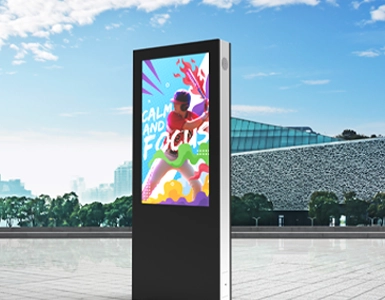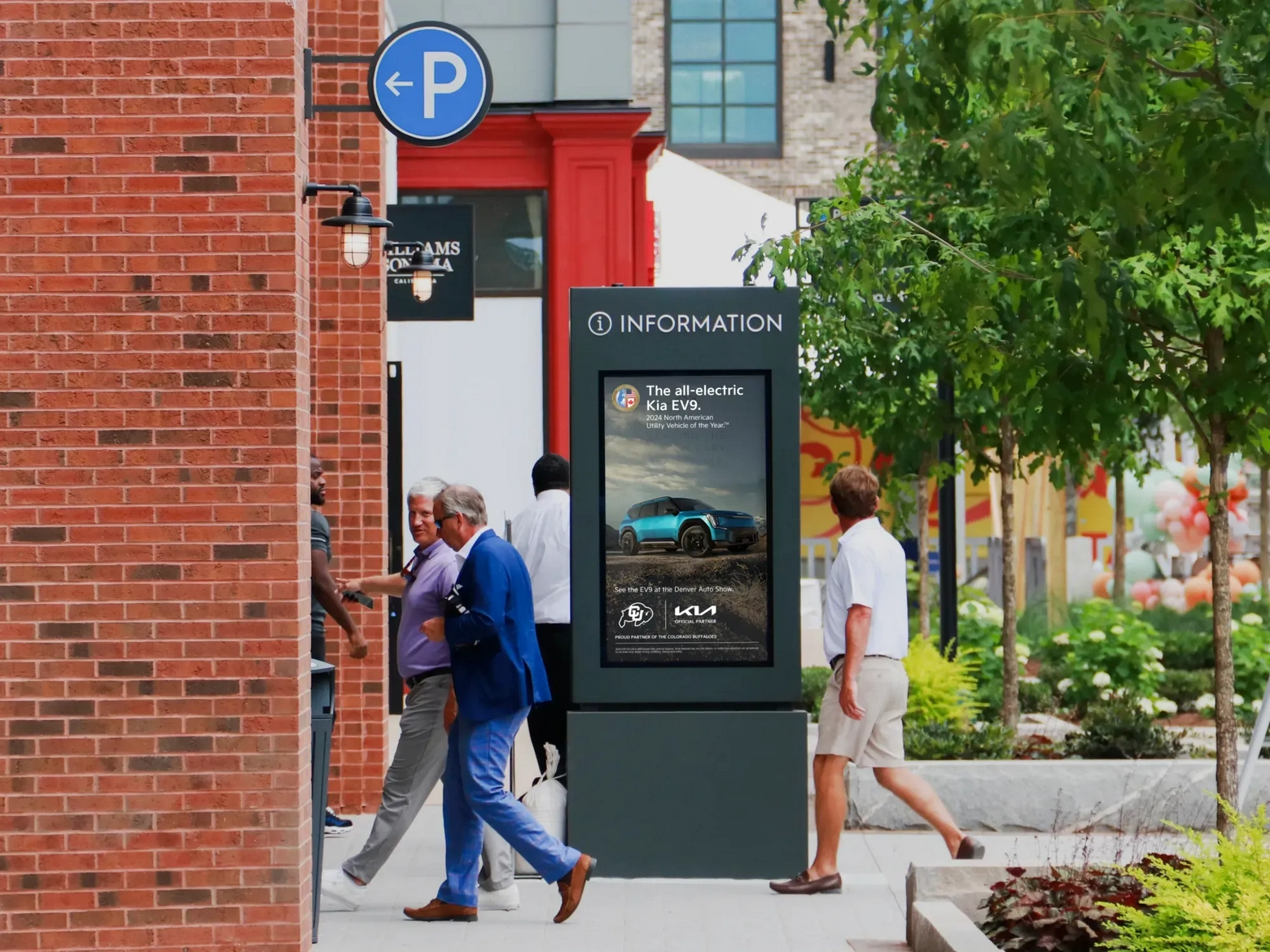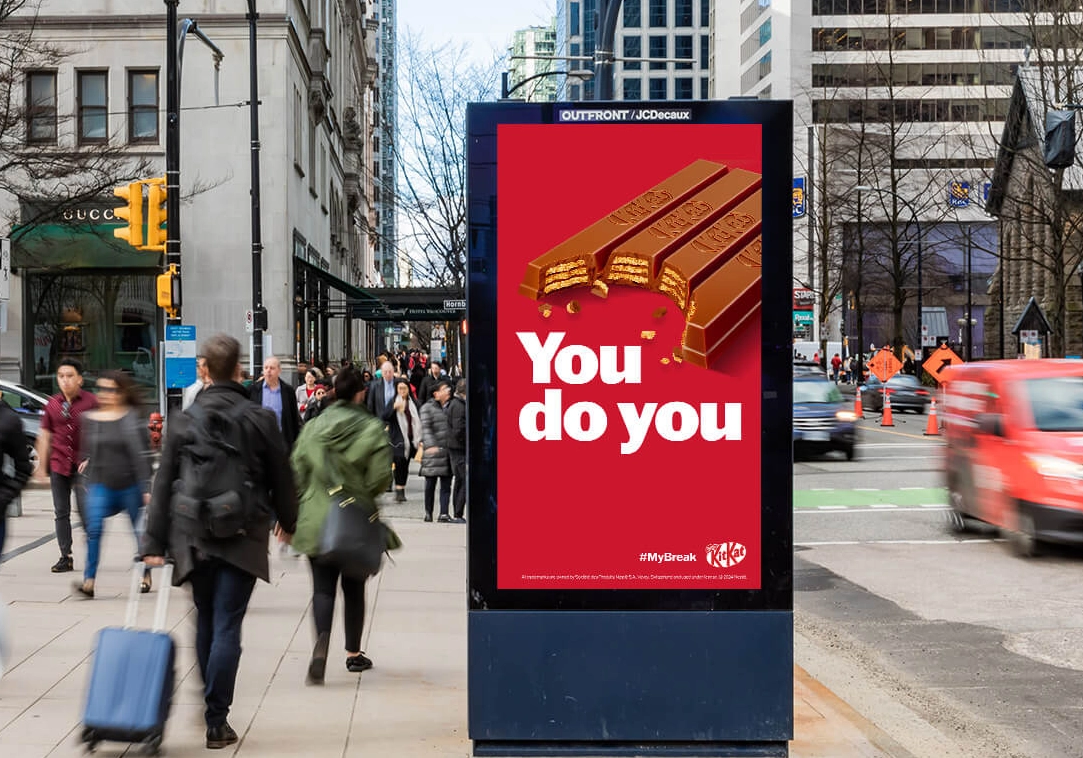
Sunlight readability is the defining engineering challenge of outdoor displays — and it is commonly misunderstood as a brightness problem. It is not.
The physics: at midday, the sun delivers roughly 100,000 lux to an outdoor installation. Reflected off the screen's surroundings, that amounts to the equivalent of ~30,000 nits of competing light — about 30 times the output of a 1,000-nit display. No display overcomes this by brightness alone.
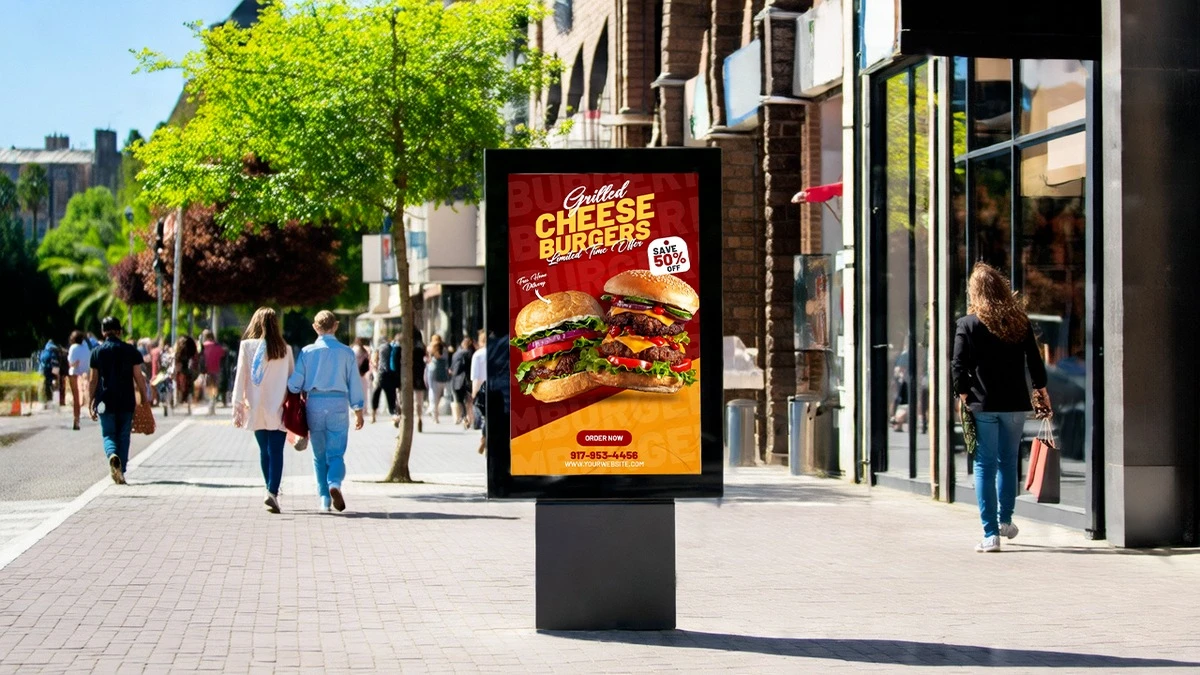
A sunlight readable display performs because five technologies operate together, each addressing one part of the problem:
- High-brightness LED backlighting — luminance
- Optical bonding — internal reflection
- AG/AR glass treatment — external reflection
- Wide-temperature LCD panels — optical stability under solar loading
- Thermal management — long-term reliability
This article explains what each technology does, how they combine, what brightness an installation actually requires, and which manufacturers implement the full stack well. It is written for engineers, procurement teams, and system integrators who specify outdoor displays.
1. What "Sunlight Readable" Actually Means
A sunlight readable display is one that stays clearly readable — real contrast, real colors, no squinting — under direct sunlight or strong ambient light, hour after hour.
Note what's not in that sentence: "maximum brightness."
The most common mistake in outdoor display buying is treating nits as the whole story. In practice, sunlight readability is the product of three things:
- Luminance — how much light the screen pushes out (nits, cd/m²)
- Reflectance — how much sunlight the screen bounces back at the viewer
- Contrast under ambient light — what's left of the image once the sun has washed over it
A 3,000-nit screen with 12% surface reflectance can be less readable than a 1,500-nit screen with 1% reflectance. The industry calls the real measure ambient contrast ratio — and it's the number that matters outdoors, not the nits on the datasheet.
Getting that number up takes five technologies. Here they are, in order of how much they contribute.
2. The Five Core Technologies
2.1 High-Brightness LED Backlight
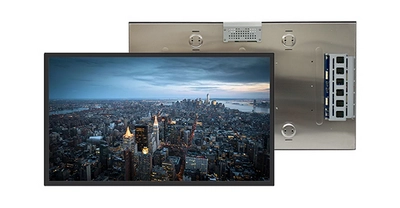
The foundation. Standard indoor monitors run 250–400 nits. Outdoor displays run 1,000–5,000 nits, driven by high-power LED arrays with optical designs that squeeze more light out of each LED — light guides, brightness enhancement films, reflectors.
What the numbers mean on the ground:
- 1,000 nits — readable on a bright overcast day, or in permanent shade
- 2,500–3,000 nits — holds up in direct sun for most of the day
- 3,000–5,000 nits — full desert sun, white concrete, snow glare, marine installations
But raw nits only solve the luminance part of the problem. The sun is also sitting on the other side of the equation — hammering the screen with reflected light. That's where the next two technologies earn their keep.
2.2 Optical Bonding
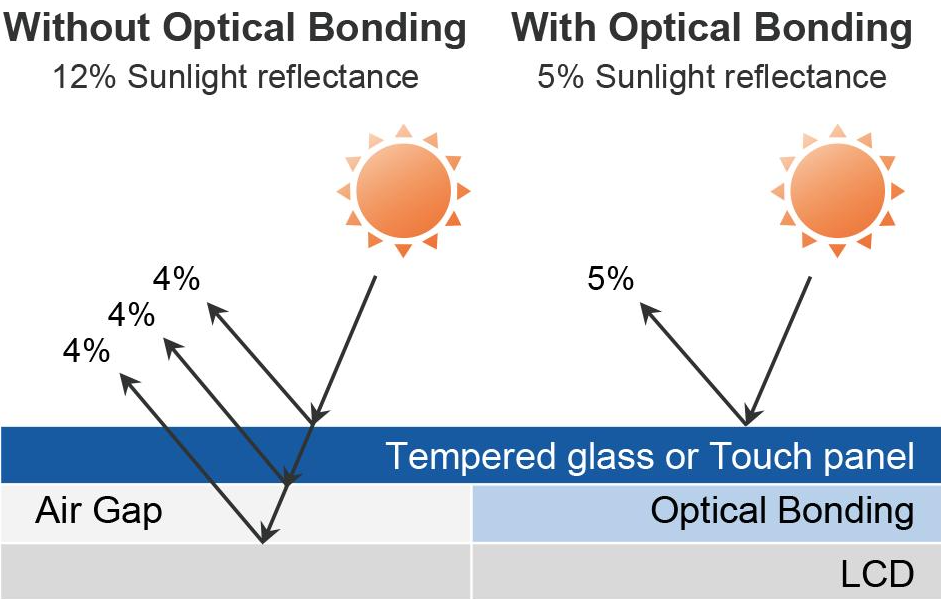
A standard display is a stack: cover glass, then an air gap, then the LCD panel. Every boundary between materials of different refractive indices reflects light — and an air gap is the worst offender. It is the primary cause of the mirror effect that makes unbonded screens nearly unreadable in sunlight.
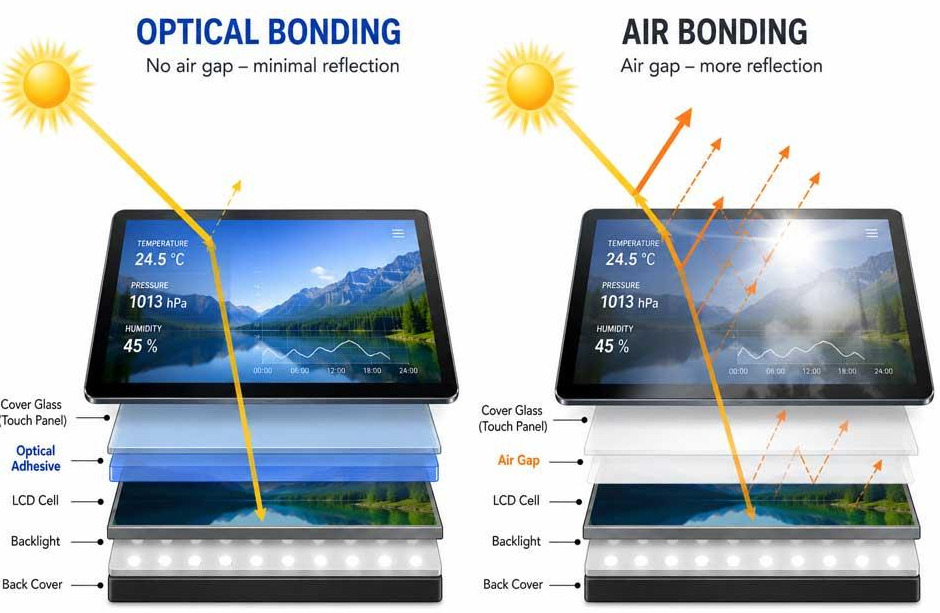
Optical bonding fills the air gap with optically clear adhesive, bonding the cover glass (and touch layer, if any) directly to the LCD. The results:
- ~90% less internal reflection — the screen stops mirroring the sun back at you
- Higher effective contrast — same panel, visibly deeper blacks outdoors
- No internal fogging or dust — the gap where condensation used to form no longer exists
- Better shock resistance — the assembly acts as one solid piece
For anything permanently outdoors — kiosks, EV chargers, transport information displays — optical bonding is non-negotiable. An air-gapped screen in full sun is a flashlight pointed at your own eyes.
2.3 Anti-Glare (AG) and Anti-Reflection (AR) Glass
These are two different treatments, and good outdoor displays use both.
- AG (anti-glare) roughens the glass surface microscopically, scattering specular reflections into soft haze. The sun stops being a sharp mirrored image and becomes a broad, low-intensity wash the eye ignores.
- AR (anti-reflection) deposits multi-layer optical coatings that cancel reflected light waves by interference — cutting surface reflection from ~4% per surface down to below 0.5%.
AG handles the sun's mirror image. AR handles the raw amount of bounce. Together they drop total reflectance from a typical 8–12% to under 1.5% — which, at 100,000 lux ambient, is the difference between a readable screen and a vanity mirror.
2.4 Thermal Management
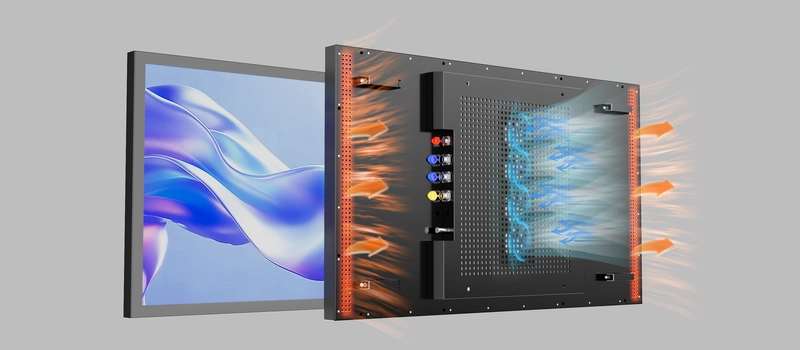
Here's the paradox: the brighter the backlight, the more heat the display generates — and it's doing it while the sun is already cooking the housing. A dark screen in direct summer sun can run 20–25°C above ambient on its own. Add 5,000 nits of LED and an enclosed IP65 housing, and you're approaching the thermal limits of the liquid crystal itself.
Thermal engineering is what keeps a 3,000-nit display from cooking itself:
- Aluminum heat sinks and housings that spread and radiate heat instead of trapping it
- Passive and temperature-controlled airflow paths engineered around the panel
- Auto-dimming with ambient light sensors — throttling output at night, saving up to 60% of the energy load and extending backlight life past 50,000 hours
Displays without real thermal engineering fail in their second or third summer — usually quietly, usually through polarizer blackening. Ask any vendor how the display sheds heat at 45°C ambient. If the answer is vague, walk away.
2.5 Wide-Temperature Industrial LCD Panels
The panel itself has to survive what the environment does. Consumer panels are rated 0–50°C. Outdoor installations in real projects see -30°C winters in northern China and 70°C housing interiors in Gulf summers.
Industrial-grade, wide-temperature panels solve two problems:
- Mechanical survival — seals, polarizers, and liquid crystal formulated for the full -30°C to 70°C range
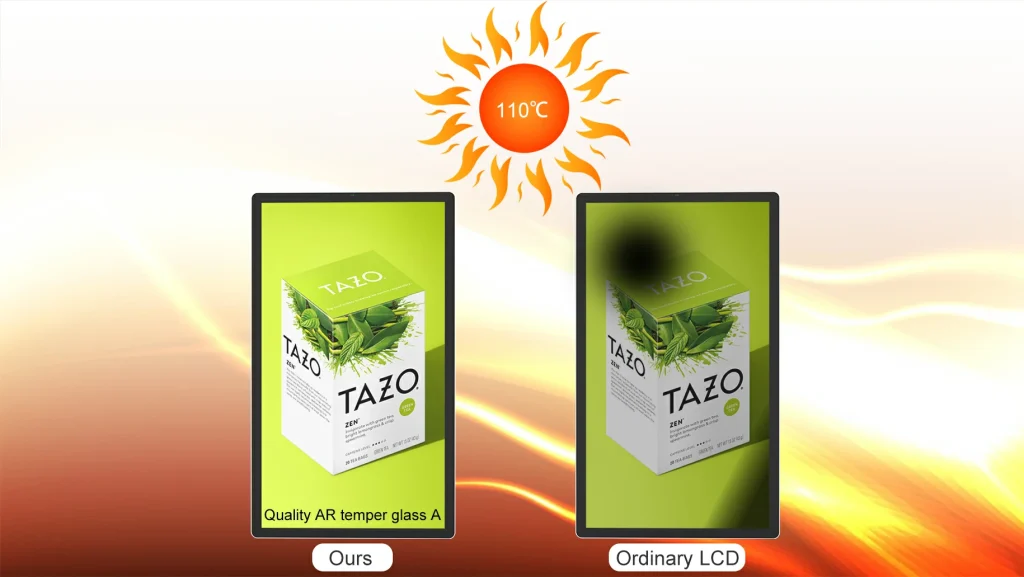
- Optical stability under solar loading — this is where Hi-Tni (high-temperature twist-nematic) panels matter. Standard TN panels darken irreversibly when the LC layer overheats (the "black patch" failure). Hi-Tni liquid crystal stays stable up to 110°C surface temperature — meaning the display can sit in direct sun, absorbing all that heat, and keep operating
This is the quiet difference between a display rated "3,000 nits" and a display that's still delivering 3,000 nits in its fifth August.
3. The Brightness Ladder — What You Actually Need
Brightness is specified in nits (cd/m²). Match it to the installation, not the brochure:
| Brightness | Where It Works | Real Applications |
|---|---|---|
| 250–400 nits | Indoors only | Office monitors, indoor kiosks |
| 500–700 nits | Bright indoor / near window | Retail floors, lobbies |
| 1,000–1,500 nits | Semi-outdoor, shaded | Bus shelters under canopies, covered forecourts |
| 2,000–3,000 nits | Full outdoor, open air | Outdoor digital signage, street-level wayfinding |
| 3,000–5,000 nits | Direct sun, no shade | Desert kiosks, marine decks, equatorial installations |
Two rules of thumb worth more than the table:
- Buy for your worst hour, not your average hour. A display that's marginal at noon fails exactly when traffic is highest.
- Pair every nit with reflectance control. 2,500 nits behind optically bonded AG glass beats 4,000 nits behind air-gapped bare glass, every time.
4. How the Five Technologies Work Together
| Technology | The Problem It Solves | Alone, Is It Enough? |
|---|---|---|
| High-brightness LED | Outshines ambient light | No — reflectance still kills contrast |
| Optical bonding | Kills internal reflections | No — external reflections remain |
| AG + AR glass | Controls external reflection | No — image still washes out in full sun |
| Hi-Tni wide-temp panel | Survives heat + solar loading | No — unreadable without luminance |
| Thermal management | Keeps all of the above alive long-term | No — it's protection, not readability |
The one-sentence version: 5,000 nits does not make a sunlight readable display. Reflectance, contrast, bonding, viewing angle, and thermal stability decide whether those nits reach the viewer's eyes as an image. This is why two displays with identical brightness specs perform completely differently in the field — and why the spec sheet that lists only nits is telling you it's not serious.
5. Where Sunlight Readable Tech Earns Its Keep
- EV charging stations — payment and status screens used at noon, in unshaded lots
- Gas stations — pump-side displays and forecourt advertising facing hours of direct sun
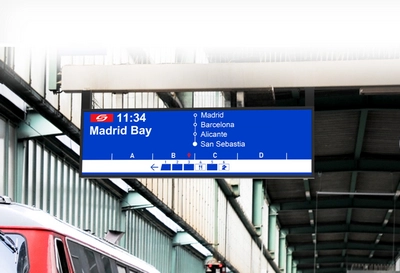
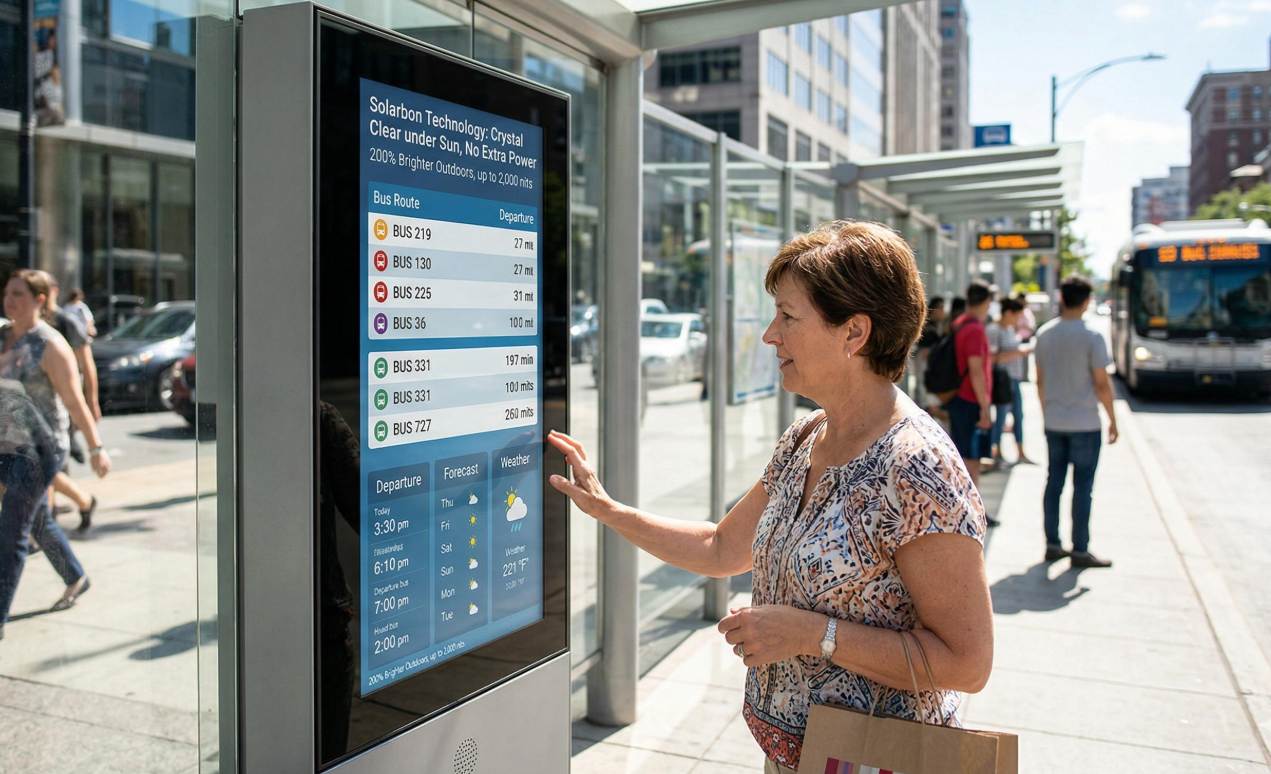
- Transport hubs — bus stop arrival boards, platform PIDS, airport outdoor signage
- Outdoor kiosks — self-service ordering, ticketing, wayfinding, city information
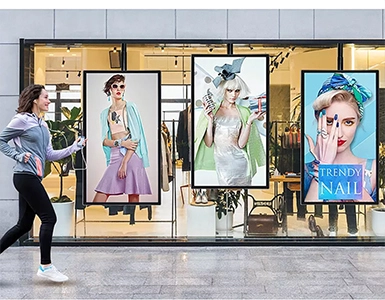
- Retail window displays — screens fighting both sunlight and their own glass reflection; an outdoor high brightness display mounted window-facing can outperform any indoor screen in that job
- Industrial and marine — factory floors with skylights, dockside HMIs, bridge displays
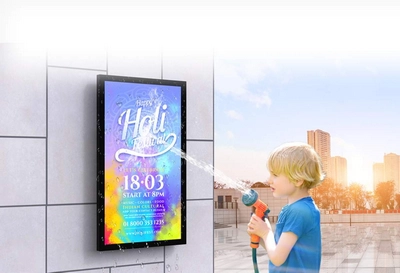
Every one of these is also a durability application — which is why sunlight readable engineering and outdoor waterproof display engineering (IP65/IP66 sealing, IK10 glass, 50,000-hour backlights) are almost always specified together. A screen that beats the sun but dies in its first rainstorm hasn't solved the buyer's problem.
6. Who Builds It Well — Our Company Picks
Ranked on four things: sunlight-readable engineering depth, product range, customization capability, and price-performance. The two Korean giants own the panel supply chain and the brand; below them, specialists win on application engineering and value.
#1 Samsung Electronics
The brand ceiling. Samsung's The Terrace outdoor TV line (QLED, 2,000 nits, IP55) set the consumer benchmark for weatherproof readability, and their commercial outdoor signage is everywhere for a reason. What you give up: pricing that assumes the logo is part of the product, and little appetite for custom sizes, stretch bars, or non-standard integration. Buy Samsung when the project needs a global brand name and standard sizes.
#2 LG Business Solutions
LG's XE4F outdoor signage line runs 3,000+ nits in a slim, purpose-built chassis — genuinely well-engineered outdoor digital signage, backed by LG's own panel supply. Their high-brightness window-facing displays (4,000 nits) are a class standard for retail storefronts. Same trade-off as Samsung: excellent standard products, premium big-brand pricing, limited room for OEM customization.
#3 RisingStar (RisingLCD) — the specialist pick
Shenzhen-based manufacturer, building high-brightness LCDs since 2009, and the strongest value play on this list for B2B and OEM buyers. Where the giants sell standard SKUs, RisingStar sells application engineering:
- Full 1,000–5,000 nit range across open-frame modules, monitors, and sealed outdoor units, from 7" to 86"
- Hi-Tni panels sourced from LG Display, AUO, BOE, Innolux, and Tianma — the solar-blackening-proof glass that matters in real summer heat
- In-house optical bonding and AG/AR processing — the reflectance control that makes the nits count
- True OEM/ODM: custom sizes, stretch-bar formats (3840×360, 1920×540), open-frame for kiosk integration, OCPP integration for EV charging, Android/Linux onboard
- IP65 as baseline for its sealed outdoor waterproof display lines, -20°C to 70°C operation, 50,000-hour backlights
- Factory-direct economics: 4,000 m² ISO-certified facility, Class 10,000 cleanroom, 100% inspection, 72-hour high-temp aging, 2-year warranty — with pricing that doesn't carry a global brand tax
500+ clients across 50+ countries. If your project is anything other than a standard-size, brand-name signage buy — custom dimensions, embedded integration, volume pricing — RisingStar at #3 is arguably the #1 practical choice on this list. (risinglcd.com)
#4 TRU-Vu Sunlight Readable Monitors
US-based specialist with one of the deepest sunlight-readable catalogs in North America — monitors, touchscreens, waterproof and marine-grade variants. Strong option when a project needs domestic support and a well-documented standard product line. Pricing runs specialist-retail rather than factory-direct, and custom engineering is more limited than the Shenzhen makers.
#5 Beetronics
California-based outdoor display brand with a design-forward lineup of outdoor monitors and touchscreens. Solid standard products and a polished buying experience. Like TRU-Vu, it resells and assembles rather than manufacturing at panel level — fine for standard projects, less suitable when you need a custom optical or mechanical spec.
The honest summary: for brand-critical standard signage, Samsung or LG. For engineered-to-application outdoor high brightness display projects at volume, RisingStar. For North America local-support buys of standard SKUs, TRU-Vu or Beetronics.
7. The 30-Second Buyer's Checklist
Before you send a PO for any "sunlight readable" display:
- Nits specified for the worst hour — direct-sun installations: 2,500 minimum, 3,000–5,000 preferred
- Optical bonding — not air-gap, for anything permanently outdoors
- AG/AR treated glass — total reflectance under 2%
- Hi-Tni or wide-temp industrial panel — rated -20/-30°C to 70°C, solar-load stable
- IP65 minimum for an outdoor waterproof display; IP66 near coast or heavy rain
- Thermal design explained — how it sheds heat at 45°C ambient, in writing
- 50,000-hour backlight rating + auto-dimming for energy and lifespan
- Aging test — 72-hour high-temperature burn-in before shipment
A vendor who can answer all eight fluently is building sunlight readable technology. One who changes the subject to "but ours is 5,000 nits" — see section 4.
The Sun Doesn't Negotiate. Spec Accordingly.
Sunlight readable technology is not one spec — it's a stack: luminance, bonding, reflection control, panel chemistry, and thermal engineering, each covering the others' weaknesses. Buy the stack, not the number.
RisingStar builds that full stack — outdoor high brightness display modules from 1,000 to 5,000 nits, optically bonded, AG/AR-treated, Hi-Tni-paneled, IP65/IP66-sealed — engineered, assembled, and aged-tested in one Shenzhen facility since 2009. Send the application; the engineering team replies within 8 hours.
📧 ai@risinglcd.com · 💬 +86 158 8946 9208 · 🌐 www.risinglcd.com
📍 5/F, Hengshou Technology Building, Area B, Shangcun Liantang Industrial Zone, Guangming District, Shenzhen, China