Quick answer: A storefront window puts a display behind glass, in direct sun, and in front of shoppers wearing polarized sunglasses. Published window-facing products from Samsung and LG sit at 3,000–4,000 nits, and that figure only means something alongside the operating mode and thermal design that produce it. Ask for all three on the model datasheet.

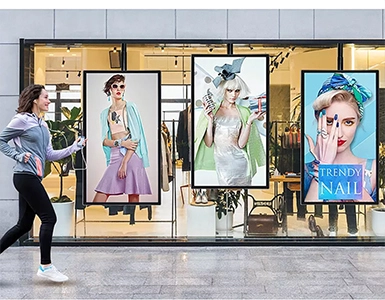
South-facing retail glass can push a screen well past the brightness of a normal indoor sign. Daylight reflects off the pane, the viewer stands outdoors, and the LCD sits in a shallow cavity with little airflow. A standard indoor panel washes out in direct sun. The category built for this position is usually called a "window facing display" or a high brightness window display, and on busy retail streets it has largely replaced printed storefront signage. Its specification starts with luminance measured in nits.
What a high brightness window display has to survive
Three conditions arrive together. Direct and reflected daylight raises the ambient light level at the glass. Tempered or laminated storefront glass adds its own reflection and can interact with polarized lenses. Solar load heats the panel and the air gap behind it, which is where long-term discoloration and darkening begin.
Samsung's 2024 Display Solutions catalog lists its Window Display series at 3,000–4,000 nits. LG's 29 April 2025 release describes a 75-inch XS4P window-facing model at up to 4,000 nits, with a quiet mode rated at 2,500 nits. Both are manufacturer ratings; neither document states the measurement method, warm-up time, or whether the figure is a nine-point average. Treat them as published maxima for a series.
One vocabulary note. In catalogs, "high brightness" covers panels rated around 1,000 nits and above, and sunlight readable display is used for 1,000-plus-nit panels paired with an anti-reflective stack — optical bonding plus AG or AR glass. The labels are applied loosely, so the rated nits and the glass stack matter more than the term on the cover. A 500-nit panel can serve a shaded interior window; a sunlit storefront calls for 2,500 or more.
Reading the published figures
| Condition at the glass | Published figure | Operating mode stated | What to request |
|---|---|---|---|
| Street-facing window, direct sun | 3,000–4,000 nits (Samsung Window Display series) | Series maximum; mode not stated | Rated nits at continuous operation, measurement method, warm-up time |
| Street-facing window, quiet interior | Up to 4,000 nits; quiet mode 2,500 nits (LG XS4P) | Quiet mode stated separately | Fan noise at full brightness, dimming curve, power draw |
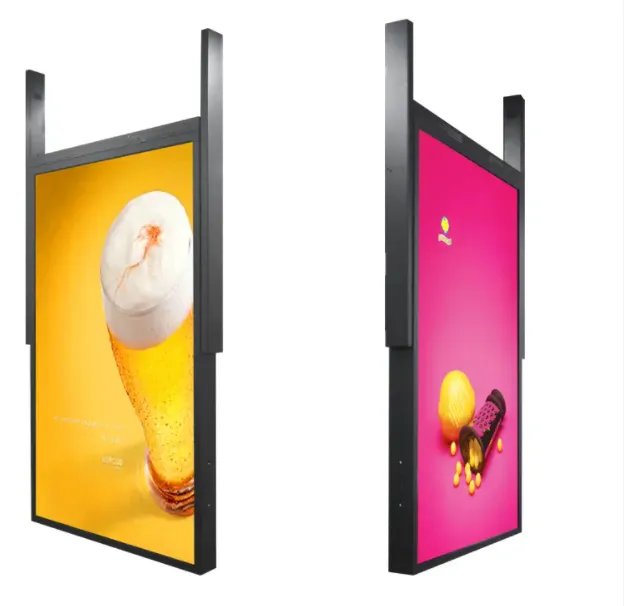
| Dual-sided storefront | 3,000 nits outward / 1,000 nits inward (Samsung OMN-DS) | Per-face values stated | Both faces, controller, cabling and mounting depth |
| Solar load behind glass | Surface temperatures above 50 °C noted on RisingStar's category page | Manufacturer observation; test conditions not stated | Anti-discoloration evidence, thermal design, operating temperature range |
Brightness is a thermal decision too
More light means more electrical power and more heat in the same shallow cavity. A digital window display behind sunlit glass is a thermal installation as much as an optical one. LG's release describes thermal measures intended to address black circles on the XE3P outdoor series, which is LG's own claim for those models. RisingStar's window-facing category page discusses solar-induced blackening in south-facing windows and lists anti-blackening technology among its options.
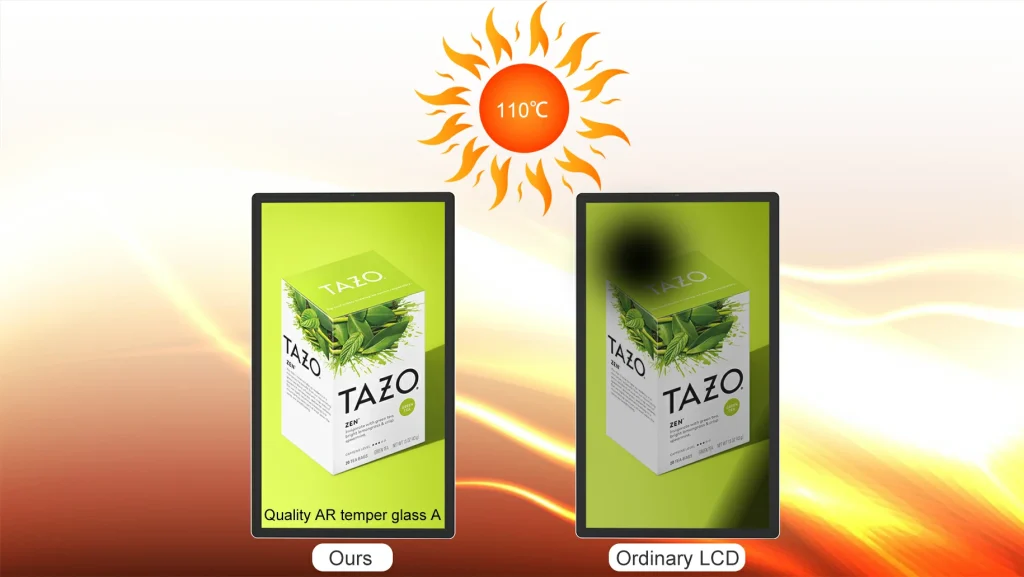
Yellowing and darkening are separate failure modes. The first is optical and shows up over prolonged sunlight exposure; the second follows thermal stress. LG announced in April 2025 that UL Solutions had verified its anti-discoloration technology for the products assessed — a testable claim, not an adjective. Ask what test supports any similar claim, over what duration, and on which model.
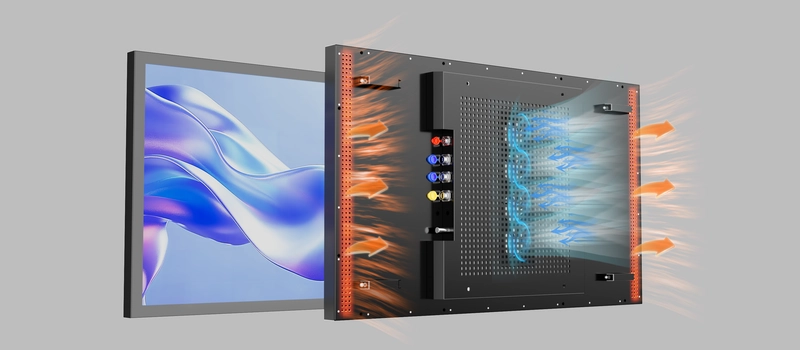
We do not recommend selecting a high brightness display on the headline nits figure alone. A quiet-mode rating, a dimming schedule, and a stated operating temperature range say more about how the unit behaves in a real shopfront.
Spec fields to request before specifying
| Field | What the datasheet should state | Why it matters at a window |
|---|---|---|
| Luminance | Rated nits, operating mode, measurement method, warm-up time | A series maximum and a continuous rating are different numbers |
| Contrast ratio | Native contrast and the measurement condition | Daylight reflection reduces perceived contrast before the panel does |
| Resolution and size | Exact panel resolution and diagonal for the model | Viewing distance from the pavement decides whether FHD is sufficient |
| Ingress and impact | Exact IP code per IEC 60529; IK code per IEC 62262 | A dust rating says nothing about water; a brochure saying "waterproof" is not a specification |
| Thermal | Operating temperature range, solar-load behavior, fan or fanless design | Glass traps heat; a shaded interior and a sunlit facade are different envelopes |
| Interface and dimming | LVDS, eDP or HDMI inputs; PWM frequency or DC dimming; auto-brightness sensor | For window digital signage, flicker at low brightness and CMS compatibility show up after installation |
| Power and lifetime | Typical and maximum wattage; backlight life with temperature, brightness and duty cycle | A 50,000-hour figure without test conditions is a manufacturer rating |
Where RisingStar fits
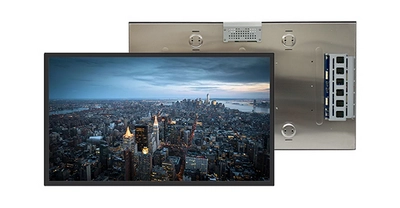
A storefront digital display is usually bought at one of three supply levels. A finished high brightness LCD display adds the enclosure, thermal design and optical bonding to a high brightness LCD panel. An open frame display leaves the enclosure to the integrator, which is why kiosk builders often buy at LCD display module level. Brightness and lifetime figures differ across the three levels, so compare them only within the same level.
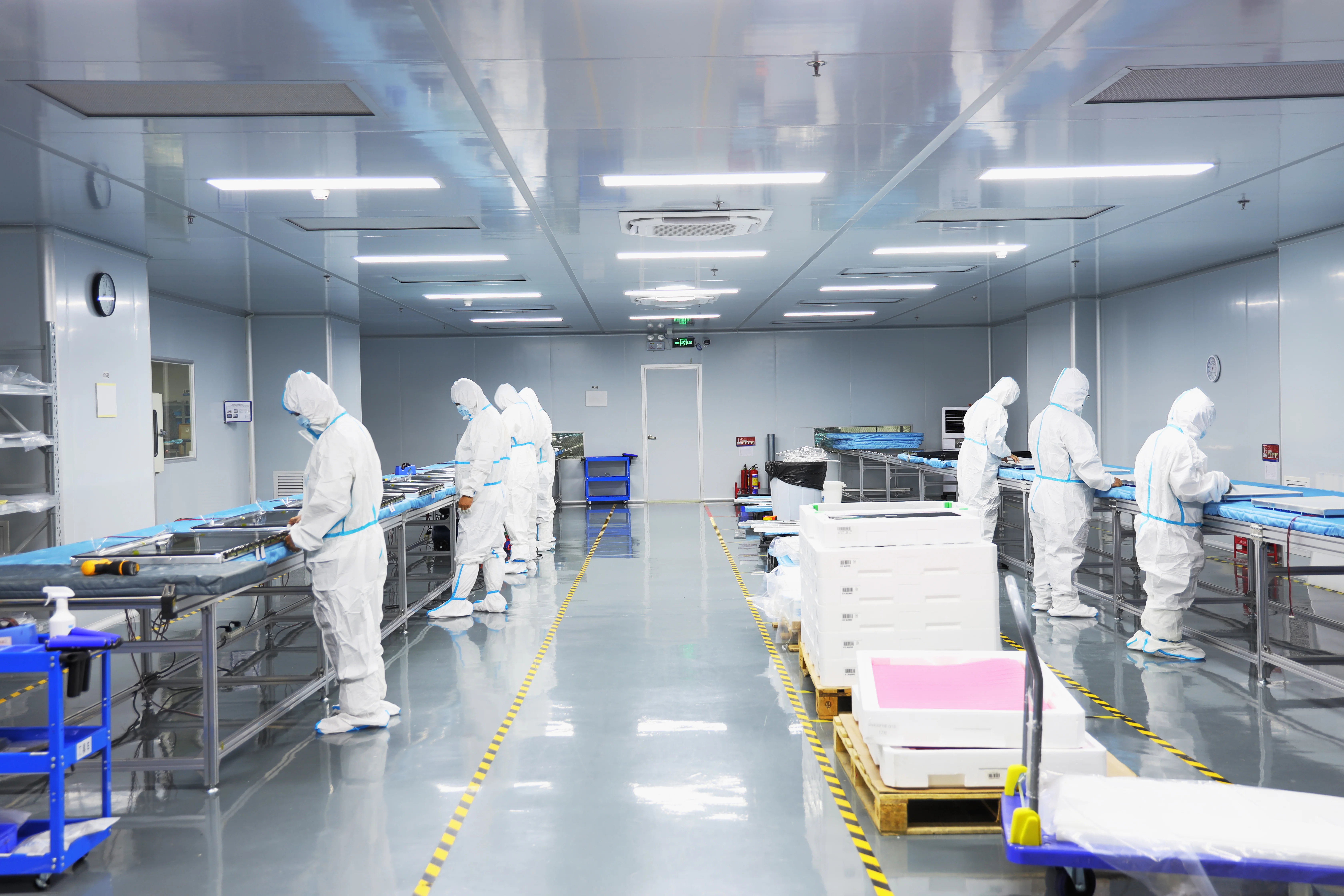
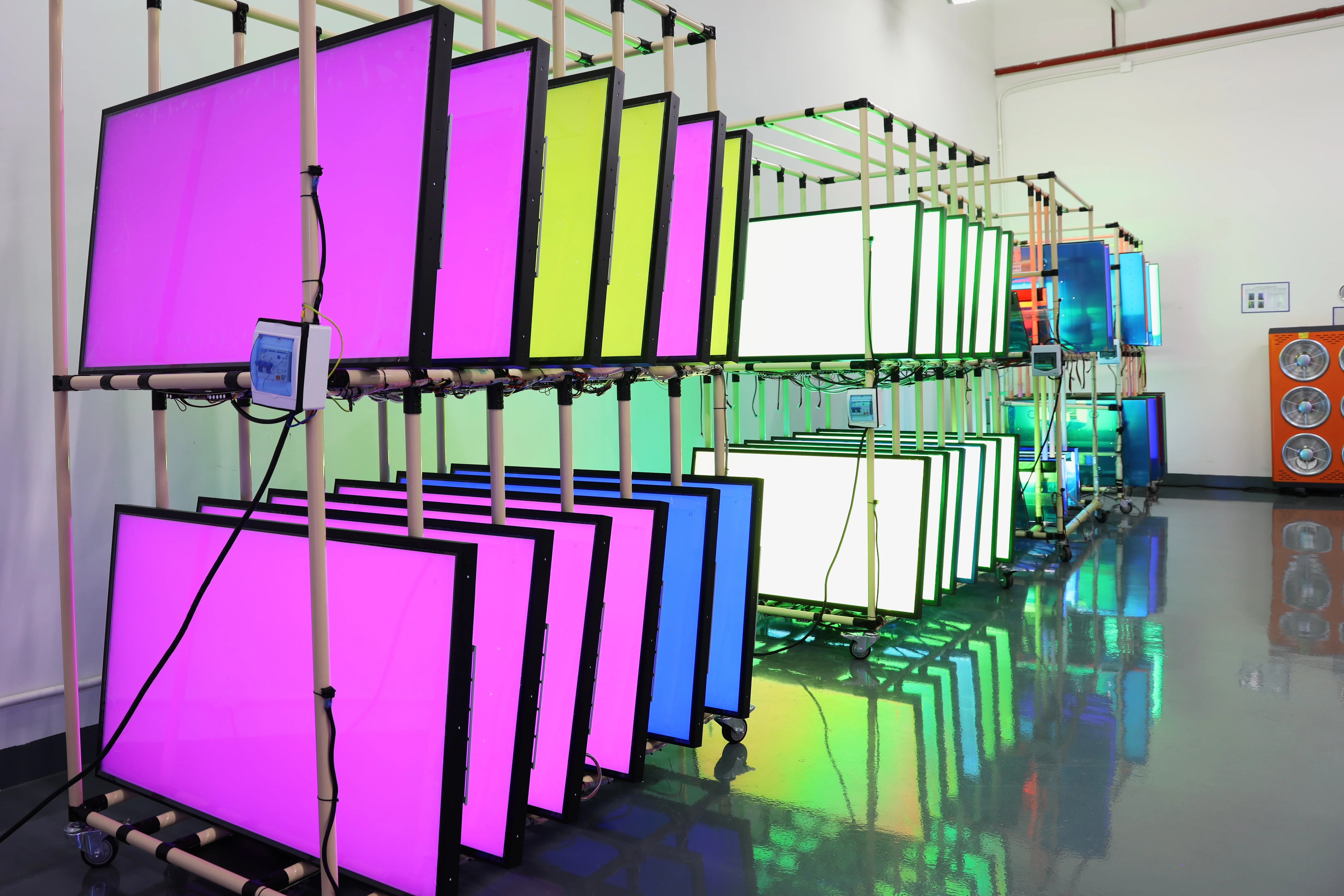
RisingStar is a Shenzhen-based OEM/ODM manufacturer of high-brightness LCD panels, LCD display modules, finished displays and outdoor digital signage. Its window-facing category covers 21.5–86 inch sizes at up to 5,000 nits, with dual-sided and open frame options; the wider catalog index lists 533 products from 10.1 to 98 inches. Sealed enclosures run from IP65 to IP69K with IK10 impact glass as OEM/ODM options, and operating temperature is model-dependent, with −20 °C to 70 °C on outdoor-rated products. The model-specific datasheet is the controlling document.
Frequently asked questions
Is 3,000 nits always necessary for a storefront window?
No. A shaded or north-facing window can work at a lower rating. Glass type, orientation, reflected daylight and viewing distance set the requirement; a site survey and the model datasheet should decide it.
What is the difference between high brightness and sunlight readable?
High brightness refers to luminance — in practice, panels rated around 1,000 nits and above. Sunlight readable means that brightness is paired with an anti-reflective stack: optical bonding and AG or AR glass. A bright panel without reflection control still washes out in direct sun, so ask for the rated nits and the glass stack rather than the label.
Does an IP rating tell me anything about brightness?
No. IP codes describe ingress protection under IEC 60529. A window facing LCD display can carry a dust rating and still be a 500-nit panel; the two figures come from different tests.
Can an open frame display go straight behind shop glass?
It can, provided the integrator supplies the enclosure, thermal path and mounting. An open frame display has no ingress rating of its own, so the finished assembly carries it.
Which document should I ask a vendor for first?
The model-specific datasheet, with brightness at a stated operating mode, contrast ratio, exact IP and IK codes, operating temperature, interfaces, power draw and the test conditions behind the backlight-life figure.
Sources
- Samsung Electronics, "2024 Samsung Display Solutions" catalog, Window Display and Outdoor Display sections with numbered footnotes (manufacturer document, 2024).
- LG Electronics USA, "LG Debuts High-Brightness Outdoor Displays Featuring Groundbreaking Anti-Discoloration Technology", press release, 29 April 2025.
- RisingStar, Window Facing Displays category page, published catalog index and About page, accessed 26 October 2026.
Figures are transcribed from the cited documents. Where a test condition is not published, the text says so; the model datasheet controls.