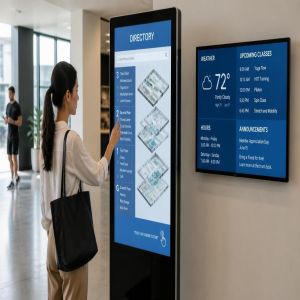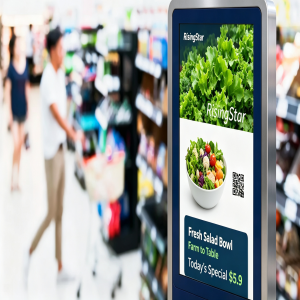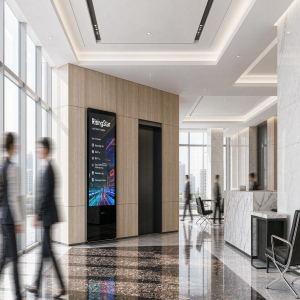
Interactive directories mounted at building entrances, campus plazas, transit concourses, and hospital grounds must remain legible under direct solar load, survive high public touch frequency, resist vandalism, and deliver real-time navigation — all while meeting ADA reach and contrast requirements. This article defines the engineering parameters that separate a deployable outdoor wayfinding kiosk display from a consumer monitor in a weatherproof enclosure..webp)
Environment and Threat Analysis
An interactive outdoor directory sits in one of two exposure classes, and the specification diverges between them.
Entrance / semi-outdoor zones — building lobbies, covered walkways, transit platform canopies, mall atriums. The display is shaded for part of the day but still receives oblique sun, reflected glare from glass facades, and HVAC exhaust heat.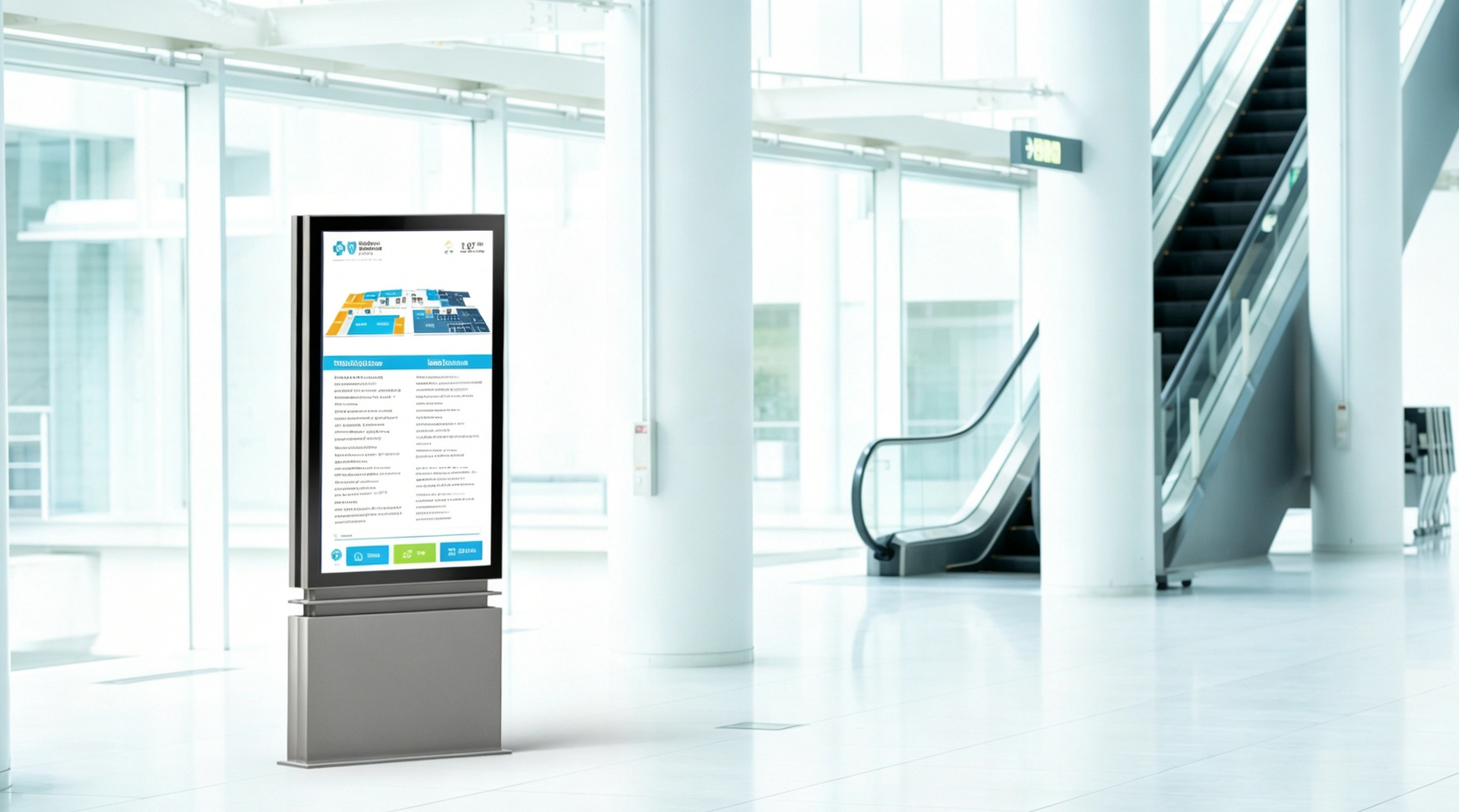
Open plaza / fully sun-exposed zones — hospital campus intersections, park entrances, transit plazas with no overhead cover. The panel faces direct solar load. Without adequate nits and anti-reflective treatment, the image washes out completely between 10:00 and 16:00.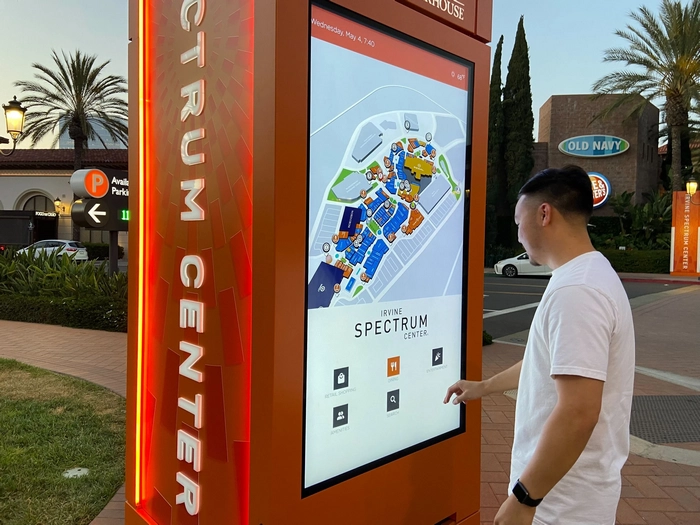
Public touch frequency — a busy campus or mall directory sees hundreds of touches per day. Capacitive controllers must handle continuous duty without drift or phantom touches, and the front glass must resist scratching and impact.
Vandalism and weather exposure — IK10-rated tempered glass is mandatory for any public-reachable surface. IP65 sealing is the floor for rain and dust; EPDM gaskets and screw-lock I/O prevent ingress at cable penetrations.
Multilingual and ADA constraints — wayfinding content is multilingual by default in transit and hospital settings. The UI must support pinch-zoom maps, high-contrast text (≥4.5:1 against background per WCAG AA, 3:1 acceptable for large text above 18pt), and a wheelchair-reachable mounting height.
Key Specifications That Matter
| Parameter | Entrance / Semi-Outdoor | Plaza / Fully Sun-Exposed |
|---|---|---|
| Typical size | 32″–55″ PCAP touch | 32″–55″ PCAP touch |
| Brightness | 1,000–1,500 nits | 1,500–2,500 nits |
| Panel type | Industrial Hi-Tni LCD | Industrial Hi-Tni LCD (clearing point ≥110°C) |
| Ingress | IP65 sealed | IP65 (IP66 optional) |
| Vandal rating | IK10 tempered glass | IK10 tempered glass |
| Touch | PCAP, glove + wet-hand mode | PCAP, glove + wet-hand/rain rejection |
| Optical bonding | OCA/OCR recommended | OCA/OCR required (reflection <1%) |
| AR/AG treatment | AR or AG surface | AR + AG dual treatment |
| Operating temp | –20°C to +70°C | –20°C to +70°C |
| ADA | Wheelchair-reachable, contrast ≥3:1 | Same, plus auto-dim at low sun angles |
| Data integration | Real-time directory API | Real-time + GTFS/SIRI for transit-adjacent sites |
Brightness vs. reflection is the real equation. A 2,500-nit panel behind a 4% reflective air-gap cover glass can still wash out because surface reflection adds a bright veil over the image. Optical bonding (OCA/OCR) removes the air gap, pushing surface reflection below 1%, which is why it is non-negotiable for plaza installs.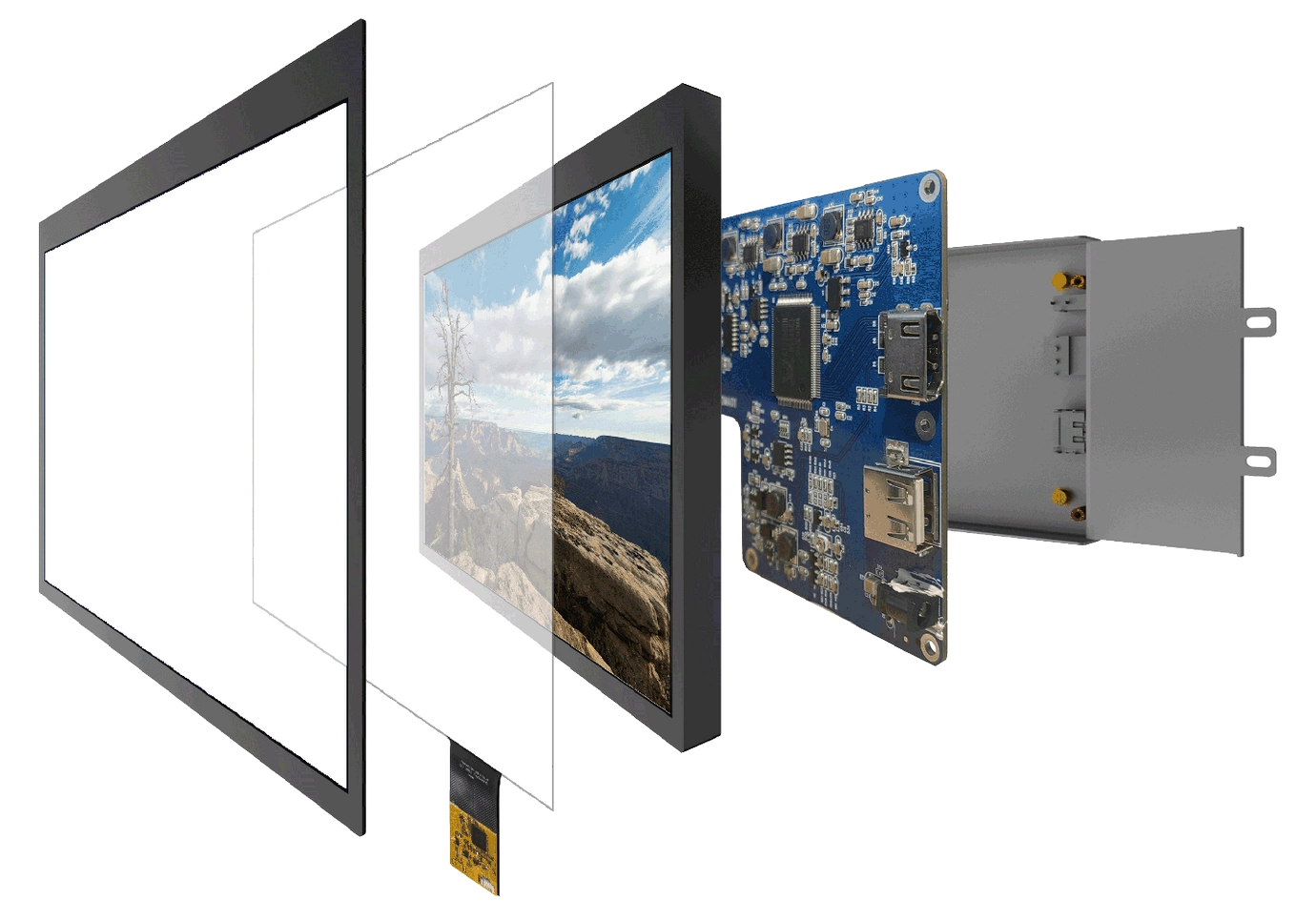
Thermal: Hi-Tni is the only defense against solar blackening. Standard LCDs have a clearing point around 70–80°C. In a sealed enclosure under direct sun, the panel's internal temperature exceeds that within minutes. Industrial Hi-Tni liquid crystal raises the clearing point to ≥110°C.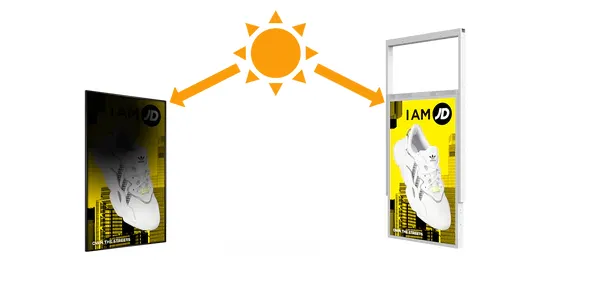
Glove and wet-hand PCAP. Public wayfinding is frequently used with bare, gloved, or wet hands in rain. Firmware-level glove mode and rain-rejection prevent the touch controller from ignoring input or registering phantom touches from droplets.
Common Failures to Avoid
Non-ADA mounting and contrast. A flush wall mount at standing eye level fails wheelchair users. Pair this with low-contrast menu art and the kiosk is both non-compliant and unusable. Enforce ≥3:1 contrast and a wheelchair-reachable active zone.
Glare washout from insufficient nits or no bonding. A 1,000-nit panel with air-gap glass in a plaza is unreadable at noon. Below 2,500 nits without optical bonding, the install is effectively dead during business hours.
Vandal breakage from thin cover glass. Consumer-grade 3 mm glass shatters on impact. IK10 tempered glass with a proper aluminum chassis backing is the minimum for public-reachable surfaces.
No real-time data path. A static PDF map becomes obsolete the moment a store closes or a gate changes. Transit-adjacent and hospital directories must pull live data or the kiosk loses its core value within weeks.
Consumer panel EOL. An off-the-shelf TV panel means a 12-month end-of-life cycle. Industrial panels with a 3–5 year supply commitment keep a multi-site deployment serviceable.
RisingStar Configuration for Wayfinding
RisingStar engineers outdoor kiosk displays as a system:
Range: 7″–100″ standard sizes, 500–2,500 nits factory-calibrated to the application. PCAP touch available up to 55″; larger sizes use non-touch or alternative touch technologies.
Panels: Industrial Hi-Tni liquid crystal (clearing point ≥110°C)
Optical bonding: OCA/OCR bonding cuts surface reflection below 1%; AR/AG surface treatment maximizes contrast under direct sun
Enclosure: IP65/IP66 sealed, IK10 tempered glass, aluminum chassis doubling as heat sink
Build: Screw-lock I/O, through-hole PCB, thread-locking, and EPDM gaskets
Touch: PCAP with glove-mode and wet-hand/rain-rejection firmware
Certifications: CE / RoHS
Supply: 3–5 year product-life commitment, sample in 10 working days, bulk 15–25 days, full OEM/ODM
For wayfinding specifically, RisingStar configures the PCAP controller for gloved and wet-hand operation, applies optical bonding as standard on sun-exposed units, and validates the enclosure against IK10 impact and IP65/IP66 ingress before shipment.
Engage RisingStar's sunlight-readable display solutions for application-specific brightness and bonding validation, or review the full industrial display product range to match size, nits, and enclosure rating to your deployment.
📧 ai@https://www.risinglcd.com · 💬 +86 158 8946 9208 · 🌐 www.https://www.risinglcd.com