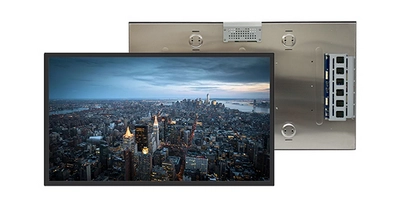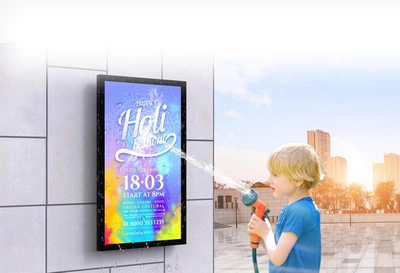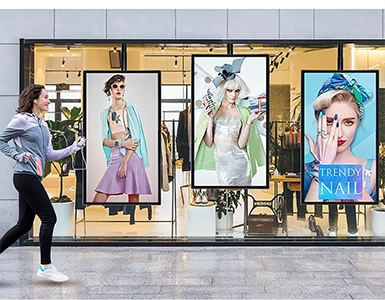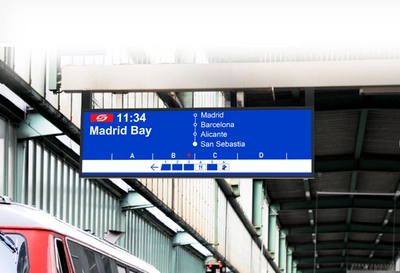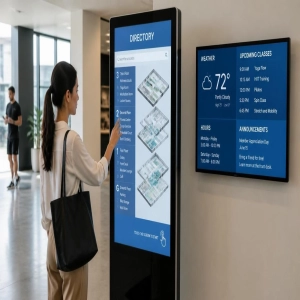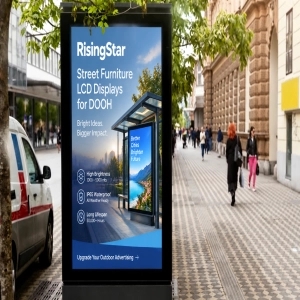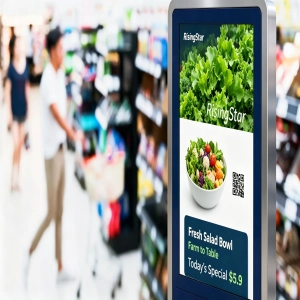
A network operator signs a contract to light up 200 office towers. Screens go into elevator lobbies, fitness floors, and pantry areas. Each location differs: some face a window wall, some sit under recessed ceiling lights, some are touched every ninety seconds, and all must run quietly for the length of a three-year lease.
Place-based media is the segment of DOOH where LCD earns its keep. Unlike roadside spectaculars fighting for a glance from 50 meters, place-based screens live where the viewer stands. Viewing distance is one to three meters. Ambient light is controlled. Dwell time is measured in minutes, not seconds. That combination changes every assumption in the display specification.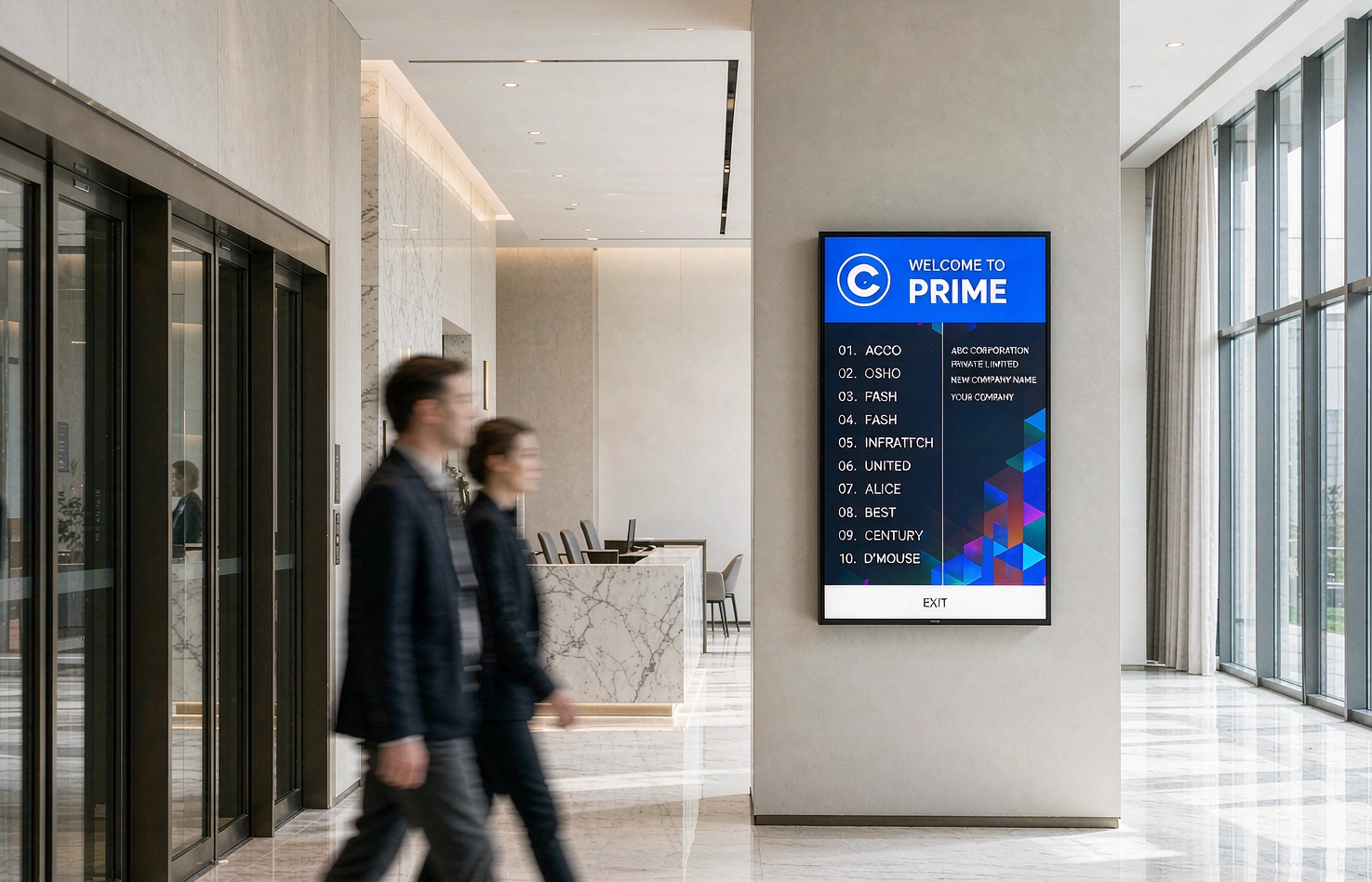
What Changes When the Screen Is Close
The single largest difference between a place-based LCD deployment and a roadside LED site is the requirement for usable pixels per degree of viewing angle. At two meters, a viewer resolves far more detail than at twenty. Text, price points, QR codes, and fine product photography must render with genuine sharpness — a question of resolution and panel quality, not just brightness.
A 55-inch full-HD panel at 1.5 to 2.5 meters yields roughly 45 to 60 pixels per degree. That is the comfortable reading zone for body copy and interface elements. Dropping below that — for example, forcing an older XGA panel into a tight lobby position — makes anti-aliased text look soft and QR codes harder to scan. This is why most place-based inventory is built on FHD or UHD LCD rather than low-pixel-density alternatives.
Brightness by Venue, Not by Habit
A common mistake in place-based planning is quoting one brightness figure across an entire portfolio. Indoor venues differ by more than an order of magnitude in ambient light. Overspecifying brightness wastes power and shortens backlight life just as surely as underspecifying causes washout.
| Venue zone | Typical ambient light | Recommended LCD brightness | Typical screen |
|---|---|---|---|
| Interior elevator lobby (recessed lighting) | 300-600 lux | 700-1,000 nits | 32"-55" FHD landscape or portrait |
| Office lobby with glazed facade | 1,500-8,000 lux near glass | 1,500-2,500 nits (window-facing grade) | 43"-86" |
| Fitness floor, full-height windows | 2,000-20,000 lux | 2,000-3,500 nits | 43"-65" |
| Mall corridor / wayfinding point | 800-2,000 lux | 1,000-1,500 nits | 43"-75" |
| Hotel lobby / lounge | 400-1,200 lux | 700-1,200 nits | 43"-75" |
Where a screen sits adjacent to a window wall or glass atrium, standard indoor brightness will not hold. The rule used in our window-facing range is simple: assume the worst sun angle the glass allows, then add margin. A 1,500-nit panel behind tinted storefront glass reads acceptably; a 700-nit panel in the same position washes out by mid-afternoon.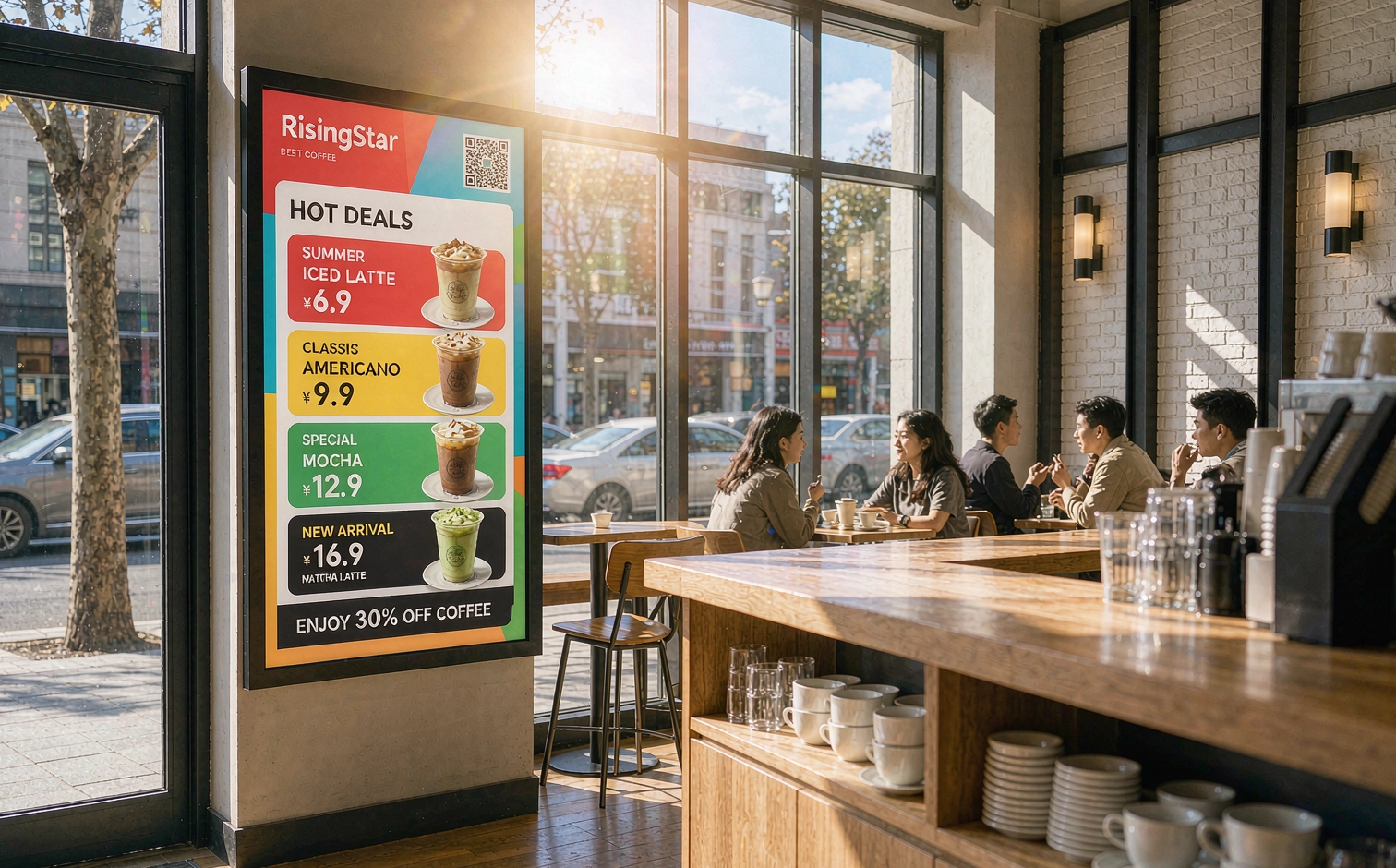
Panel Format and Orientation
Place-based DOOH is one of the few media segments where portrait and square content are financially justified, because screens carry utility content — directories, floor plans, booking screens — alongside advertising. That changes the hardware decision.
Landscape 16:9 remains the default for general advertising and video content.
Portrait panels suit directories, digital posters, and phone-shaped creative. On LCD, portrait is simply a landscape panel rotated in the housing; there is no resolution penalty, unlike some LED modules.
Stretch formats work where the housing dictates an unusual aspect, such as narrow columns or shelf-edge positions inside retail venues.
Because the same physical panel can ship in portrait or landscape, an operator can standardize on one SKU per size tier and let the enclosure dictate orientation. That reduces spares inventory across a multi-venue network.
Touch, Enclosures, and Duty Cycle
Place-based screens frequently serve interactive roles: wayfinding, event calendars, tenant directories, check-in assistance. When touch is specified, projected-capacitive (PCAP) is the right technology at these distances. Two engineering details matter for venue operators:
Optical bonding should be applied whenever the screen is touched or installed near a light source. Bonding removes the parallax gap between glass and panel, improving touch accuracy, and it cuts internal reflections that otherwise reduce effective contrast in a bright lobby.
Cover glass hardness should match the exposure. A lobby screen behind a concierge desk may only need a basic anti-glare surface. A floor-standing directory in a mall corridor, reachable by the public, needs hardened glass (7H or IK-rated) because it will be leaned on and knocked.
Duty cycle is another variable place-based buyers underestimate. Venue screens typically run 16 to 24 hours per day, seven days a week, because the building is occupied or the space is monitored. Consumer TVs are not engineered for this. Industrial LCD with a 24/7-rated backlight and a realistic operating envelope of -20°C to 70°C eliminates the two most common failure modes: premature backlight decay and heat-related board failure inside sealed enclosures.
Managing a Portfolio, Not a Pilot
The practical challenge of place-based media is scale drift. When one lobby screen runs slightly dimmer than the screen in the neighboring tower, the difference is immediately visible to the same audience that passes both every day. Consistent appearance across the network is what makes place-based inventory sellable to advertisers at a premium.
Three specifications protect network-level consistency:
Matched brightness bins: panels sourced and grouped so adjacent screens start at the same luminance.
Auto-dimming with ambient sensing: screens in bright lobbies run brighter during the day and step down at night, holding perceived contrast constant rather than blasting full power around the clock.
Uniform panel quality: all panels should come from the same grade-A tier so color and gamma do not shift between screens in a portfolio.
Our factory standard is 100 percent inspection of every unit plus a 72-hour burn-in before shipment, catching early backlight and driver failures on the production line rather than on a lobby wall. For a place-based operator running hundreds of sites with limited field staff, that pre-shipment validation is worth more than a marginal spec improvement.
Sourcing for Place-Based LCD Networks
As a direct LCD manufacturer, we build place-based media displays from 7 to 110 inches with brightness from 500 to 5,000 nits, PCAP touch with glove and wet-hand firmware, IP65/IP66 sealing for semi-outdoor positions, and IK10 glass where the public can reach the screen. Panels are sourced from LG Display, AUO, INNOLUX, and BOE, and every unit is inspected before it leaves the factory. ISO 9001 certified.
If you are planning a place-based DOOH rollout and need brightness matched to real venue measurements, send the site list and lighting conditions to ai@risinglcd.com. An engineer will map the recommended spec per location, free of charge. Browse our LCD digital signage and window-facing LCD display product lines to see current configurations.