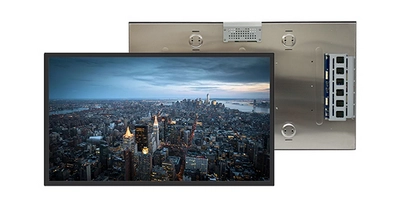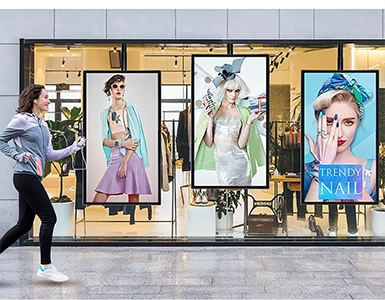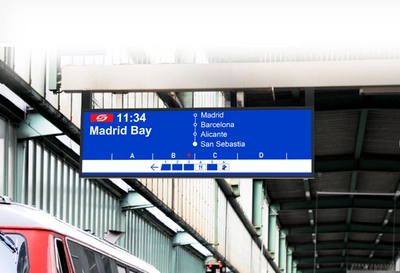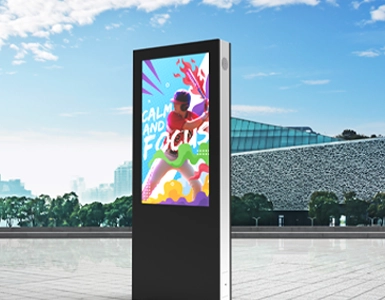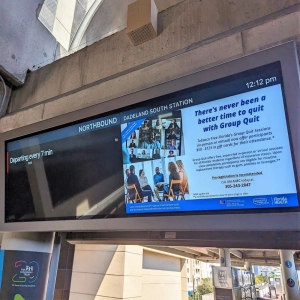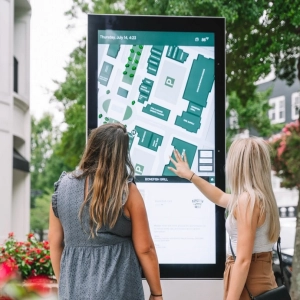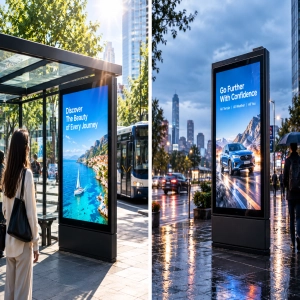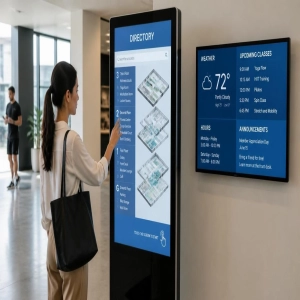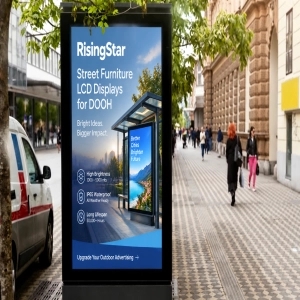
A bus shelter screen faces a road that carries direct morning sun, exhaust residue, and the occasional kick from a waiting commuter. A wayfinding pillar at a transit interchange stands under a glass canopy that turns it into a greenhouse by noon. A smart-city kiosk on a sidewalk plaza operates 24/7 in rain, salt air, and freezing nights. Street furniture is digital out-of-home at its most punishing: unlike a rooftop billboard, every screen is at eye level, within reach, and fully exposed to the elements.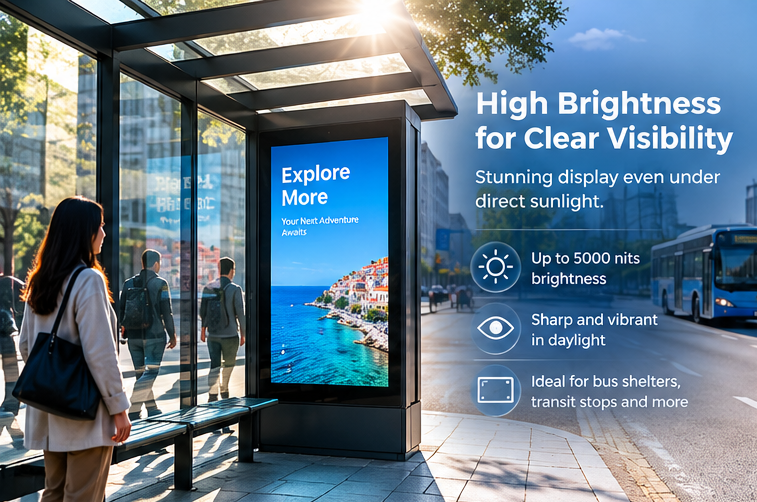
The Viewing Geometry of the Street
Street furniture screens are seen from one to five meters, by people standing still (waiting for a bus), walking past, or glancing from a passing vehicle. This middle-distance viewing band is where LCD's resolution advantage pays off: text and logos stay crisp, and a 55-inch LCD delivers legible wayfinding copy where a coarse-pitch LED screen would need to be much larger to hold the same text.
That same geometry dictates brightness. A screen at eye level competes with the sky, not with a wide-open vista. The practical ranges for street furniture:
| Placement | Viewing distance | Ambient challenge | Brightness tier |
|---|---|---|---|
| Bus shelter interior (facing street) | 1-3 m | Direct sun through the open face | 2,500-4,000 nits |
| Bus shelter exterior ad panel | 3-10 m | Full daylight | 3,000-5,000 nits |
| Wayfinding kiosk under canopy | 1-2 m | Partial shade, variable | 1,500-2,500 nits |
| Free-standing smart-city kiosk, open plaza | 2-5 m | Full sun, no shade | 3,500-5,000 nits |
| Column / totem at transit interchange | 3-10 m | Sun + reflected ground light | 2,500-4,000 nits |
A common mistake is specifying for average daylight, then watching the screen wash out during the 90 minutes around solar noon, when the sun sits low enough to strike the glass directly. Specify for the worst hour of sun, and let auto-dimming step the backlight down at night so the screen does not glare at pedestrians.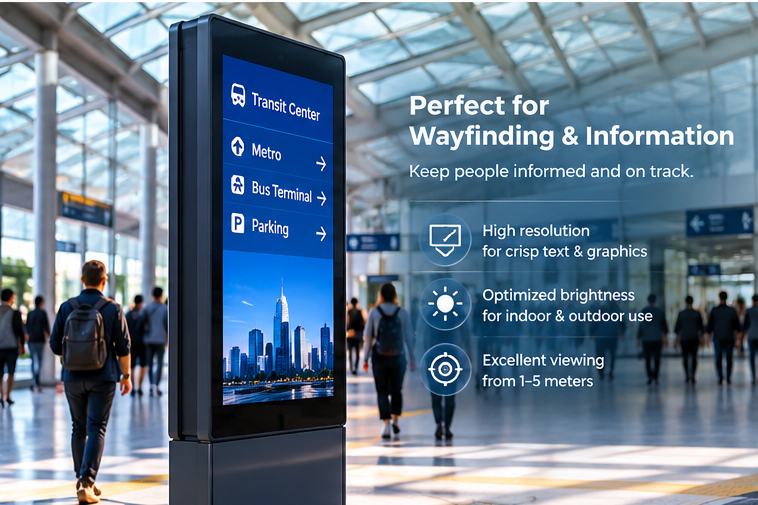
Glass Is the Second Display
The front surface is the most vulnerable part of a street-level screen, and the engineering choice behind that glass contributes as much to readability as the panel brightness itself.
Optical bonding — filling the air gap between LCD and cover glass — is not optional in street furniture. It cuts internal reflections by roughly 80 percent, raising effective contrast far more than a few hundred extra nits ever could. Bonding also prevents condensation inside the air gap when a shelter screen warms after a cold night, and it eliminates the double-image ghosting that plagues unbonded outdoor displays.
Anti-glare (AG) and anti-reflection (AR) treatments handle the surface. AG diffusion stops the screen from mirroring the sky; AR coatings cut specular reflection where the sun strikes at grazing angles. A street-facing panel typically wants an AG layer with sufficient hardness, and where the sun angle is severe, an AR layer on top.
Impact protection is a decision about who can reach the screen. A bus-shelter panel at head height, behind a barrier, can spec IK08 glass. A wayfinding kiosk at chest height, open to public interaction, should be IK10 — the same rating demanded of ticketing machines — because it will be leaned on, rapped, and tested. IK10 glass is specified under IEC 62262 and is compatible with PCAP touch when laminated.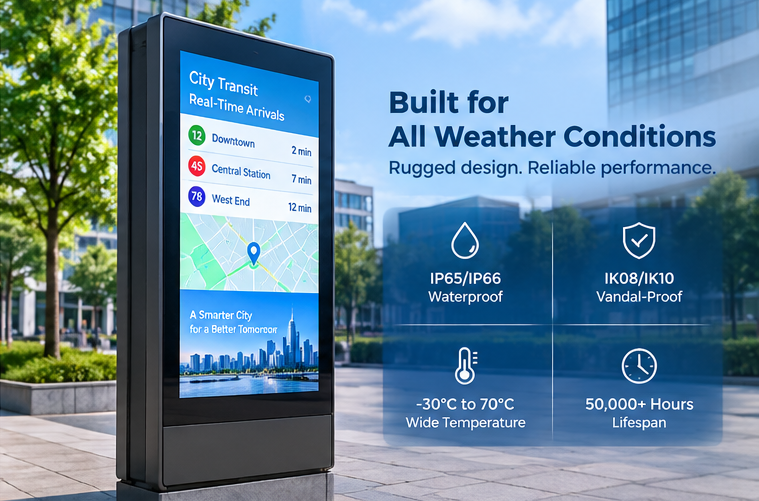
Enclosure Engineering: Rain, Heat, and Salt
The enclosure determines whether a street furniture screen survives its second year. Three loads decide longevity:
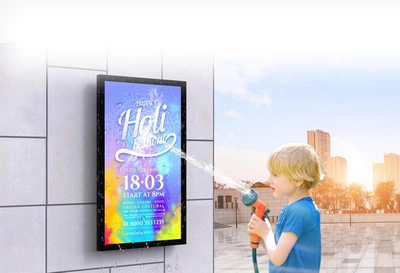
Water and dust. An IP65 rating protects against low-pressure jets and dust; IP66 adds protection against powerful jets. For a shelter screen facing a road, IP65 on the front face is the working minimum; fully sealed IP65/IP66 across the entire unit is preferred where the housing is serviced from behind. Coastal deployments should explicitly call out the salt-air environment — salt spray accelerates corrosion on connectors and boards.
Solar heat. A sealed black enclosure in direct sun can top 60°C internally, even in temperate climates. The display must be rated for continuous operation at 60-70°C internally, and the enclosure needs a thermal path — finned rear or controlled airflow — so heat does not pool around the backlight. Industrial Hi-Tni liquid-crystal panels withstand higher internal temperatures without the blackening defect that appears in consumer-grade panels under sustained heat.
Condensation management. Even a well-sealed housing breathes. Optical bonding, plus desiccant and a sealed rear compartment, prevents the internal fogging that otherwise appears as moisture between glass layers after rain.
Touch, Where Street Furniture Turns Interactive
Modern street furniture is increasingly interactive: wayfinding maps, transit arrival lookups, emergency alerts, city services. Street-level touch adds three PCAP requirements:
Glove and wet-hand operation — transit users interact in winter and rain.
IK10-rated laminated glass that keeps the sensor functional behind impact protection.
Reliable accidental-touch rejection, since a kiosk beside a busy walkway receives constant brushes and leans.
A bonded PCAP module behind IK10 glass is what survives a public sidewalk. Non-bonded touch panels in the same position fail faster: the air gap flexes under impact and lets moisture migrate to the sensor.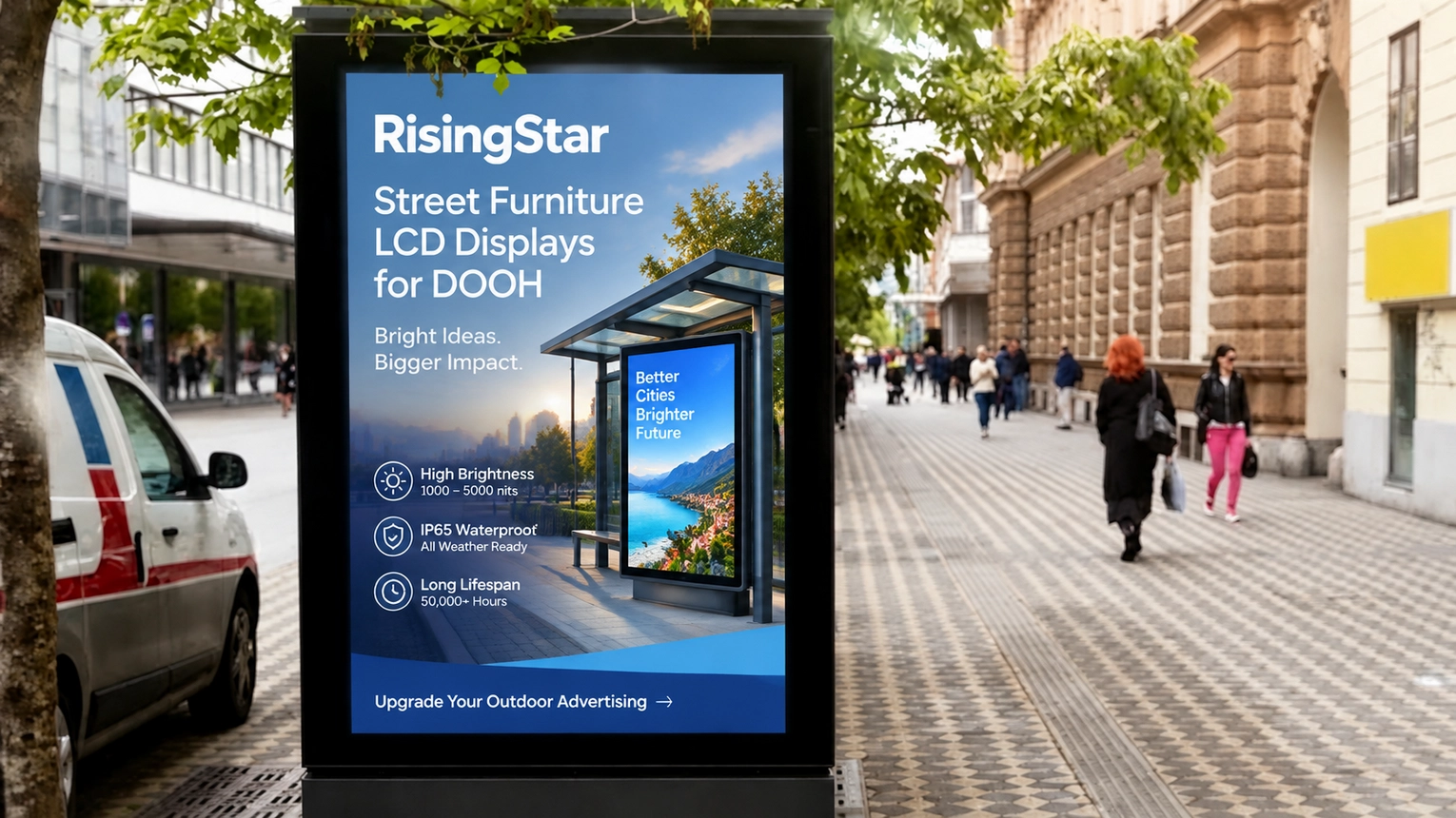
Network Operations Reality
Street furniture networks span hundreds of locations with limited field staff. Choose screens with the service model in mind:
Remote diagnostics — the display reports temperature, backlight hours, and fault state, so a failing unit is flagged before the ad slot goes dark.
Uniform brightness and color across the network, so a bus-shelter ad looks the same on every route and advertisers receive consistent proof-of-play.
Standard interfaces (LVDS/eDP/HDMI) so the network's media player and CMS integrate without custom boards.
Sourcing Street Furniture Displays
RisingStar manufactures street furniture displays from 21.5 to 86 inches, with brightness from 2,500 to 5,000 nits, optical bonding, AG/AR surface treatments, IK10-rated cover glass, and IP65/IP66 fully sealed enclosures rated for -20°C to 70°C operation. Every unit is 100 percent factory-inspected and subjected to a 72-hour burn-in before shipment. ISO 9001 certified.
If you are specifying screens for bus shelters, wayfinding pillars, or smart-city kiosks, send the site conditions — orientation, sun exposure, coastal or inland — to ai@risinglcd.com. Our engineers will confirm the brightness tier and enclosure spec for each location. Browse our outdoor waterproof displays and sunlight readable display product lines to see current configurations.