You're comparing two outdoor displays. Supplier A's spec sheet has bigger numbers. Supplier B's is more modest. You pick A.
Six months later, B's display is still readable at noon. A's is not.
The spec sheet didn't lie. It just didn't tell you the things that actually matter.
💡 Quick Answers — The Spec Sheet Decoder
Which spec sheet numbers can't be trusted?
Seven: (1) peak brightness, (2) "contrast ratio" (unqualified), (3) IP rating without test conditions, (4) operating temperature range without enclosure context, (5) "sunlight readable" (no industry standard), (6) backlight lifespan without junction temperature, (7) viewing angle without brightness/color shift data.What should I ask instead?
For each misleading number, there's a specific question that exposes the truth. The seven questions are listed in the article below. A supplier who answers them precisely is trustworthy. One who deflects is selling.Is any spec sheet number reliable?
Physical dimensions, interface type (LVDS, eDP, HDMI), and panel manufacturer (LG Display, AUO, BOE, Innolux, Tianma) are factual and verifiable. Everything else needs context.
1. Brightness: "2,500 Nits"
What it doesn't tell you: Whether that's peak (3% window, 3 seconds), sustained full-screen, or measured at 25°C or 50°C.
A display rated at 2,500 nits peak may deliver only 1,800 nits sustained full-screen at 50°C. In a sealed outdoor enclosure, that's the number you get at 2 p.m. in July.
Ask instead: "What's the sustained full-screen brightness at 25°C and at 50°C? What test pattern and measurement method did you use?"
A precise answer names the test conditions. A vague answer ("it's very bright") means the number is marketing.
2. Contrast Ratio: "5,000:1"
What it doesn't tell you: How it was measured. Most "contrast ratio" numbers on spec sheets are sequential contrast — full white screen, then full black screen, in a dark room. This produces the highest possible number and bears no resemblance to real-world readability.
The metric that matters is ANSI contrast — measured with a checkerboard pattern that tests the display's ability to simultaneously produce bright whites and dark blacks in the same frame. A display with 5,000:1 sequential contrast may have only 800:1 ANSI contrast.
Ask instead: "What's the ANSI checkerboard contrast ratio, measured at operating temperature?"
A number of 1,000:1 or higher is good for outdoor use. Below 800:1, dark content will wash out in bright ambient light regardless of how many nits the display produces.
3. IP Rating: "IP65"
What it doesn't tell you: What was actually tested, for how long, and whether the rating covers the complete assembly or just the panel front.
IP65 means "dust-tight, protected against water jets from any direction." But the display front might be IP65 while the rear — where the controller board and connectors live — is IP20. The complete display-in-enclosure assembly is only as protected as its weakest point.
Ask instead: "Is the IP rating for the panel front only, or the complete display assembly? Was it tested under IEC 60529 with the actual enclosure I'll be using?"
A panel rated IP65 on the front but designed for an open-frame installation is not an IP65 display. It's an IP65 panel that needs an IP65 enclosure to become an IP65 display.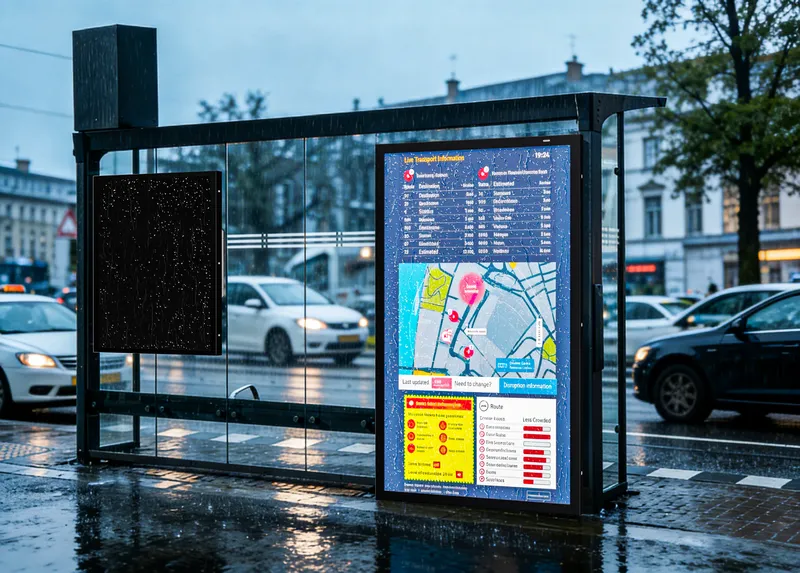
4. Operating Temperature: "−20°C to +70°C"
What it doesn't tell you: Whether that's the ambient air temperature outside the enclosure, or the internal enclosure temperature the display can tolerate.
A display rated for +70°C operating temperature may fail at +50°C ambient if the enclosure traps heat. The rating assumes adequate cooling — and "adequate" is defined by the supplier, not by your installation.
Ask instead: "At what maximum ambient air temperature can this display operate continuously, in a sealed enclosure with no active cooling?"
If the answer is below your deployment climate, you need active cooling or a different display. This question alone eliminates more bad specifications than any other.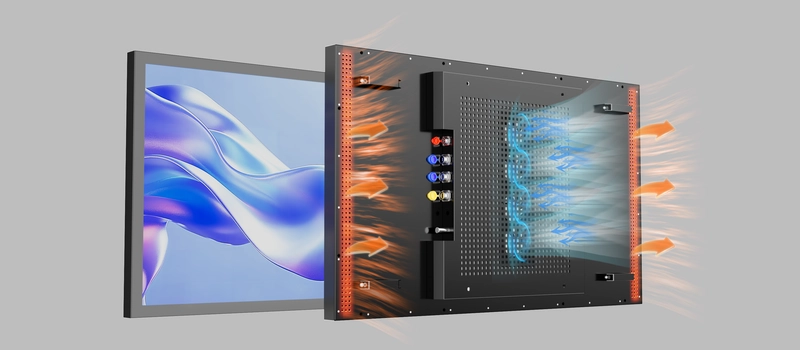
5. "Sunlight Readable"
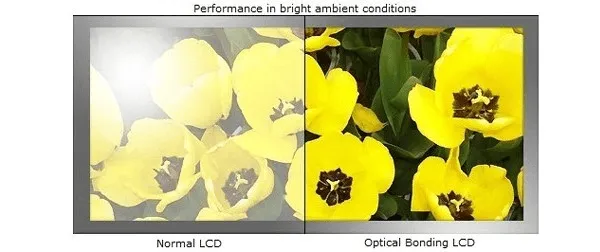
What it doesn't tell you: There is no industry standard for "sunlight readable." Any supplier can print this on a spec sheet. It typically means "brighter than a standard monitor" — which is not the same as readable in direct sun.
True sunlight readability requires three things working together: sufficient brightness (1,500+ nits sustained), low surface reflectance (AR/AG coating, <4% reflectance), and optical bonding (eliminating internal reflections). A display with only one of these three is not sunlight readable — it's just bright.
Ask instead: "What three technologies make this display sunlight readable, and what's the measured surface reflectance?"
A supplier who can't name all three — and can't quote a reflectance number — is selling a label, not a solution.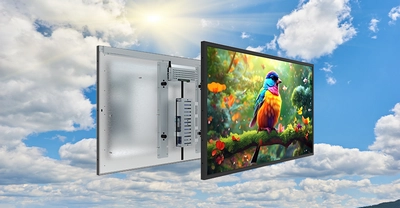
6. Backlight Lifespan: "50,000 Hours"
What it doesn't tell you: The junction temperature at which that lifespan is measured. LED backlight life is highly temperature-dependent.
A rating of 50,000 hours to L70 (70% of initial brightness) measured at 25°C junction temperature may drop to 15,000 hours at 65°C — a difference of 3.3×. In a hot outdoor enclosure, the "50,000-hour" display reaches 70% brightness in 18 months.
Ask instead: "What's the L70 backlight lifespan at 65°C junction temperature?"
If the supplier can't answer this, assume the 50,000-hour number is measured at room temperature and plan for a shorter real-world lifespan.
7. Viewing Angle: "178°/178°"
What it doesn't tell you: That this is typically measured for contrast and color shift at dim brightness levels. At outdoor-relevant brightness (1,000+ nits), viewing angle performance degrades. Color shifts become more pronounced, and contrast drops faster at off-axis angles.
A display that looks perfect head-on at 2,500 nits may show significant color shift when viewed from 60° — and in a transit station or storefront, many viewers are at extreme angles.
Ask instead: "What's the color shift (Δu'v') and contrast ratio at 60° off-axis, measured at the display's rated outdoor brightness?"
A Δu'v' below 0.02 is considered good. Above 0.04, color shift is visible and problematic for multi-user environments.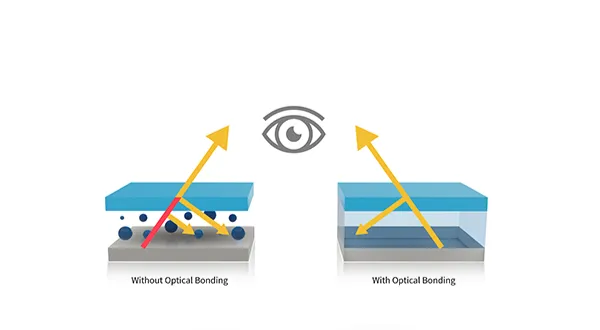
The Seven Questions at a Glance
| # | Spec Sheet Claim | The Hidden Problem | The Question That Exposes It |
|---|---|---|---|
| 1 | "2,500 nits" | Peak vs. sustained vs. temperature-derated | "What's the sustained full-screen brightness at 50°C?" |
| 2 | "5,000:1 contrast" | Sequential, not ANSI | "What's the ANSI checkerboard contrast at operating temperature?" |
| 3 | "IP65" | Panel front only, not the full assembly | "Was this tested with the actual enclosure?" |
| 4 | "−20°C to +70°C" | Internal temp, not ambient | "At what ambient temperature in a sealed enclosure?" |
| 5 | "Sunlight readable" | No industry standard | "What's the measured surface reflectance?" |
| 6 | "50,000-hour lifespan" | Measured at room temperature | "What's the L70 at 65°C junction temperature?" |
| 7 | "178° viewing angle" | Measured at dim brightness | "What's the color shift at 60° at rated outdoor brightness?" |
The Bottom Line
A spec sheet is a sales document. It highlights the numbers that sell and omits the context that qualifies them.
The seven questions above don't require a lab. They require a supplier who knows their product well enough to answer precisely — and that's the real test. A supplier who answers all seven without hesitation is one you can trust. A supplier who deflects on even one is selling you a hope.
RisingStar provides full test data with every quotation — sustained brightness at multiple temperatures, ANSI contrast measurements, thermal camera images, and real deployment photos. Our spec sheets tell you what the display does, not just what it's rated for.
📧 ai@risinglcd.com · 💬 +86 158 8946 9208 · 🌐 www.risinglcd.com